Blog

  • Coal Harbour Vancouver: The Best 2026 Waterfront Luxury Stays Guide

    Coal Harbour Vancouver: The Best 2026 Waterfront Luxury Stays Guide

    Hero Coal Harbour
    Photo by Farnaz Kohankhaki via Pexels. Coal Harbour Vancouver — the city’s most photogenic luxury waterfront and cruise terminal-adjacent neighbourhood.

    Coal Harbour Vancouver is the city’s most photogenic luxury waterfront — a 1.5 km strip of glass-tower condos, marina views, and the cruise terminal at Canada Place — bordered by Stanley Park to the west, downtown’s central business district to the south, and Burrard Inlet to the north. For visitors who want walking-distance Stanley Park, direct cruise terminal access, and the city’s flagship luxury hotels in one neighbourhood, Coal Harbour is the obvious pick.

    This 2026 guide covers Coal Harbour’s best waterfront hotels, the seawall walks that locals swear by, the marina restaurants, the pre/post-cruise logistics that matter, and an honest comparison against the West End and Yaletown for waterfront-stay decisions.

    Coal Harbour Overview
    Photo by Інна Бутко via Pexels. Coal Harbour runs along Burrard Inlet from Burrard Street east to Canada Place — about 1.5 km of waterfront.

    Coal Harbour Vancouver: A Quick Overview

    Coal Harbour sits on downtown Vancouver’s northern shore. The neighbourhood runs roughly from Burrard Street east to Canada Place — about 1.5 km of waterfront — and from Burrard Inlet south two blocks to West Pender or West Hastings. Almost all the residential buildings are 25–60 storey glass condo towers built between 1990 and 2015.

    Quick facts:

    • Approximate area: 1.5 km × 0.4 km along Burrard Inlet
    • Houses Vancouver’s flagship luxury hotels (Fairmont Pacific Rim, Pan Pacific, Loden, Westin Bayshore)
    • Canada Place cruise terminal is the eastern anchor
    • Stanley Park’s southeast entrance is the western anchor
    • Walking distances: Stanley Park 5–10 min, Canada Place 0–10 min, Vancouver Lookout 8 min, Robson Street 5 min, Yaletown 18 min
    • Closest SkyTrain: Burrard or Waterfront stations (5 min walk)
    • Coal Harbour Marina holds 600+ boat slips plus the Harbour Air floatplane terminal

    Coal Harbour is downtown’s quietest residential strip — fewer late-night bars and clubs than Robson or Granville, more contemporary high-rise feel than the West End’s leafy streets.

    For wider city overview see our where to stay pillar.

    Coal Harbour Luxury
    Photo by Luke Lawreszuk via Pexels. Fairmont Pacific Rim, Pan Pacific, Loden Hotel and Westin Bayshore anchor Coal Harbour’s luxury hotels.

    Best Coal Harbour Luxury Hotels

    Coal Harbour holds Vancouver’s heaviest concentration of luxury accommodation.

    Fairmont Pacific Rim (1038 Canada Place Way). Vancouver’s flagship luxury hotel since 2010. 377 rooms and suites with floor-to-ceiling harbour views. Botanist restaurant on-site is a destination in its own right; Willow Stream Spa is the Pacific Northwest’s best hammam. Indoor pool with city/harbour views. From $550/night; suites $850+.

    Pan Pacific Vancouver (300–999 Canada Place). Directly above the Canada Place cruise terminal. 503 rooms; the Five Sails restaurant has the cruise-ship-arrival view across Burrard Inlet. Most convenient hotel in Vancouver for cruise passengers. From $400/night, peak summer $700+.

    Loden Hotel (1177 Melville). 76 intimate rooms with European-style design; the Tableau Bar Bistro is widely loved. Smaller, quieter than the Pacific Rim. From $420/night.

    Westin Bayshore Vancouver (1601 Bayshore Drive). 511 rooms; the largest hotel pool downtown (heated outdoor); marina view. The most family-friendly luxury option. Slightly removed from the central Coal Harbour cluster (about 8 min walk from Canada Place). From $380/night.

    Hyatt Regency Vancouver (655 Burrard). 644 rooms; convention-style hotel with full amenities. From $360/night.

    Sheraton Vancouver Wall Centre (1088 Burrard). 733 rooms across two glass towers; flexible suite layouts. From $340/night.

    For non-luxury options see Mid-Range below or our downtown Vancouver guide.

    Coal Harbour Mid Range
    Photo by Luke Lawreszuk via Pexels. Coast Coal Harbour Hotel and Renaissance Vancouver Harbourside cover the mid-range tier in Coal Harbour.

    Coal Harbour Mid-Range Hotels

    Mid-range options here run $250–$400/night.

    Coast Coal Harbour Hotel (1180 W Hastings). Coast Hotels brand; 220 rooms, 5-minute walk to Canada Place. Reliable mid-tier; family rooms available. From $260/night.

    Renaissance Vancouver Harbourside Hotel (1133 W Hastings). 425 rooms with harbour-side options; full hotel amenities. From $290/night.

    Le Soleil Hotel Vancouver (567 Hornby, on Coal Harbour edge). Boutique-feel; European-style. From $300/night.

    Sandman Suites Vancouver Downtown (Coal Harbour edge). Apartment-style suites with kitchens. From $230/night.

    Beyond these, Coal Harbour skews heavily luxury. Budget travellers should look at the West End or Yaletown.

    Coal Harbour Cruise
    Photo by Jeffry Surianto via Pexels. Canada Place is the eastern anchor of Coal Harbour and Vancouver’s only active cruise terminal.

    Coal Harbour for Cruise Passengers

    Canada Place is the only active cruise terminal in Vancouver and is anchored at the eastern end of Coal Harbour. Most Alaska cruises board between 12:00 noon and 4:00 p.m. and disembark between 7:00 and 9:00 a.m.

    Pre-cruise logistics:

    • Stay at the Pan Pacific. Directly above the cruise terminal — bag drop, breakfast, cruise check-in all in one building.
    • Stay at the Fairmont Pacific Rim. 4-minute walk to Canada Place. Better in-room luxury for the same price tier.
    • Stay at the Loden Hotel. 8-minute walk; quieter than the larger hotels.
    • Westin Bayshore. 8-minute walk; family-friendly with the largest pool.

    Disembarkation day plan: Most ships disembark you between 7 and 9 a.m. with a 90-minute customs clearance. Drop bags at WestPark Canada Place Parkade ($25/day) or Bounce luggage storage near the cruise terminal ($4.75/day). Then start a Vancouver day plan from FlyOver Canada (in the same building), or Stanley Park, or our 1 day in Vancouver itinerary. For a deep cruise plan see our Vancouver cruise port guide.

    Coal Harbour Seawall
    Photo by Travis Kerkvliet via Pexels. The Coal Harbour Seawall is the eastern entry to the full Stanley Park Seawall loop.

    The Coal Harbour Seawall

    The Coal Harbour Seawall is a 1.5 km waterfront walking and cycling path — the eastern entry to the full Stanley Park Seawall loop. The route runs from Canada Place west along Coal Harbour Park, past the marina, the Vancouver Rowing Club (a heritage 1911 building still in use), and into Stanley Park.

    Most Coal Harbour hotels open onto the seawall at their northern edges. Mornings are the best time to walk — quiet light, fewer cyclists, and the harbour just waking up. The seawall is fully wheelchair-accessible and dog-friendly (on-leash).

    Practical detail: The Coal Harbour seawall is part of the protected cycle route on the Stanley Park Seawall loop. Cyclists ride counter-clockwise (mandatory). Walkers can go either direction.

    For the full Stanley Park loop see our Stanley Park visitor’s guide.

    Coal Harbour Marina
    Photo by Farnaz Kohankhaki via Pexels. Coal Harbour Marina holds 600+ boat slips plus the Harbour Air floatplane terminal.

    Coal Harbour Marina & Floatplane Terminal

    The Coal Harbour Marina, opened in 1929 and continuously expanded, holds 600+ boat slips. It’s home to Vancouver’s commercial floatplane terminal — Harbour Air, Westcoast Air, and Saltspring Air all depart from here.

    Harbour Air’s downtown-to-downtown floatplane to Victoria is the best floatplane experience on the BC coast: 35 minutes one way, $330 round trip. The departure from Coal Harbour at sunrise or sunset is one of the great Pacific Northwest flying experiences.

    Other Harbour Air routes: Whistler (40 minutes, $250+), Tofino (45 minutes, $400+), Salt Spring Island (45 minutes, $250+).

    The marina is publicly accessible — walk the dock, watch the floatplanes, and grab coffee at one of the marina cafés. Free.

    Coal Harbour Restaurants
    Photo by Saba Foods via Pexels. Botanist, Cardero’s, Five Sails, Lift Bar Grill View and Tableau Bistro anchor Coal Harbour dining.

    Best Coal Harbour Restaurants

    Coal Harbour has the city’s highest density of luxury hotel restaurants plus a few independent waterfront classics:

    Botanist (Fairmont Pacific Rim). Vancouver’s flagship contemporary fine dining; mains $48–$78; tasting menu $145+. Botanist Bar adjacent has the most acclaimed cocktail program in the city.

    Hawksworth Restaurant (Rosewood Hotel Georgia, 8 min walk inland). The other Vancouver flagship; mains $48–$78.

    Five Sails Restaurant (Pan Pacific Vancouver). Cruise-ship view; Pacific Northwest fine dining; mains $48–$78.

    Cardero’s (1583 Coal Harbour Quay). Waterfront patio; the most-loved Coal Harbour casual destination. Mains $32–$58.

    Lift Bar Grill View (333 Menchions Mews). Waterfront cocktails; mains $36–$58.

    The Mill Marine Bistro (1199 W Cordova). Casual harbour-front; weekend brunch is excellent.

    Tableau Bar Bistro (Loden Hotel). French bistro; mains $34–$52.

    For wider Vancouver dining see our Vancouver food scene pillar.

    Coal Harbour Things To Do
    Photo by Esteban Arango via Pexels. Stanley Park 5–10 min walk, Canada Place at the eastern edge, and FlyOver Canada inside the building.

    Things to Do in Coal Harbour

    Coal Harbour is a “stay and walk” neighbourhood. Specific anchors:

    1. Walk to Stanley Park. 5–10 minutes from any Coal Harbour hotel to the southeast park entrance. Bike rental at Spokes (Denman & Georgia) for the seawall ride.

    2. Canada Place. The white-sails iconic waterfront building hosts the cruise terminal, FlyOver Canada ($35–$40 adult; see our FlyOver Canada review), the Vancouver Convention Centre, and excellent harbour views.

    3. Coal Harbour Marina walk. Free; watch the floatplanes, see superyachts.

    4. Vancouver Lookout. 8 min walk south; $19.95; 360° city view from 130 m. See our Vancouver Lookout guide.

    5. Stanley Park’s totem poles. 25 min walk west via the seawall, or 5 min by Uber. BC’s most-visited tourist attraction.

    6. Robson Square & the Vancouver Art Gallery. 8 min walk south; the art gallery is pay-what-you-can Tuesday evenings.

    Coal Harbour Getting There
    Photo by Uzay Yildirim via Pexels. From YVR — Canada Line SkyTrain to Burrard or Waterfront Station, then 5–10 min walk.

    Getting to & Around Coal Harbour

    From YVR airport. Canada Line SkyTrain to Burrard or Waterfront Station, then 5-10 min walk.

    From Canada Place cruise terminal. 0-10 min walk to most Coal Harbour hotels.

    To Stanley Park. 5-10 min walk to the southeast entrance.

    To Granville Island. 10 min walk south to the Hornby Street Aquabus dock + 5 min crossing.

    To downtown core. 5-10 min walk south to Robson Street.

    Parking. Most Coal Harbour hotels charge $40-$55/night for valet. Limited street parking (metered $4-$6/hour). Best to skip the car for downtown days.

    For full transit info see our Vancouver transportation guide.

    Coal Harbour Vs
    Photo by Line Knipst via Pexels. Coal Harbour vs West End and Yaletown — quick stay-decision comparison for Vancouver waterfront stays.

    Coal Harbour vs West End & Yaletown

    Quick neighbourhood comparison:

    Coal Harbour — Northern waterfront strip, glass towers, luxury hotels, marina, cruise terminal-adjacent. Best for: cruise passengers, luxury travellers, walking-distance Stanley Park access.

    West End — Southwestern downtown residential, leafy tree-lined streets, mid-budget hotels, English Bay. Best for: families, budget-mid travellers, English Bay sunset access. See our West End guide.

    Yaletown — Southern False Creek waterfront, converted brick warehouses, design boutiques, Aquabus to Granville Island. Best for: design-conscious travellers, Granville Island access, dining focus. See our Yaletown guide.

    The right pick depends on your trip purpose. Coal Harbour wins on luxury hotel selection, cruise convenience, and Stanley Park access. West End wins on price and English Bay. Yaletown wins on Aquabus and design feel.

    Coal Harbour With Kids
    Photo by Giannis Gao via Pexels. Westin Bayshore is the family-friendly luxury pick in Coal Harbour — largest hotel pool downtown.

    Coal Harbour with Kids

    Coal Harbour is more adult-luxury than family-oriented, but workable with kids:

    • Westin Bayshore is the family-friendly luxury pick — largest hotel pool downtown.
    • Stanley Park access is excellent for families with kids 5+.
    • Canada Place and FlyOver Canada are easy walking-distance attractions.
    • Coal Harbour Marina walk is family-friendly and free.
    • Avoid the Fairmont Pacific Rim and Loden Hotel for families with very young kids — their luxury rooms are smaller and not suited to cots/cribs.

    For more family ideas see our Vancouver with kids pillar.

    Coal Harbour Faqs
    Photo by Mila Emilivna via Pexels. Common questions about Coal Harbour Vancouver — best hotels, cruise convenience, walking distance to Stanley Park.

    Coal Harbour Vancouver FAQs

    Is Coal Harbour a good area to stay in Vancouver?
    Yes — for cruise passengers, luxury travellers, and visitors who want walking-distance Stanley Park and the cruise terminal. Less ideal for budget travellers (limited budget options) or visitors prioritizing nightlife (quieter than Granville or Robson).

    What are the best Coal Harbour hotels?
    Fairmont Pacific Rim ($550 luxury), Pan Pacific Vancouver ($400 cruise convenience), Loden Hotel ($420 intimate luxury), Westin Bayshore ($380 family-luxury). Coast Coal Harbour ($260) and Renaissance Harbourside ($290) cover mid-range.

    Where should cruise passengers stay in Coal Harbour?
    The Pan Pacific is directly above the cruise terminal — most convenient. The Fairmont Pacific Rim is 4 minutes’ walk; the Loden Hotel is 8 minutes; the Westin Bayshore is 8 minutes (best for families).

    How far is Coal Harbour from Stanley Park?
    5-10 minutes’ walk to the southeast park entrance from any Coal Harbour hotel. The Westin Bayshore is the closest at 5 minutes.

    Is Coal Harbour safe?
    Yes — one of downtown Vancouver’s safest neighbourhoods. High-rise residential, well-lit, well-policed. Standard urban awareness applies.

    What’s the difference between Coal Harbour and Yaletown?
    Coal Harbour is downtown’s northern waterfront with luxury high-rises and the cruise terminal; Yaletown is downtown’s southern False Creek waterfront with converted brick warehouses and design boutiques. Coal Harbour is closer to Stanley Park; Yaletown is closer to Granville Island.

    Can I walk from Coal Harbour to Granville Island?
    The Aquabus is faster — 10 min walk to the Hornby Street dock + 5 min Aquabus crossing. Walking via the seawall and Burrard Bridge is 35-40 minutes.

    Where is the Harbour Air floatplane terminal?
    Right in Coal Harbour Marina, between Canada Place and the Westin Bayshore. The downtown-to-downtown Victoria floatplane is one of the best 35-minute flying experiences on the BC coast.

    Coal Harbour: A Brief History

    Coal Harbour’s name comes from the actual coal seams discovered along the inlet shoreline in 1859 — the Hudson’s Bay Company surveyed the area, found commercial-grade coal, and named the inlet after the resource. The coal turned out to be too thin to mine commercially, but the name stuck.

    Pre-contact Indigenous use. The Coast Salish (xʷməθkʷəy̓əm, Sḵwx̱wú7mesh, səlilwətaɬ) peoples used the inlet as a fishing ground for thousands of years before European contact — the modern Coal Harbour Marina sits on what was once a fish-trap and clam-bed area. Archaeological evidence shows continuous Indigenous habitation along the inlet for at least 9,000 years.

    1860s–1880s — early industrial era. After the failed coal-mining surveys, Coal Harbour became a sawmill and shipping hub. The Hastings Mill (operating 1865–1928) was the city’s first major industrial employer and one of the largest sawmills in the world at its peak.

    1886 — incorporation of Vancouver. The Canadian Pacific Railway chose the inlet as its Pacific terminus; Coal Harbour became the railway’s deep-water shipping point. Heavy industrial use through the 1950s.

    1970s–1980s — transition. The closure of major industrial sites along the inlet opened space for redevelopment. The Vancouver Convention Centre opened in 1987 as part of Expo 86; Canada Place was originally built as the Canadian Pavilion for Expo 86.

    1990s–2010s — luxury condo boom. The current Coal Harbour residential character emerged through 2000–2015 as glass condo towers replaced industrial buildings. Notable buildings: Fairmont Pacific Rim opened 2010; the Shaw Tower opened 2004; the Three Harbour Green tower complex finished 2010s. The neighbourhood’s transition to a fully residential luxury district was complete by about 2015.

    The Marine Building (355 Burrard, on Coal Harbour’s southern edge). Built 1929–1930; one of Canada’s most important Art Deco buildings. The lobby’s terrazzo floors, brass fixtures, and underwater-themed mosaics are open to the public during business hours; well worth a 15-minute visit. Free.

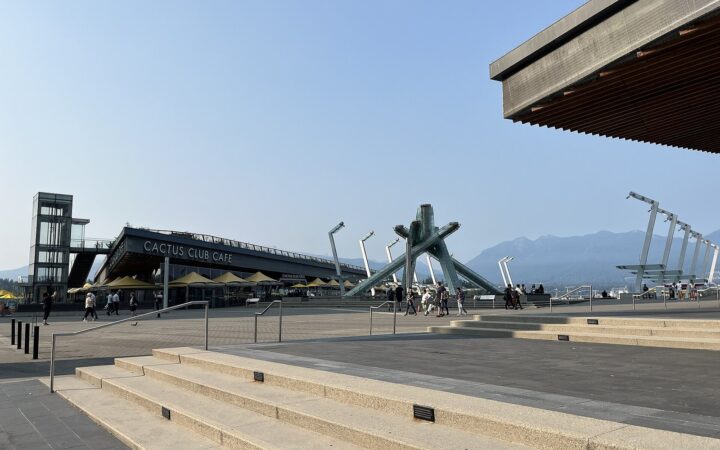
    The Olympic Cauldron. The 2010 Winter Olympics flame sat on the Coal Harbour waterfront just east of the Convention Centre. The cauldron is now a permanent art piece — relit during major Vancouver events (Pride Week, Lunar New Year, Diwali, etc.). The relit cauldron is one of the more atmospheric Vancouver photos available.

    For wider Vancouver history see our Vancouver culture and history pillar.

    Coal Harbour Photography Locations

    Coal Harbour is one of Vancouver’s most photogenic waterfronts — the combination of harbour water, mountain backdrop, glass-tower architecture, and (often) seaplanes departing creates compositions you can’t easily replicate elsewhere. The signature photo locations:

    1. Canada Place Promenade. The waterfront walkway around Canada Place gives you the iconic “white sails plus mountains” shot. Best at dawn (5:30 a.m. summer; 7:30 a.m. winter) when the sun rises behind Burrard Inlet and illuminates the North Shore Mountains as alpenglow. The cruise ships at the dock add scale.

    2. The Coal Harbour Seawall (between Convention Centre and Stanley Park). The 1.5 km seawall has continuous photo opportunities. Best at golden hour (1 hour before sunset). The marina, the floatplanes departing, the rowing club at the eastern end of Stanley Park — all make compelling foregrounds.

    3. The Olympic Cauldron at twilight. When the cauldron is lit (during major events), the post-sunset blue sky combined with the orange flames against the harbour produces dramatic photos. Best 20–30 minutes after sunset.

    4. Stanley Park’s Brockton Point looking back at downtown. Walk 25 minutes from Coal Harbour into Stanley Park; from Brockton Point, the entire Coal Harbour skyline is visible across the inlet. The afternoon golden hour gives you the buildings illuminated against shadow.

    5. Lions Gate Bridge from below. Walk further into Stanley Park to the underside of Lions Gate Bridge. Wide-angle shots looking up at the bridge’s 1938 art-moderne arches with the mountains as backdrop.

    6. Inside the Marine Building. The Art Deco lobby (355 Burrard) is one of Vancouver’s most photogenic interior spaces. The floor mosaics, the brass elevator banks, and the underwater-themed sculptures make excellent indoor photography subjects.

    7. The Vancouver Convention Centre’s living roof. The 6-acre living roof on top of the Convention Centre (the largest non-industrial green roof in North America) is sometimes accessible during specific events; check with the Convention Centre. Even from below the building, the green-roof line at the building edge is visible from the seawall.

    8. Floatplane departures. Harbour Air’s commercial floatplane departures from Coal Harbour Marina happen throughout the day. Best photos: early morning (6–9 a.m.) when the harbour is calm and the planes’ wakes are clean. Telephoto lens (70–200 mm) for compressed shots from the seawall; wide-angle for full-scene shots.

    Equipment recommendations. Wide-angle lens (16–35 mm) for the cityscape compositions; telephoto (70–200 mm) for compressed mountain shots and floatplane photography; polarizing filter to reduce harbour-water reflections; tripod essential for the dawn and twilight shots. Drones are restricted in downtown Vancouver — don’t fly without specific authorization.

    Annual Events at Coal Harbour

    Coal Harbour hosts several of Vancouver’s biggest annual events. Visitors who time their trips around these events get a fundamentally different Coal Harbour experience.

    Honda Celebration of Light (late July to early August). Three Saturday-evening fireworks competitions over English Bay. Coal Harbour gets a different (better, in many opinions) view than English Bay itself — the cauldron is relit, the harbour fills with anchored boats, and the cruise ships in port participate. Free; 1.5 million spectators across the 3 evenings.

    Vancouver Pride Festival (late July to early August). Pride Week’s “Sunset Beach Festival” is at the south edge of the West End, but the parade route runs through downtown including the Coal Harbour neighbourhood. Hotels in Coal Harbour are particularly Pride-welcoming.

    FIFA World Cup 2026 matches (mid-June to early July 2026). Vancouver hosts 7 World Cup matches at BC Place stadium. Coal Harbour’s Convention Centre hosts the FIFA Fan Festival (free; outdoor screenings of all World Cup matches). The neighbourhood becomes a global meeting place during match days.

    Vancouver International Film Festival (mid-September to early October). The Vancouver International Film Centre (Vancity Theatre at 1181 Seymour) is on the Coal Harbour edge. Many festival screenings; international filmmakers and actors stay at Coal Harbour hotels. Best month for celebrity-spotting in Coal Harbour.

    National Indigenous Peoples Day (June 21). The Coal Harbour seawall hosts free Indigenous-led events including drum circles at the Olympic Cauldron, Coast Salish artwork installations, and traditional canoe paddles. Free.

    Cherry Blossom Festival (early-mid April). The Burrard SkyTrain area has the densest Yoshino cherry trees in the city; the cherry-blossom photo cluster spills into Coal Harbour’s southern edge. Vancouver Cherry Blossom Festival’s “Big Picnic” is at Burrard SkyTrain, 2 minutes from Coal Harbour.

    Lunar New Year (February). Falls February 22 in 2026 (Year of the Horse). The Olympic Cauldron is relit; the Sun Yat-Sen Garden in Chinatown (15 minutes away) hosts the major parade. Vancouver Aquatic Centre on the West End edge runs special programming.

    Diwali (October/November, varies by year). The Olympic Cauldron is relit; Coal Harbour and downtown sees significant Diwali events at hotels and the Convention Centre. The South Asian community in Vancouver is large enough that Diwali celebrations are city-wide.

    Cruise Season Opening (late April). Each spring, the first Alaska cruise ship arrival at Canada Place marks the start of cruise season. Free public welcome ceremony with First Nations performances; the Coal Harbour seawall fills with onlookers.

    December lights and Christmas season. Canada Place’s “Lights to the Sky” runs December evenings — free outdoor light show on the white sails. The Marine Building lobby is decorated for Christmas (worth a visit). Coal Harbour hotels offer Christmas Day brunch and dinner programs.

    For the full Vancouver event calendar see our events and festivals pillar.

    Related reading: Where to Stay in Vancouver Master Pillar · Downtown Vancouver Guide · Yaletown Guide · West End Guide · Luxury Hotels Vancouver · Cruise Port Guide · Stanley Park Guide


  • West End Vancouver: The Best 2026 Davie Village Neighborhood Guide

    West End Vancouver: The Best 2026 Davie Village Neighborhood Guide

    Vancouver West End leafy streets
    Photo by Esteban Arango via Pexels. West End Vancouver — leafy residential downtown southwest with Davie Village and Stanley Park-adjacent stays.

    West End Vancouver is the leafy, residential southwest quadrant of downtown — bounded by Burrard Inlet to the north, Stanley Park to the west, English Bay to the south, and Burrard Street to the east. About 47,000 residents pack into 2 km², making it one of the densest neighbourhoods in Canada — and yet the streetscape feels remarkably calm: tree-lined streets, low-rise apartment buildings, restaurants, dog parks, and the famous Davie Village (Vancouver’s LGBTQ+ neighbourhood) running along its southern edge.

    This 2026 neighbourhood guide covers the West End and Davie Village in depth — what to see and do, the best hotels and B&Bs, the dining strips on Davie and Denman, the LGBTQ+ history and venues, and how the West End compares to other downtown sub-areas for a Vancouver stay.

    Vancouver residential apartment buildings
    Photo by Maximilian Ruther via Pexels. The West End packs 47,000 residents into 2 km² — Canada’s densest neighbourhood by population.

    West End Vancouver: A Quick Overview

    The West End is Vancouver’s densest residential neighbourhood — 47,000 people on roughly 2 km² of low-rise and mid-rise apartments along leafy streets like Robson, Davie, Denman, Pendrell, and Comox. The area’s defining features:

    • Stanley Park 5–10 minutes’ walk from any West End hotel
    • English Bay Beach 0–10 minutes’ walk
    • The Davie Village LGBTQ+ neighbourhood along Davie Street (Burrard to Jervis)
    • Robson Street’s western blocks (the West End side, between Burrard and Denman)
    • Three small parks: Nelson Park, Sunset Beach Park, English Bay Beach Park
    • 250+ restaurants and cafés
    • Direct bus access to downtown attractions and Stanley Park

    West End hotels lean budget-to-mid-range — the area has fewer luxury options than Coal Harbour or Robson Street, but better Stanley Park access and a more genuinely “neighbourhood” feel.

    For wider city overview see our where to stay pillar.

    Vintage Vancouver West End residential
    Photo by The Six via Pexels. Vancouver’s first wealthy residential neighbourhood; Davie Village’s LGBTQ+ role emerged in the 1970s.

    A Brief West End History

    The West End was Vancouver’s first wealthy residential neighbourhood — between 1890 and 1920, the city’s lumber and railway barons built large Victorian and Edwardian houses on streets like Beach Avenue and Pendrell. Most were torn down in the 1950s–1970s as the city’s first wave of high-rise apartments transformed the area into the dense residential neighbourhood you see today.

    The Davie Village’s role as Vancouver’s LGBTQ+ neighbourhood emerged in the 1970s, anchored by the original gay bar Numbers Cabaret (1980, still operating) and the visible community organizations along Davie. Vancouver’s first Pride parade was held in 1981 along Davie Street.

    The neighbourhood’s tree-lined streets and walkable density came from a 1970s-era zoning experiment that limited buildings to 3–6 storeys on the residential blocks while concentrating high-rises on Robson and along the southern edge. The result is one of Canada’s most walkable urban neighbourhoods.

    For more Vancouver history see our Vancouver culture and history pillar.

    Rainbow crosswalk pride street pink
    Photo by RDNE Stock project via Pexels. Davie Village runs along Davie Street between Burrard and Jervis — Vancouver’s LGBTQ+ neighbourhood since the 1970s.

    Davie Village & LGBTQ+ Vancouver

    Davie Village runs along Davie Street between Burrard and Jervis (about 6 blocks). The pink crosswalks, the “Davie Village” street-flag designation, and the rainbow-painted street furniture all date from the 2010s, but the neighbourhood’s role as Vancouver’s LGBTQ+ centre goes back to the 1970s.

    Anchor venues and businesses:

    • Numbers Cabaret (1042 Davie) — Vancouver’s longest-running gay bar, since 1980.
    • Celebrities Nightclub (1022 Davie) — long-running gay dance club with regular drag and DJ programming.
    • Junction Public House (1138 Davie) — relaxed neighbourhood pub welcoming all.
    • The Score on Davie (1262 Davie) — sports bar with a strong LGBTQ+ following.
    • The Pumpjack Pub (1167 Davie) — long-running mixed crowd.
    • Little Sister’s Book and Art Emporium (1238 Davie) — Canada’s oldest LGBTQ+ bookstore (since 1983); legal precedent for LGBTQ+ free speech in Canada.

    Vancouver Pride Festival typically runs late July through early August; the parade ends at the Davie Village festival on Sunday. See our events and festivals pillar.

    The neighbourhood is welcoming and inclusive year-round; the rainbow crosswalks at Bute and Davie mark the Davie Village heart.

    English Bay Beach Vancouver sunset
    Photo by Adi K via Pexels. English Bay Beach, the seawall, Stanley Park entrance, Davie Village walks, the AAA Engaging laughing-bronze figures.

    Things to Do in the West End

    The West End is more of a “live and walk” neighbourhood than a sightseeing district. Specific stops:

    1. English Bay Beach. The southwestern beach in the West End, with the famous “AAA Engaging” laughing-bronze figures by Yue Minjun (2009). Sunset is the move; in summer, the beach plays host to the annual Celebration of Light fireworks (late July/early August — see our events pillar).

    2. Stanley Park entrance. The southeast park entrance is a 5-minute walk from any West End hotel. Bike rentals at Spokes (Denman & Georgia) for the seawall ride.

    3. Robson Street’s West End blocks. The Robson strip from Burrard to Denman has a more local-feeling restaurant/café cluster than the central tourist Robson section.

    4. Sunset Beach Park. Smaller than English Bay; best for quiet picnics and the inukshuk sculpture (the same design that became Vancouver’s Olympic 2010 logo).

    5. The seawall walk. West End access to the Stanley Park Seawall (counter-clockwise to Brockton Point) and the False Creek Seawall (under the Burrard Bridge to Granville Island).

    6. Walk Davie Village. Pink crosswalks, rainbow-painted bus shelters, and the Davie Village banner. Best on weekends or any sunny afternoon.

    Heritage hotel exterior ivy Vancouver
    Photo by Marc Curtis via Pexels. The Sylvia Hotel ($230 heritage), The Listel ($280 boutique), Sandman Suites Davie ($230 family) anchor West End stays.

    Best Hotels in the West End

    The West End’s hotel cluster runs budget-to-mid-range with a few unique heritage options.

    Sylvia Hotel (1154 Gilford). The most-loved West End hotel — restored 1912 heritage building, ivy-covered exterior, intimate; only 119 rooms. Rooms with English Bay view are the prize. From $230/night.

    The Listel Hotel Vancouver (1300 Robson). Boutique art-themed hotel with rotating gallery exhibitions. From $280/night.

    Best Western Plus Sands Hotel (1755 Davie). Dated but clean; classic budget Stanley Park-adjacent option. From $180/night.

    Sandman Suites Vancouver – Davie Street (1160 Davie). All-suites with full kitchens; family-friendly. From $230/night.

    Times Square Suites Hotel (1821 Robson). Suites with kitchenettes; long-stay friendly. From $200/night.

    Days Inn by Wyndham Vancouver Downtown (921 W Pender, technically downtown but West End-adjacent). Reliable budget. From $150/night.

    Buchan Hotel (1906 Haro). Restored 1926 heritage building; budget-boutique hybrid. From $170/night.

    Many West End vacation rentals exist as well, mostly converted condos. With Vancouver’s May 2024 short-term rental rules, listings now require principal-residence registration. Typical rates: $250–$400/night for a one-bedroom.

    Casual restaurant patio Vancouver
    Photo by Matthew Jesús via Pexels. Joe Fortes (the Vancouver classic), Stepho’s Greek, Forage at the Listel, Kingyo Izakaya, Banana Leaf Malaysian.

    Best West End Restaurants

    The West End’s three main restaurant strips are Davie Street, Denman Street, and the West End blocks of Robson:

    Joe Fortes Seafood & Chop House (777 Thurlow). The Vancouver classic seafood/steakhouse since 1985; mains $44–$78.

    Stepho’s Greek Taverna (1124 Davie). 30-year cult favourite; the best Greek in Vancouver; mains $24–$36. No reservations; 30-minute queue typical.

    Forage (Listel Hotel, 1300 Robson). Locally-focused Pacific Northwest; mains $32–$48.

    Glowbal at Telus Garden (590 W Georgia, West End edge). Glamorous; signature steakhouse classics.

    Kingyo Izakaya (871 Denman). Traditional Japanese izakaya; small plates $14–$28.

    Banana Leaf Malaysian Cuisine (1096 Denman). Long-running Malaysian; mains $24–$32.

    Café Crepe (1003 Davie). Casual French crepes; weekend brunch favourite.

    The Templeton (1087 Granville, West End edge). Diner-style classics; the city’s beloved late-night vinyl-and-comfort-food spot.

    For more dining see our Vancouver food scene pillar.

    Neighbourhood pub cocktail bar
    Photo by Büşra Yurt via Pexels. Numbers Cabaret, Celebrities Nightclub, Junction Public House, Sylvia Lounge, Cardero’s anchor West End nightlife.

    West End Bars & Nightlife

    The West End nightlife is more local-pub and LGBTQ+-focused than downtown. Highlights:

    Davie Village venues (covered above): Numbers Cabaret, Celebrities Nightclub, Junction Public House.

    Eight 1/2 Restaurant Lounge (151 W 8th). Stylish neighborhood lounge.

    Cardero’s (1583 Coal Harbour, West End edge). Waterfront patio; sunsets are excellent.

    Lift Bar Grill View (333 Menchions Mews). Coal Harbour-edge waterfront cocktails.

    The Sylvia Lounge (Sylvia Hotel). Cozy heritage pub; Vancouver’s first cocktail bar (1954).

    For wider nightlife see our Vancouver nightlife pillar.

    English Bay Beach driftwood logs
    Photo by Adi K via Pexels. English Bay Beach hosts the Honda Celebration of Light fireworks competition each summer (1.5 million annual viewers).

    English Bay Beach & the Seawall

    English Bay Beach sits at the southwestern corner of the West End, one of Vancouver’s most-loved free outdoor spaces.

    What’s there:

    • 500 m of sandy beach with the iconic logs and unobstructed views to Vancouver Island and Bowen Island
    • The “AAA Engaging” laughing-bronze figures by Yue Minjun
    • Lifeguards (May–Labour Day)
    • Concession stand
    • The Vancouver Aquatic Centre (heated indoor pool, just east) — adult $7.91

    Vancouver’s biggest summer festival, the Honda Celebration of Light fireworks competition, takes place over English Bay (late July/early August), drawing 1.5 million spectators across three Saturday nights. Free; arrive 4–5 hours early for prime beach blanket spots.

    The seawall connects English Bay to Stanley Park (counter-clockwise) and to Granville Island (south under the Burrard Bridge). The 5-km Stanley Park entrance to Granville Island walk is one of Vancouver’s signature urban walks.

    Vancouver bus stop downtown transit
    Photo by Jeffry Surianto via Pexels. From YVR — Canada Line to Burrard, then 5-10 min walk west. From Canada Place — 15-min walk west.

    Getting to & Around the West End

    From YVR airport. Canada Line SkyTrain to Burrard or Vancouver City Centre stations, then 5–10 minute walk west.

    From Canada Place cruise terminal. 15-minute walk west.

    To Stanley Park. 5–10 minutes’ walk to the southeast entrance.

    To downtown core. 5–15 minutes’ walk to Robson Street, Vancouver Lookout, or Granville Street SkyTrain.

    To Granville Island. 25-minute walk via Sunset Beach + Burrard Bridge, or 12-minute False Creek Ferry from the Aquatic Centre.

    The #19 bus runs along West Pender to Stanley Park; the #5 along Davie; both are useful for tourists.

    Parking. Most West End hotels charge $30–$45/night for parking. Street parking metered $4–$6/hour. Limited.

    Couple traveling decision city
    Photo by Samson Katt via Pexels. Pros: closest non-luxury Stanley Park hotels, mid-budget pricing, residential. Cons: 15 min to Lookout, no SkyTrain.

    Pros & Cons of Staying in the West End

    Pros:

    • Closest non-luxury hotels to Stanley Park (5–10 min walk)
    • Walking distance to English Bay Beach
    • Davie Village + LGBTQ+ inclusive atmosphere
    • Mid-budget hotel cluster
    • Tree-lined residential character
    • Quieter than Robson or Granville Street
    • 250+ restaurants within walking distance
    • Excellent for couples and budget travellers

    Cons:

    • Fewer luxury hotel options than Coal Harbour
    • 15-minute walk to Vancouver Lookout
    • 20-minute walk to Canada Place cruise terminal
    • Davie Village can be lively/loud Friday/Saturday nights
    • Limited SkyTrain access (Burrard is the closest, on the far edge)
    • Older heritage hotels may have inconsistent room sizes/elevators
    Family children beach park sand
    Photo by Paco Alonso via Pexels. Stanley Park playgrounds, Second Beach pool, English Bay, Aquatic Centre, Stanley Park Train (seasonal).

    West End with Kids

    The West End is family-friendly, especially for visitors who prioritize Stanley Park access. Kid-specific anchors:

    • Stanley Park playground (Ceperley) and Second Beach pool — 10–15 minutes’ walk
    • English Bay Beach (sandy, lifeguarded in summer)
    • Vancouver Aquatic Centre (heated indoor pool)
    • Stanley Park Train (seasonal, especially Halloween Ghost Train and Christmas Bright Nights)
    • Mobile food trucks at Sunset Beach Park
    • Family-friendly hotel suites at Sandman Suites Davie or Times Square Suites

    For full family planning see our Vancouver with kids pillar.

    Vancouver West End skyline mountain
    Photo by Luke Lawreszuk via Pexels. Common questions about West End Vancouver — Sylvia Hotel, Davie Village, distance to Stanley Park, safety.

    West End Vancouver FAQs

    Is the West End a good area to stay in Vancouver?
    Yes — for visitors who want Stanley Park-adjacent stays, mid-budget hotel options, and a residential neighbourhood feel. Best for couples, budget travellers, and visitors who plan to walk Stanley Park every morning.

    What are the best West End hotels?
    The Sylvia Hotel ($230/night, heritage) is the most-loved. The Listel Hotel ($280/night, art-themed boutique) is the best mid-range. Sandman Suites Davie ($230, family suites) and Best Western Plus Sands ($180/night) cover budget.

    How far is the West End from Stanley Park?
    5–10 minutes’ walk from any West End hotel to the park’s southeast entrance. The closest hotels (Sylvia, Best Western Sands) are 5 minutes.

    Is the West End safe?
    Yes — one of downtown Vancouver’s safer residential neighbourhoods. Davie Village is generally welcoming and well-policed. Standard urban awareness applies.

    What is Davie Village in the West End?
    The 6-block stretch along Davie Street between Burrard and Jervis is Vancouver’s LGBTQ+ neighbourhood since the 1970s. Pink crosswalks, rainbow street art, and an active LGBTQ+ business and venue cluster. Vancouver Pride parade ends at the Davie Village festival each summer.

    Is the West End good for couples?
    Yes. Walking-distance Stanley Park, English Bay Beach sunsets, the Sylvia Lounge cocktails, and the dense restaurant strip make the West End one of Vancouver’s most romantic neighbourhoods.

    What’s the best West End restaurant?
    Joe Fortes (the Vancouver seafood classic), Stepho’s Greek (cult favourite), Kingyo Izakaya, and Forage are the four reliable West End picks. Davie Village adds Banana Leaf Malaysian and many Asian fusion options.

    Is parking easy in the West End?
    No. Most West End hotels charge $30–$45/night for parking and street parking is metered. Better to use transit/walk and rent a car only for day trips.

    Second Beach & Sunset Beach Park

    The West End extends west into Stanley Park’s southern edge. Two of Stanley Park’s most-loved beach areas — Second Beach and Sunset Beach Park — sit within 10 minutes’ walk of any West End hotel. Both are free, both heavily used by locals year-round, and both offer a different beach character than the more touristy English Bay.

    Second Beach (Stanley Park). The family beach. Heated outdoor 50 m saltwater pool (open mid-May through mid-September; adult $7.91 in 2026), Ceperley Playground (the largest playground in any Vancouver park), free outdoor showers, lifeguards through summer, picnic tables, public BBQs available for rental, the iconic Second Beach Concession (burgers, fries, ice cream; open seasonally), and connections to the Stanley Park Seawall in both directions. Second Beach is West End-residents-with-kids territory.

    Sunset Beach Park. The smaller, quieter beach east of English Bay (between English Bay Beach and the Burrard Bridge). The “secret” beach the locals reach when English Bay is too crowded. Distinguishing features: the iconic inukshuk sculpture (the same design that became Vancouver’s 2010 Winter Olympics logo); the Vancouver Aquatic Centre indoor heated pool adjacent ($7.91 adult); the Burrard Civic Marina; and the False Creek Ferry dock that connects to Granville Island.

    Beach water temperature. 15–18 °C (59–64 °F) at peak summer. Locals do swim in the ocean off both beaches; most visitors prefer the heated saltwater pools. Second Beach Pool is genuinely warm (28 °C) and excellent for kids; the Vancouver Aquatic Centre’s indoor pool runs 27 °C.

    Best activities at Second Beach.

    • Heated pool (mid-May to mid-September): $7.91 adult. The 50 m pool has a separate kids’ shallow area; lap-swim hours 6:30–9 a.m. weekdays.
    • Ceperley Playground: Free; one of Vancouver’s most-loved playgrounds. Adventure climbing structures, sandbox, accessible swings.
    • Disc golf: Free disc-golf course adjacent (9 holes); bring your own discs.
    • Beach pickleball: 4 dedicated pickleball courts; first-come-first-served; bring your own paddles and balls.
    • Public BBQs: Reservable through the Vancouver Park Board; $30 for a 4-hour BBQ slot.
    • Yoga in the park: Free community yoga during summer (Wednesday and Saturday mornings).

    Best activities at Sunset Beach.

    • Vancouver Aquatic Centre: Indoor heated pool ($7.91 adult), sauna, hot tub, water slide. Open year-round.
    • Inukshuk sculpture photo.
    • False Creek Ferry to Granville Island: 12-minute crossing ($7).
    • Stanley Park Seawall connection — walk west into Stanley Park; about 90 minutes to Brockton Point round-trip.
    • Drum circle (Tuesday evenings, May–September): Free informal drum circle on the grass; 7 p.m. start; bring your own drum or just enjoy.

    Both beaches in winter. The pools close mid-September. Lifeguards leave Labour Day. The beaches themselves remain open (free) year-round; on a sunny December day you’ll find local dog-walkers, runners, and the occasional cold-water-plunge enthusiasts. The Second Beach Pool reopens for swimming the following May.

    West End Cafés & Daily Routines

    The West End has Vancouver’s densest coffee-and-café culture per square kilometre — partly because the residential density supports it, partly because the long-term local population includes many Vancouver writers, designers, and creative professionals who work from cafés daily. The West End café circuit:

    49th Parallel Coffee Roasters Burrard (1124 Davie or 2152 W 4th in Kitsilano). Vancouver’s flagship specialty coffee roaster. The Davie location is the West End anchor; flat whites, cortados, and pour-overs from $5–$8. Open 6 a.m. – 7 p.m.

    JJ Bean Coffee Roasters (multiple West End locations: Denman, Davie, Robson). Vancouver’s largest local coffee chain; reliable everywhere. The Denman location near Stanley Park is the local-runners morning anchor.

    Caffè Artigiano (Robson at Cardero). Italian-style espresso bar; the macchiato is the local specialty. Slower service; better for an espresso-and-newspaper morning.

    Cosmic Coffee (Denman Street). Smaller independent; cult following among West End regulars.

    Small Victory Bakery (Yaletown but West End-edge). Excellent pastries plus solid espresso; West End locals walk to it weekly.

    Continental Coffee (Commercial Drive but worth the trip; 30 minutes from West End by transit). The 1973-founded Italian classic; West End coffee enthusiasts make pilgrimages.

    Daily routines. The classic West End coffee routine: morning walk along the seawall (4–6 km), coffee at 49th Parallel or JJ Bean afterward (8–9 a.m.), late breakfast or brunch at home or at one of the West End brunch spots (Stepho’s Greek, Banana Leaf Malaysian, the Sylvia Lounge brunch). Evening coffee or wine at Café Artigiano or one of the West End wine bars.

    Best brunch spots. The Sylvia Lounge (1154 Gilford) is the heritage classic — Vancouver’s first cocktail bar (1954) and one of the city’s longest-running brunches. Stepho’s Greek Taverna (1124 Davie) is the cult favourite for moussaka and souvlaki brunch. Cardero’s (1583 Coal Harbour Quay) is the West End-edge waterfront brunch with the marina view.

    Café for working. If you need a café to work from, the JJ Bean on Davie has reliable Wi-Fi and dozens of power outlets — the most “remote-worker-friendly” West End café. The Robson Square JJ Bean has a quieter atmosphere if you need to make calls.

    Wine bar evenings. The West End has several intimate wine bars: Wine Bar (Bidwell Street), the Sylvia Lounge (Gilford), and the Bistro Boulevard (Davie). All accommodate solo evening visitors and open late (typically until midnight or later).

    Vancouver Pride: A Brief History

    Vancouver Pride is the third-largest Pride festival in Canada (after Toronto and Montreal) and one of the longest-running in North America. The West End’s role as Vancouver’s LGBTQ+ neighbourhood is essential to understanding the city’s culture, and Vancouver Pride traces directly through the West End’s Davie Village.

    The early years (1970s). Vancouver’s first formal Pride march occurred in 1971 at the Vancouver Public Library — a small group of activists organized by the Gay Liberation Front (GLF). The Davie Village’s emergence as Vancouver’s LGBTQ+ neighbourhood happened over the next decade as gay-friendly businesses (the original Numbers Cabaret in 1980, the Pumpjack Pub, Junction Public House) opened along Davie Street between Burrard and Jervis.

    1981 — first official Vancouver Pride parade. Held August 1, 1981 along Davie Street, ending at the Davie Village. About 300 marchers; the first sanctioned Pride event in Vancouver. The original parade was specifically organized as a political march for LGBTQ+ rights amid the AIDS crisis that was beginning to devastate the community.

    1992 — formalization. Vancouver Pride Society incorporated as a non-profit; the parade became an annual event at scale.

    2000s — growth and politicization. Vancouver’s Pride parade grew through the early 2000s; same-sex marriage legalized in BC in 2003 (Canada-wide in 2005), and Pride increasingly celebrated victories alongside ongoing advocacy.

    2010s — corporate sponsorship and expansion. Pride became larger, more corporate, and broader in programming. The full Pride Festival now runs 10 days, with the parade as the centerpiece on the Sunday of the closing weekend (typically late July to early August).

    2026 Vancouver Pride. Provisional dates are July 25 – August 2, 2026. The parade is Sunday, August 2 (typically the Sunday closest to BC Day weekend). The route runs along Davie Street, ending at the Davie Village festival in Lord Roberts Square. Free.

    Davie Village landmarks of LGBTQ+ history:

    • Numbers Cabaret (1042 Davie; opened 1980). Vancouver’s longest-running gay bar.
    • Celebrities Nightclub (1022 Davie). Long-running gay dance club.
    • Little Sister’s Book and Art Emporium (1238 Davie; opened 1983). Canada’s oldest LGBTQ+ bookstore; subject of a landmark 2000 Supreme Court of Canada free-speech case (Little Sisters Book and Art Emporium v. Canada (Minister of Justice)).
    • The AIDS Memorial (Sunset Beach Park, just south of the West End). Named “Sunset Beach AIDS Memorial,” dedicated 2004; the largest AIDS memorial in Western Canada.
    • The pink crosswalks at Bute and Davie — installed 2013 as the official designation of Davie Village.

    Pride Week 2026 events to know. Beyond the parade, Pride Week includes the Davie Street Block Party (free; the Saturday before the parade), the West End Concert Series (free outdoor concerts; Friday and Saturday), the Pride Film Festival (Vancouver Pride Society’s curated cinema; ticketed at $15–$25 per film), and the Big Sunday at Sunset Beach (the post-parade festival; free).

    For travellers visiting outside Pride. Davie Village is welcoming year-round. The pink crosswalks at Bute and Davie are the most-photographed LGBTQ+ landmark; Numbers Cabaret runs nightly drag shows; Celebrities has weekly dance nights. Visiting LGBTQ+ travellers report the West End as one of North America’s most welcoming neighbourhoods regardless of season.

    Related reading: Where to Stay in Vancouver Master Pillar · Downtown Vancouver Guide · Yaletown Guide · Kitsilano Guide · Stanley Park Guide · Events & Festivals


  • Kitsilano Vancouver: The Best 2026 Beach-Side Neighborhood Guide

    Kitsilano Vancouver: The Best 2026 Beach-Side Neighborhood Guide

    Kitsilano beach Pacific sunset
    Photo by Jessica Lewis 🦋 thepaintedsquare via Pexels. Kitsilano Vancouver — the city’s signature beach neighbourhood with the 137 m heated saltwater pool.

    Kitsilano Vancouver — known to locals as “Kits” — is the city’s signature beach neighbourhood. Spread across the south shore of English Bay, west of Granville Island, Kits delivers what Vancouver tourism brochures promise but downtown can’t: actual beach culture, sunset volleyball, the Pacific within walking distance of your hotel, and a 4 km-long seawall that locals jog every morning. The neighbourhood also holds Canada’s longest heated saltwater pool (Kitsilano Pool, 137 m), three excellent museums, and one of Vancouver’s most-loved restaurant strips on West 4th Avenue.

    This 2026 neighbourhood guide covers Kitsilano’s beaches, the best hotels and B&Bs in Kits, the West 4th and West Broadway dining strips, the museums at Vanier Park, transit logistics back to downtown, and an honest take on whether Kits is the right base for a first-time Vancouver visit.

    Vancouver Kitsilano beach view
    Photo by JP via Pexels. Kitsilano spans 5 km² on Vancouver’s west side with 2 km of beach and the 137 m Kitsilano Pool.

    Kitsilano Vancouver: A Quick Overview

    Kitsilano sits on Vancouver’s west side, across English Bay from downtown. The neighbourhood spans roughly 5 km² between Burrard Street to the east and Trafalgar Street to the west, and from West 16th Avenue south to the waterfront.

    Quick facts:

    • Approximate population: 45,000
    • 2 km of beach along Kitsilano Beach Park, Hadden Park, and Vanier Park
    • Kitsilano Pool: Canada’s longest heated saltwater pool (137 m)
    • 3 museums at Vanier Park (Museum of Vancouver, Maritime Museum, H.R. MacMillan Space Centre)
    • 4th Avenue and West Broadway are the two main commercial strips
    • To downtown: 15-minute SkyTrain or 25-minute walk via Burrard Bridge
    • To Stanley Park: 30-minute walk over the Burrard Bridge or 12-minute False Creek Ferry
    • To Granville Island: 8-minute walk from Vanier Park

    Kits is younger and more outdoorsy than downtown — yoga studios, organic juice bars, surf-shop aesthetics, and the active 20s-and-30s crowd that Vancouver is known for. It’s also where some of the city’s biggest food/lifestyle brands started: Earnest Ice Cream, lululemon (the original Kitsilano store on West 4th since 2000), and Aphrodite’s Café.

    For wider city overview see our where to stay pillar.

    Vintage Vancouver beach historical
    Photo by Scott Webb via Pexels. Kitsilano is named after Squamish Chief Khatsahlano — the original Sen̓áḵw village site at the south end of Burrard Bridge.

    A Brief Kitsilano History

    Kitsilano is named after Squamish Chief Khatsahlano (1834–1933), one of the last Squamish Nation members to live continuously at Sen̓áḵw — the Squamish village that occupied the south end of what is now the Burrard Bridge until the early 1900s. The original Coast Salish Sen̓áḵw village was the largest Indigenous settlement in the Burrard Inlet region; the residents were forcibly removed in 1913 to make way for industrial development.

    Modern Kitsilano was built between 1900 and 1940 as a streetcar suburb — the original streetcar line ran along West 4th Avenue. The 1960s saw Kits become Vancouver’s hippie/counterculture neighbourhood; Greenpeace was founded here in 1971. By the 1990s, the area had gentrified into the upscale beach neighbourhood you see today.

    Recent: the Squamish Nation is leading the Sen̓áḵw redevelopment at the south end of the Burrard Bridge — a 6,000-unit housing project on the original Squamish village site. It’s one of the largest Indigenous-led developments in Canada and is reshaping the eastern edge of Kitsilano. For more see our Vancouver culture and history pillar.

    Kits Beach driftwood logs sand
    Photo by Jeff Moyer via Pexels. Kits Beach is Vancouver’s most-loved beach — 2 km of sand, the 137 m heated saltwater pool, volleyball, sunset views.

    Kitsilano Beach & Pool

    Kitsilano Beach (locals call it “Kits Beach”) is Vancouver’s most-loved beach. The 2 km of sand stretches west from the foot of Cornwall Avenue past the Kitsilano Showboat (a free outdoor amphitheatre) and the heated saltwater pool to Hadden Park.

    What’s there:

    • 2 km of sandy beach with driftwood logs and unobstructed views of downtown Vancouver, the North Shore Mountains, and the Strait of Georgia
    • Lifeguards (May–Labour Day)
    • Volleyball nets (free; bring your own ball or pick up Saturday/Sunday games)
    • Concession stands
    • Free outdoor showers
    • Picnic tables
    • The Kitsilano Showboat — a free outdoor amphitheatre with summer evening performances

    Kitsilano Pool at the eastern end of the beach is Canada’s longest heated saltwater pool — 137 metres of swimming with downtown views over the lane lines. Open mid-May to mid-September; adult admission about $7.91 in 2026 (Vancouver Park Board prices). One of the city’s most beloved summer institutions.

    Vancouver beach water is cold year-round (15–18 °C in summer); locals do swim in the ocean, but most visitors prefer the heated pool.

    Boutique hotel beachfront
    Photo by Vladimir Srajber via Pexels. The Kitsilano Hotel and Granville Island Hotel are the main hotel options; most Kits stays are B&B-style.

    Where to Stay in Kitsilano

    Kitsilano has fewer hotels than downtown — about 5–6 options total — because most accommodation in Kits is residential or B&B style.

    The Kitsilano Hotel Vancouver (1755 Davie). Restored heritage hotel; 22 rooms; minutes from the beach. From $260/night.

    Granville Island Hotel (1253 Johnston, on Granville Island — 8 minutes from Kits). 84 rooms; the only hotel on Granville Island. Excellent for visitors who want both Kits beach access and Granville Island access. From $290/night.

    Park Inn & Suites by Radisson Vancouver (898 W Broadway, on Kitsilano edge). 108 rooms; mid-range chain. From $220/night.

    Kits Beach Bed & Breakfast and various B&Bs in Kitsilano residential streets. Typical $200–$350/night for 2-3 guests; book directly via Airbnb or Booking.com.

    Vacation rentals. Kits has many converted-house rentals; with the May 2024 short-term-rental rules now requiring principal-residence registration, listings are more limited. Typical 2-bedroom: $300–$500/night plus cleaning fees.

    Honest reality: Most first-time Vancouver visitors stay downtown and visit Kits for a half-day. The hotels in Kits suit visitors who want a longer beach-focused stay (3+ nights) and don’t mind being 15 minutes from downtown attractions.

    Casual restaurant west coast cuisine
    Photo by kevin yung via Pexels. Bishop’s, AnnaLena, Fable Kitchen, The Naam (24-hour vegetarian) and Las Margaritas anchor Kits dining.

    Kitsilano Restaurants

    Kitsilano’s two main commercial strips — West 4th Avenue (between Burrard and Trafalgar) and West Broadway (between Granville and Macdonald) — hold one of Vancouver’s most-loved restaurant clusters. Highlights:

    AnnaLena (1809 W 1st Ave). Pacific Northwest fine dining; multi-course tasting menus from $148. Reservations 2–3 weeks ahead.

    Bishop’s (2183 W 4th). The original Vancouver fine-dining destination since 1985; mains $48–$78; reserve well ahead.

    Fable Kitchen (1944 W 4th). Locally focused Pacific Northwest; mains $36–$58.

    Joe Fortes Kitsilano (a Kits-cluster outpost in some seasons; check current locations).

    The Naam (2724 W 4th). Vancouver’s iconic 24-hour vegetarian restaurant since 1968; the late-night/early-morning Vancouver classic. Mains $14–$24.

    Las Margaritas (1999 W 4th). 30+ year cult Mexican restaurant; the original Vancouver Mexican classic. Mains $24–$36.

    Aphrodite’s Pie Shop & Café (3605 W 4th). Brunch and pies; weekend favourite.

    Cafe Deux Soleils and other budget-friendly cafés along Kitsilano’s residential streets.

    For more dining ideas see our Vancouver food scene pillar.

    Museum exterior Vancouver art
    Photo by christian hembert via Pexels. Three museums at Vanier Park: Museum of Vancouver, Maritime Museum and H.R. MacMillan Space Centre.

    Museums at Vanier Park

    Vanier Park, on the eastern edge of Kitsilano (between Burrard Bridge and Cornwall), holds a cluster of three museums that visitors can do as a half-day combined:

    Museum of Vancouver (MOV). The flagship museum of Vancouver’s history — neon signs, the Jazz Age, Expo 86, and rotating shows on Indigenous, Chinese-Canadian, and South Asian histories. Adult $20. Allow 2 hours. See our culture pillar.

    Vancouver Maritime Museum. Pacific Northwest maritime history; the highlight is the RCMP Arctic patrol vessel St. Roch (1928 — the first ship to traverse the Northwest Passage in both directions). Adult $14.

    H.R. MacMillan Space Centre. Astronomy, planetarium, and rotating exhibits; family-friendly. Adult $19.50.

    Combo passes available; the three together fill a full day if you have museum-loving kids.

    Yoga shop boutique interior
    Photo by RDNE Stock project via Pexels. West 4th Avenue is one of Vancouver’s most distinctive independent shopping strips — the original lululemon store is here.

    Shopping in Kitsilano

    West 4th Avenue between Burrard and Trafalgar is one of Vancouver’s most distinctive independent shopping strips. Highlights:

    • The original lululemon store (2113 W 4th) — the global yoga/athleisure brand was founded in this Kitsilano space in 2000.
    • MEC Vancouver (130 W Broadway, on Kits edge) — Mountain Equipment Coop’s flagship; the Canadian outdoor outfitter classic.
    • Beadworks (1965 W 4th) — independent bead/jewellery supply.
    • Indigo Books and Music Kitsilano — flagship bookstore.
    • Kalena’s Tea House (3540 W Broadway) — independent tea retailer with 200+ varieties.
    • Lululemon flagship at 2113 W 4th — for the brand origin photo.

    For more shopping see our things to do pillar.

    Seawall beach Pacific Ocean walk
    Photo by lange x via Pexels. The Kitsilano Seawall connects Vanier Park to Jericho Beach in an unbroken 4 km waterfront walk.

    The Kitsilano Seawall

    The Kitsilano Seawall connects Vanier Park to Jericho Beach in an unbroken 4 km waterfront walk. The route:

    1. Start at Vanier Park (Maritime Museum dock)
    2. Pass the Maritime Museum and the H.R. MacMillan Space Centre
    3. Cross under the Burrard Bridge
    4. Reach Kitsilano Beach Park (the heated pool, the volleyball courts, the showboat amphitheatre)
    5. Continue west past Hadden Park and into Spanish Banks
    6. Reach Jericho Beach Park at the western end

    The 4 km route takes 60–75 minutes at a relaxed walk. Cyclists can extend the route — the Spanish Banks/Jericho seawall connects via Vancouver’s Off Broadway bike lanes back to downtown for a 12 km loop.

    Best at sunset on summer evenings — the view across English Bay to downtown Vancouver and the North Shore Mountains is the Vancouver postcard angle.

    Vancouver bus transit Kitsilano
    Photo by Jeffry Surianto via Pexels. From downtown — Burrard Bridge walk (25 min), bus #2 or #22 (15 min), or False Creek Ferry (12 min).

    Getting to & Around Kitsilano

    From downtown. Walk over the Burrard Bridge (25 minutes), bus #2 or #22 (15 minutes), or False Creek Ferries from the Aquatic Centre to Kitsilano Beach Park (12 minutes; $7).

    From YVR airport. Canada Line SkyTrain to King Edward station, then #16 bus west to Kits (about 45 minutes total).

    From Granville Island. 8-minute walk along the seawall under the Burrard Bridge.

    To Stanley Park. 30-minute walk over the Burrard Bridge or 12-minute False Creek Ferry.

    To downtown. Same options reversed.

    Kitsilano is fully walkable internally; bike rentals available at Kitsilano Beach for $8/hour.

    Couple beach decisions travel
    Photo by Sourabh Narwade via Pexels. Pros: walking-distance beach, family-friendly. Cons: 15-25 min from downtown, fewer hotel options.

    Pros & Cons of Staying in Kitsilano

    Pros:

    • Walking-distance Kitsilano Beach
    • Heated 137 m saltwater pool (May–Sept)
    • Less touristy than downtown
    • Independent restaurant strip (West 4th)
    • 3 museums at Vanier Park
    • Family-friendly residential character
    • Direct Aquabus to Granville Island
    • Quieter mornings; less honking and city noise

    Cons:

    • 15-25 minutes from downtown attractions
    • Limited hotel options (mostly B&B and small boutique)
    • No SkyTrain station (relies on buses)
    • No Stanley Park within walking distance (30 minutes)
    • Less nightlife than downtown
    • More expensive than downtown for similar 3-star quality
    Family children beach playing sand
    Photo by RDNE Stock project via Pexels. Kitsilano Pool, Vanier Park playground, MacMillan Space Centre and Aquabus rides anchor Kits family days.

    Kitsilano with Kids

    Kits is one of Vancouver’s most family-friendly neighbourhoods. Family-friendly anchors:

    • Kitsilano Pool (May–Sept; $7.91 adult, kids reduced)
    • Kitsilano Beach playground
    • Vanier Park playground (between MOV and Maritime Museum)
    • H.R. MacMillan Space Centre (planetarium shows)
    • Kitsilano Showboat (free summer evening performances)
    • Aquabus rides to Granville Island Kids Market
    • Bike rentals along the seawall

    For full family planning see our Vancouver with kids pillar.

    Kitsilano beach pool swimming
    Photo by Matt Hardy via Pexels. Common questions about Kitsilano Vancouver — beach, hotels, museums, distance from downtown.

    Kitsilano Vancouver FAQs

    Is Kitsilano a good area to stay in Vancouver?
    Yes, for visitors who want beach-side stays, family-friendly neighbourhood character, and don’t mind being 15–25 minutes from downtown. Best for 3+ night stays focused on outdoor and beach activities.

    What are the best Kitsilano hotels?
    The Kitsilano Hotel ($260/night), Granville Island Hotel ($290/night, technically on Granville Island but 8 minutes from Kits), and Park Inn & Suites ($220/night) are the main hotel options. Most Kits accommodation is B&B-style or vacation rentals.

    How far is Kitsilano from downtown Vancouver?
    15-minute bus or 25-minute walk via the Burrard Bridge. Direct False Creek Ferry from the Aquatic Centre is 12 minutes.

    Is Kitsilano Beach worth visiting?
    Yes. Kits Beach is Vancouver’s most-loved beach — 2 km of sand, the 137 m heated pool, volleyball, sunset views over English Bay to downtown. The free Showboat amphitheatre runs summer-evening shows.

    What’s the best Kitsilano restaurant?
    Bishop’s (1985 — the Vancouver fine-dining classic), AnnaLena (multi-course tasting menus), and Fable Kitchen are the three top fine-dining options. The Naam (24-hour vegetarian since 1968) is the iconic casual.

    Is Kitsilano safe?
    Yes — one of Vancouver’s safer neighbourhoods. Standard residential awareness applies; no particular safety concerns.

    What’s at Vanier Park in Kitsilano?
    Three museums: Museum of Vancouver, Vancouver Maritime Museum, and H.R. MacMillan Space Centre. Plus the Kitsilano Showboat, the playground, and the Maritime Museum’s outdoor RCMP Arctic patrol vessel St. Roch.

    Is Kitsilano good for couples?
    Yes. The seawall sunset walk, the Naam late-night meal, and the Bishop’s special-occasion dinner make Kits one of Vancouver’s romance-friendly neighbourhoods.

    Kitsilano Yoga & Fitness Culture

    Kitsilano is the global birthplace of lululemon — the yoga-athleisure brand opened its first store at 2113 W 4th Avenue in 2000, and the Kitsilano fitness culture that surrounded that store became one of Vancouver’s defining identities. The neighbourhood remains North America’s most concentrated yoga-and-wellness district outside Los Angeles’ Venice Beach.

    The original lululemon store at 2113 W 4th is still operating as the brand’s “first store” pilgrimage destination. Limited “made in Kitsilano” merchandise sometimes available; the store has photos and historical signage about the brand’s origin. Open daily 10 a.m. – 8 p.m.

    Yoga studios in Kitsilano. 12+ yoga studios within 2 km. The most-loved:

    • Semperviva Yoga (City Studio at 2540 Cypress; Kitsilano flagship). The Vancouver yoga community’s anchor since 1995. Drop-in classes $26; introductory week $40 unlimited.
    • YYoga Kitsilano (1623 W 4th). Vancouver’s largest yoga chain; the Kitsilano studio is the original. Classes from $26.
    • Westside Yoga (W Broadway). Older, slower-paced studio favoured by Kitsilano’s more experienced practitioners.
    • Yyoga at Spirit Gateway (Granville). Newer addition; modern facility; daily classes.
    • Buddhi Yoga (1830 W 4th). Specialty hot yoga (Bikram) studio.

    Outdoor yoga at Kits Beach. Free community yoga classes run roughly daily during summer (June–September) on the grass adjacent to the Kitsilano Showboat. Schedules are posted online and at the studios. Locals bring mats; visitors can rent at any nearby studio for $5.

    Pilates and barre. Pure Pilates Kitsilano (W Broadway), Solidcore Kits (Cornwall Avenue). Drop-ins from $35.

    Outdoor running and cycling. The Kitsilano Seawall (4 km from Vanier Park to Jericho Beach) is one of the city’s most-loved running and cycling routes. Free; flat; well-marked. Bike rentals at Kitsilano Beach (from $8/hour) for visitors without bikes.

    Surfing classes. Vancouver’s main surfing destination is Tofino (6.5 hours away), but Kitsilano has surf-skill classes for those preparing for a Tofino trip. Pacific Surf School Kits Beach offers indoor “surf simulator” lessons ($85/session; 90 minutes) on a wave-pool simulator.

    Stand-up paddleboarding (SUP). Vanier Park’s English Bay launch is the local Kits-area SUP rental spot. From $25/hour; lessons from $80. Best in the morning when the bay is calmest.

    Outdoor swimming. Kitsilano Pool (137 m heated saltwater outdoor pool) operates mid-May through mid-September. Adult $7.91; serious swimmers consider the lap-swim hours (6:30–9 a.m. weekdays) the city’s best.

    Wellness food and drink. Kitsilano has dozens of cold-pressed juice bars, plant-based restaurants, and supplement stores. Whole Foods Market Kitsilano is the neighbourhood’s wellness anchor. The Juicery (W 4th Ave) and Glory Juice (W Broadway) are the most-loved local juice bars.

    Kitsilano Farmers Market & Local Producers

    The Kitsilano Farmers Market is one of Vancouver’s three flagship farmers markets — running every Sunday, May through October, in the Kitsilano Community Centre parking lot at W 10th Avenue and Larch Street. About 60 vendors; 7,500+ weekly visitors at peak summer.

    Market basics.

    • Hours: 10 a.m. – 2 p.m., Sundays.
    • Season: Mid-May through late October.
    • Location: Kitsilano Community Centre parking lot (W 10th + Larch Street).
    • Free entry. Cash + card accepted at most vendors.

    What to buy. The Kits Farmers Market is the closest farmers market to downtown Vancouver, and the produce reflects the BC growing seasons:

    • Spring (May–June): Asparagus, rhubarb, strawberries, fresh-pulled greens, salad mixes, fresh BC honey, and the year’s first cherries.
    • Summer (July–August): Peaches and nectarines from the Okanagan, blueberries, raspberries, fresh BC corn, tomatoes, basil, peppers, and the season’s flowers.
    • Fall (September–October): Apples (Spartan and Ambrosia from BC), pears, squash, root vegetables, BC mushrooms (chanterelles and pine mushrooms), and the late-season tomatoes.

    Notable vendors:

    • Cropthorne Farm (Ladner) — organic vegetables; the local market staple.
    • Chillax Coffee Roasters — small-batch coffee from BC roasters.
    • Klippers Organic Farm (Cawston, BC) — organic produce; superb in summer.
    • Smile Organic Bakery — organic sourdough breads.
    • Black Sheep Farm — organic eggs; one of the few Vancouver-area producers.
    • Honey Bee Farm — BC honey; the lavender honey is the local specialty.
    • Vista D’oro Farms — preserves and BC fruit-based jams.

    Sunday Market routine for visitors. Most Kitsilano regulars start at 10 a.m. (least crowded), buy produce for the week, eat lunch at one of the food vendors (the seasonal pop-up vendors are excellent), and finish by noon. Coffee at one of the West 4th cafes after the market is the local routine.

    Other Vancouver farmers markets. If your visit doesn’t align with Sunday, the city’s other farmers markets are: Trout Lake Farmers Market (Saturdays, May–Oct, East Vancouver — the largest); West End Farmers Market (Saturdays, May–Oct, Nelson Park, downtown); Riley Park Farmers Market (Saturdays, year-round indoor at the community centre, Mount Pleasant). All free entry.

    Kits Beach Volleyball & Beach Sports

    Kits Beach has 24 outdoor volleyball nets — the largest dedicated beach-volleyball facility in Western Canada. The volleyball culture is one of Kitsilano’s defining summer features, and visitors are welcome to drop in or watch.

    Pickup volleyball. The 24 nets are first-come-first-served; bring your own ball. Most weekends and weeknights from May through September, you’ll find pickup games organizing from 5 p.m. (weekdays) and 9 a.m. (weekends). The pickup rules are inclusive — players rotate, courts are mixed-skill, and it’s normal for visitors to ask “is this open?” and join an existing game.

    Local league play. The Vancouver Beach Volleyball League runs three leagues at Kits Beach during summer: recreational, intermediate, and competitive. League play happens Tuesday and Thursday evenings; visitors can watch but not join (registered teams only). The league championships in late August are some of Vancouver’s best free spectator events.

    Kitsilano Volleyball Open (annual, mid-July). The largest summer beach-volleyball tournament in Western Canada — 200+ teams across multiple skill divisions, three days of play, free spectator access. Vendors, food trucks, and live music supplement the matches. Locals’ favourite summer Saturday.

    Other Kits Beach sports.

    • Beach soccer: Pickup soccer organizes on the larger sand sections most weekends.
    • Spikeball: Vancouver’s spikeball community plays at the south end of Kits Beach Saturday afternoons; bring your own set or borrow.
    • Frisbee golf (disc golf): Queen Elizabeth Park has Vancouver’s main disc-golf course (free, 9 holes). Kits doesn’t have a course but the beach is good for casual frisbee.
    • Beach yoga: Free community yoga classes (covered in the Yoga & Fitness section above).
    • Slackline: The Kits Beach trees are commonly used for slacklining; bring your own line.

    Volleyball etiquette for visitors. Vancouver beach volleyball culture is welcoming but expects basic skill knowledge — at least understand bumping, setting, and spiking. Beginner-friendly drop-ins exist (typically Wednesdays at 6 p.m. on courts 1–4). Bring sun protection, water, a positive attitude. The Kits Beach showers have free outdoor rinses for sand-coated players.

    Equipment rental. The Kits Beach concession stand (open May–September) sometimes rents volleyballs ($5/day), spikeball sets, and frisbees. For visitors without their own gear, this is the cheapest option. SportChek and MEC have nearby retail locations for full purchases.

    Watching the volleyball culture. Even non-players enjoy spectator-watching the Kits Beach volleyball during peak Saturday afternoons. The level of play ranges from beginner to ex-college-team level; the social atmosphere is one of Vancouver’s most distinctive summer scenes. Bring a blanket and sit on the grass adjacent to the courts.

    Related reading: Where to Stay in Vancouver Master Pillar · Downtown Vancouver Guide · Yaletown Guide · Granville Island Guide · Outdoor Activities · Vancouver with Kids


  • Yaletown Vancouver: The Best 2026 Neighborhood Guide & Hotels

    Yaletown Vancouver: The Best 2026 Neighborhood Guide & Hotels

    Yaletown brick warehouse cobblestone
    Photo by Mike van Schoonderwalt via Pexels. Yaletown Vancouver — the converted-warehouse design district with Aquabus access to Granville Island.

    Yaletown Vancouver is the city’s converted-warehouse district — a 22-block stretch of red-brick buildings on the north shore of False Creek that flipped from rail-yard industrial to high-design lifestyle neighbourhood after Expo 86 reshaped the waterfront. Today it holds Vancouver’s densest restaurant strip, a cluster of boutique design shops, an Aquabus dock to Granville Island, and one of downtown’s most-loved boutique hotels (the OPUS).

    This 2026 neighbourhood guide covers what to see and do in Yaletown, the best Yaletown hotels, the must-book restaurants, the False Creek Seawall walk that locals swear by, transit logistics, and how Yaletown stacks up against Coal Harbour, Gastown, and the West End for a Vancouver stay.

    Yaletown street brick building boutique
    Photo by Arian Fernandez via Pexels. Yaletown is a 22-block converted rail-yard district on the north shore of False Creek.

    Yaletown Vancouver: A Quick Overview

    Yaletown sits on the south side of downtown Vancouver, between the Cambie Bridge to the east and Burrard Bridge to the west. The neighbourhood’s “spine” is Mainland Street and Hamilton Street — two parallel cobblestone-and-brick blocks that hold most of the restaurants and boutiques. The Yaletown-Roundhouse Canada Line SkyTrain station anchors the centre.

    Quick facts:

    • Approximate area: 22 blocks (about 0.5 km²)
    • Heritage warehouse architecture from 1906 onwards
    • Aquabus dock to Granville Island (5 minutes; $7–$8)
    • SkyTrain Yaletown-Roundhouse station (Canada Line)
    • 40+ restaurants and bars within 10 minutes’ walk
    • 2 boutique hotels (OPUS) plus several mid-range options
    • Walking distance to: Stanley Park 25 min, Granville Island Aquabus 5 min, Vancouver Lookout 15 min, Gastown 12 min

    Yaletown is one of downtown’s most photogenic neighbourhoods — the cobblestone, the loading-dock-converted patios, and the False Creek waterfront combine to give it character that the rest of downtown lacks.

    For wider city overview see our where to stay pillar.

    Vintage rail yard locomotive
    Photo by Damien Wright via Pexels. Yaletown is named for Yale, BC — the original railway construction camp that gave the neighbourhood its character.

    A Brief Yaletown History

    Yaletown is named for the railway construction camp at Yale, BC — when the Canadian Pacific Railway (CPR) was extended to Vancouver in the 1880s, the railway workers’ neighbourhood at the rail yard came to be known as “Yaletown” after the original camp.

    From the 1880s through 1986, the area was an active rail yard with brick warehouses, loading docks, and rail spur tracks crossing every street. The 1986 Expo World’s Fair on the False Creek waterfront triggered the redevelopment that turned the warehouses into condos, restaurants, and design boutiques. The most distinctive architectural feature — loading-dock platforms now used as restaurant patios — is a direct legacy of the rail-yard era.

    The neighbourhood you see today was largely built between 1990 and 2010, with continued condo development through the 2010s. Despite the age of the buildings, most of them have been renovated to modern interior standards.

    Yaletown waterfront seawall couple
    Photo by Maximilian Ruther via Pexels. Mainland and Hamilton Streets, the Roundhouse Community Centre, David Lam Park, the Aquabus and the False Creek Seawall.

    Things to Do in Yaletown

    Yaletown is more about lifestyle than sightseeing — but there are 4–5 specific anchors:

    1. Walk Mainland and Hamilton Streets. The two parallel cobblestone blocks are the visual heart of Yaletown. Allow 30 minutes to wander past the boutiques, design shops, and restaurant patios.

    2. Roundhouse Community Centre. A converted CPR roundhouse from 1888 that now hosts community classes, exhibitions, and the original 1888 steam locomotive #374 (which pulled the first transcontinental passenger train to Vancouver). Free.

    3. David Lam Park. The waterfront green space between Yaletown and the False Creek Seawall. Sunsets over the False Creek skyline are memorable; the park hosts the annual Vancouver International Children’s Festival.

    4. Aquabus to Granville Island. 5-minute crossing; $7–$8. The Aquabus dock at the foot of Davie Street is the cheapest sightseeing boat tour in the city when you buy a day pass and ride the loop.

    5. False Creek Seawall walk. The 13-km False Creek Seawall connects Yaletown to Granville Island, Olympic Village, Science World, and on to Stanley Park. The Yaletown-to-Olympic-Village stretch is 30 minutes and one of Vancouver’s prettiest urban walks.

    Boutique hotel exterior brick building
    Photo by Scott Webb via Pexels. The OPUS Hotel Vancouver is the iconic Yaletown boutique; Residence Inn by Marriott is the family-friendly alternative.

    Best Hotels in Yaletown

    Yaletown has fewer hotels than Coal Harbour or the West End — about 5–6 options spanning luxury to mid-range.

    The OPUS Hotel Vancouver (322 Davie). The iconic Yaletown boutique hotel; 96 rooms with bold interior design and a cult following. The street-level bar and restaurant are local destinations. From $380/night.

    Residence Inn by Marriott Vancouver Downtown (1234 Hornby Street, on Yaletown edge). Apartment-style suites with kitchens; family-friendly. From $290/night.

    Le Soleil Hotel Vancouver (567 Hornby, between downtown and Yaletown). Boutique-feel European-style; the closest “luxury feel” to Yaletown without being inside it. From $300/night.

    Sandman Hotel & Suites Vancouver (180 W Georgia, downtown core 5 minutes from Yaletown). Reliable mid-budget. From $200/night.

    BCIT Downtown Campus and various boutique short-stay hotels dot the area; check Booking.com for current options.

    Vacation rentals. Yaletown has many converted-condo Airbnb-style rentals; with the May 2024 short-term-rental rules, listings are now limited to the operator’s principal residence. Typical 2-bedroom rates: $400–$600/night plus cleaning.

    Yaletown restaurant patio dining
    Photo by Lucas Silva dos Santos via Pexels. Blue Water Cafe, Provence Marinaside, Glowbal, Homer Street Cafe and Hawksworth nearby.

    Yaletown Restaurants: Where to Eat

    Yaletown is one of Vancouver’s densest dinner-reservation neighbourhoods. The classics:

    Blue Water Cafe (1095 Hamilton). Vancouver’s flagship sushi/seafood restaurant since 2000. Chef Frank Pabst; $34–$58 mains; $145+ omakase. Reserve 2 weeks ahead.

    Provence Marinaside (1177 Marinaside Crescent, on the waterfront). French-Mediterranean; one of the prettiest waterfront patios downtown. $36–$58 mains.

    Glowbal Restaurant (590 W Georgia, Yaletown edge). Glamorous; signature steakhouse classics. $42–$72 mains.

    Homer Street Cafe and Bar (898 Homer). Casual modern French-Canadian; mains $32–$48; one of the best-kept Yaletown secrets.

    The Keg Steakhouse + Bar Yaletown (1011 Mainland). Chain but consistently good; less expensive than the boutique steakhouses.

    Yaletown Brewing Company (1111 Mainland). Vancouver’s first major brewpub since 1994; casual beer-and-pub-food.

    Hawksworth Restaurant (Rosewood Hotel Georgia, 5 minutes’ walk from Yaletown). Vancouver’s flagship fine dining since 2011; tasting menu $145+.

    For more dining detail see our Vancouver food scene pillar.

    Boutique shop window display fashion
    Photo by Jose Manuel Espigares Garcia via Pexels. Cross Decor & Design, Mintage Mall, and the Hamilton Street boutique cluster anchor Yaletown shopping.

    Shopping in Yaletown

    Yaletown is one of downtown’s best independent-design shopping districts — better than chain-heavy Robson Street.

    • Cross Decor & Design (1198 Homer) — beautifully curated home goods; the most-loved Vancouver design store.
    • Mintage Mall (1037 Mainland) — multi-vendor independent fashion.
    • Hamilton Street boutiques — clusters of independent fashion, jewellery, and design.
    • Yaletown’s wedding-and-bridal cluster — about a dozen boutiques cluster on Mainland between Davie and Smithe.
    • Gourmet kitchen and food shops — Quench Beverage, several specialty food retailers, and Provence Marinaside’s market.

    For more downtown shopping see our things to do pillar.

    Rooftop cocktail bar evening
    Photo by Paolo Sbalzer via Pexels. The Roof at Black + Blue, Bambudda, Yaletown Brewing Company and the nearby Botanist Bar at Fairmont Pacific Rim.

    Bars & Nightlife

    Yaletown has a different nightlife flavour than Gastown or Granville Street — more upscale lounges and cocktail bars, less rowdy club scene.

    The Roof at Black + Blue (1032 Alberni, on Yaletown edge). Rooftop bar; one of Vancouver’s most romantic late-night venues.

    Bambudda (1313 Mainland). Modern Asian-fusion bar; cocktails $15–$22.

    Yaletown Brewing Company (1111 Mainland). The original Yaletown brewpub; casual.

    The Keefer Bar (135 Keefer, in adjacent Chinatown — 12 minutes’ walk). The most-awarded cocktail program in Western Canada.

    Botanist Bar (Fairmont Pacific Rim, 10 minutes’ walk). Vancouver’s most acclaimed contemporary cocktail bar.

    For more nightlife see our Vancouver nightlife pillar.

    Aquabus rainbow ferry False Creek
    Photo by The Six via Pexels. Aquabus dock at the foot of Davie Street — 5-minute crossing to Granville Island for $7–$8 each way.

    The Aquabus & False Creek Seawall

    Yaletown’s southern boundary is False Creek — the narrow inlet that separates downtown from the rest of Vancouver. Two ways locals enjoy the waterfront:

    The Aquabus docks at the foot of Davie Street (David Lam Park). Single fares $7–$8 each way; day passes $18–$20. The 5-minute crossing to Granville Island is one of Vancouver’s iconic small-boat experiences. Aquabus and False Creek Ferries also stop at Olympic Village, Science World, and the Maritime Museum at Vanier Park.

    The False Creek Seawall connects Yaletown to the rest of downtown’s waterfront. From David Lam Park you can walk west to Granville Island (20 minutes), east to Olympic Village (30 minutes via the bridge), or continue under the Cambie Bridge to Science World (25 minutes). The Yaletown stretch alone is 1.5 km of paved waterfront with restaurants and seating.

    For details on the Aquabus see our Granville Island guide.

    Downtown Vancouver streets comparison
    Photo by Line Knipst via Pexels. Yaletown vs Coal Harbour, Gastown and West End — quick stay-decision comparison for downtown Vancouver.

    Yaletown vs Coal Harbour, Gastown & West End

    Quick neighbourhood comparison for stay-decision purposes:

    Yaletown: Design-conscious neighbourhood feel, Aquabus access, dense restaurant strip, mid-luxury hotel options. Quieter than Robson; not as nightlife-focused as Gastown.

    Coal Harbour: Closest to Stanley Park and the cruise terminal; quietest residential feel; most expensive on average; luxury hotel cluster (Fairmont Pacific Rim, Pan Pacific).

    Gastown: Heritage cobblestone character; densest cocktail-bar/dinner-reservation cluster; closer to Chinatown; some safety considerations south of Hastings.

    West End: Closest to Stanley Park (rivals Coal Harbour); leafy residential; LGBTQ+ Davie Village; mid-budget hotel cluster.

    The right pick depends on your trip purpose. Yaletown is best for visitors who want neighbourhood character + Aquabus + restaurants without the heritage weight of Gastown or the luxury price of Coal Harbour.

    For full pillar coverage see our where to stay in Vancouver pillar.

    SkyTrain Canada Line urban transit
    Photo by Glen Zi 加侖子 via Pexels. Yaletown-Roundhouse Canada Line station — 25 minutes from YVR airport, direct rail access.

    Getting to & Around Yaletown

    From YVR airport. Canada Line SkyTrain to Yaletown-Roundhouse station; 25 minutes; $8.50 adult.

    From Canada Place cruise terminal. 12-minute walk south through downtown, or one stop on the Canada Line.

    To Stanley Park. 25-minute walk; or 5 minutes by Uber.

    To Granville Island. 5-minute Aquabus from Davie Street dock.

    Parking. Most Yaletown hotels have valet parking $35–$50/night. Street parking metered $4–$6/hour. Limited.

    Family children waterfront park
    Photo by PNW Production via Pexels. Yaletown is more adult-oriented but workable for families with kids 8+.

    Yaletown with Kids

    Yaletown is more adult-oriented than Coal Harbour or Kitsilano, but workable for families with older kids.

    Best for: Families with kids 8+ who can handle dinner reservations and adult-style restaurants.

    Kid-specific stops: David Lam Park playground; Roundhouse Community Centre programming; Aquabus rides (kids love the rainbow boats); Granville Island Kids Market 5 minutes by Aquabus.

    Family hotel pick: Residence Inn by Marriott (apartment-style suites with kitchens; pool).

    For more family ideas see our Vancouver with kids pillar.

    Yaletown False Creek waterfront
    Photo by Henry C Wong via Pexels. Common questions about Yaletown Vancouver — best hotels, safety, distance to Stanley Park.

    Yaletown Vancouver FAQs

    Is Yaletown a good area to stay in Vancouver?
    Yes — for visitors who want design-conscious neighbourhood character, Aquabus access to Granville Island, and the densest dinner-reservation cluster downtown. Quieter than Robson Street; less heritage-weighted than Gastown.

    What are the best Yaletown hotels?
    The OPUS Hotel Vancouver is the iconic Yaletown boutique hotel ($380/night). Residence Inn by Marriott is the family-friendly apartment-style alternative ($290/night). Le Soleil and Sandman are nearby mid-range options.

    Is Yaletown safe?
    Yes. Yaletown is one of downtown’s safer neighbourhoods. Standard urban awareness applies; no particular safety concerns.

    How far is Yaletown from Stanley Park?
    25 minutes’ walk; 5 minutes by Uber. Close enough that visitors regularly walk it as morning exercise.

    What’s the best Yaletown restaurant?
    Blue Water Cafe is the flagship; Provence Marinaside has the prettiest waterfront patio; Hawksworth (5 minutes’ walk) is the city’s signature fine dining; Homer Street Cafe is the underrated local favourite.

    Can I walk from Yaletown to Granville Island?
    The Aquabus is faster (5 minutes; $7–$8). Walking via the Cambie Bridge takes 25 minutes.

    Is Yaletown good for couples?
    Yes — the cobblestone streets, the False Creek Seawall walk, the cocktail bars, and the dense dinner-reservation options make Yaletown one of Vancouver’s most romantic neighbourhoods.

    What’s the difference between Yaletown and Coal Harbour?
    Coal Harbour is downtown’s northern waterfront with luxury high-rises and the cruise terminal; Yaletown is downtown’s southern waterfront with converted brick warehouses and design boutiques. Coal Harbour is closer to Stanley Park; Yaletown is closer to Granville Island.

    Heritage Architecture Walking Tour

    Yaletown’s converted-warehouse architecture is the neighbourhood’s signature feature — but most visitors walk past the heritage details without recognizing them. A 60-minute self-guided architectural walk reveals what makes the neighbourhood photogenic.

    Stop 1 — Roundhouse Community Centre (181 Roundhouse Mews). The 1888 Canadian Pacific Railway roundhouse — the oldest building in Yaletown. Eight bays once housed steam locomotives turning around for the next leg of the transcontinental railway. The original 1888 steam locomotive #374 (the engine that pulled the first transcontinental passenger train into Vancouver) is on permanent display. Free; open 9 a.m. – 9 p.m.

    Stop 2 — Yaletown Brewing Company building (1111 Mainland). 1907 brick warehouse; one of the original Yaletown rail-yard structures. The brewery has occupied this space since 1994 (Vancouver’s first major brewpub). The exterior brickwork shows the original loading-dock platforms — now converted to outdoor patio seating.

    Stop 3 — Yaletown Loading Dock District (Mainland Street, 1100–1200 block). The original loading-dock platforms along Mainland Street are the neighbourhood’s defining architectural feature. The platforms (originally about 1.5 metres above street level for direct truck-bed loading) now serve as patios for the strip’s restaurants. The 1100–1200 block has the most intact platforms; pause at any restaurant to see the original ironwork beneath the patio modifications.

    Stop 4 — The Murchies Building (1170 Mainland). 1909 warehouse; one of Yaletown’s most-photographed Mainland Street structures. Original steel-rivet construction visible at the corner; the cornice detailing at the roof line is heritage-classified. Now houses ground-floor retail and upper-level offices.

    Stop 5 — The Mainland Street brick corridor (1000–1100 block). The most-intact stretch of original Yaletown warehouse architecture. Six adjacent buildings retain their 1907–1912 brick fronts, original loading-dock platforms, and (in some cases) the original wood-and-steel beam construction visible through ground-floor windows.

    Stop 6 — David Lam Park (south end of Mainland). Modern (1991) waterfront park; not heritage but worth the walk for the False Creek skyline view. The park’s design references the rail-yard’s original layout — the linear paths follow what were once rail spurs.

    Stop 7 — The Yaletown-Roundhouse SkyTrain station (Davie + Mainland). 2009 modern building intentionally designed to complement the heritage neighbourhood. The station’s brick cladding and steel-frame design pay tribute to the warehouse vernacular without imitating it. Free public art installations rotate seasonally.

    Walking tour total: 6 stops, about 60 minutes at a relaxed pace. About 1.5 km. Best on Saturday morning when the streets are quietest. Add a coffee stop at one of Yaletown’s espresso shops along the way. For wider Vancouver architecture see our culture pillar.

    Yaletown Fitness & Wellness Scene

    Yaletown is one of Vancouver’s most fitness-and-wellness-focused neighbourhoods — partly because of the residential density, partly because the False Creek seawall extends right through the neighbourhood, and partly because the design demographics (young professionals in design-and-tech jobs) lean heavily into wellness culture.

    The Yaletown waterfront seawall is the neighbourhood’s anchor fitness venue. From David Lam Park, you can walk or run east toward Olympic Village (about 30 minutes round-trip), west toward Granville Island (20 minutes round-trip), or do the full 13 km False Creek loop in 90 minutes. Free; runners and cyclists are common 6 a.m. – 9 p.m. year-round.

    Yoga studios. The Yaletown neighbourhood hosts 8+ yoga studios. The most-loved: YYoga (Yaletown branch at 1083 Cambie), Semperviva (Yaletown branch at 800 Hornby), and the original Westside Yoga (1027 Mainland; the Vancouver yoga community’s anchor). Drop-in classes from $24; first-class promotional pricing typically $0–$10.

    Pilates and barre. Reformer Pilates classes at Pure Pilates Yaletown ($35 drop-in) are popular with Vancouver’s design and tech crowd. Pure Barre Yaletown is the local outpost of the global barre chain.

    Personal training studios. Yaletown has Vancouver’s highest concentration of boutique personal training. Top-rated: F45 Yaletown (group circuit training), Solidcore (high-intensity Pilates), and Crunch Yaletown. Memberships from $200/month; drop-ins from $40.

    Sport clubs. The Yaletown Athletic Club (915 Hornby) is a private full-service club with pool, spa, racquetball, and squash. Day passes occasionally available ($45) for members of partner clubs worldwide.

    Spa scene. Yaletown has Vancouver’s highest concentration of medi-spas and wellness clinics. The most-recommended: Skoah Yaletown (the Vancouver-founded skincare chain’s flagship), Pure Salon & Spa Yaletown, and the Float House Yaletown branch (sensory-deprivation float tanks).

    Aquabus exercise. The Aquabus from Yaletown to Granville Island is a 5-minute crossing — but several locals use it as part of their morning seawall walk: walk Yaletown to David Lam Park (15 min), Aquabus across (5 min), walk Granville Island and back to the dock (60 min), Aquabus back (5 min). About 90 minutes of low-impact exercise plus the social atmosphere of the rainbow boats.

    Wellness food and drink. Yaletown has high density of cold-pressed juice bars, organic cafés, and plant-based restaurants. The Juicery (1075 Davie), Rocky Mountain Flatbread (Mainland), and the Whole Foods Market (Cambie at Robson) all anchor the wellness food scene.

    Yaletown’s Tech Industry & Coworking

    Yaletown is Vancouver’s “Silicon Valley North” — the city’s highest concentration of tech offices, design studios, and startup ecosystem. Several tech-savvy visitors specifically choose Yaletown stays to access the working-Yaletown perspective. The neighbourhood’s tech anchor:

    Tech employer presence. Hootsuite (Mainland Street headquarters), Slack (Vancouver office at Cambie), Microsoft Vancouver (downtown but Yaletown-adjacent), Amazon (various downtown offices), Apple’s Vancouver R&D office, and a long list of mid-stage SaaS, gaming, and AI companies — collectively employing 30,000+ Yaletown-area tech workers. Tech accounts for roughly 35 percent of Yaletown’s daytime population.

    Coworking spaces. Yaletown has 8+ coworking spaces:

    • WeWork Yaletown (1058 Mainland) — the largest; flexible day passes from $40.
    • The Profile (1010 W Pender, on Yaletown edge) — Vancouver’s most-loved independent coworking; tech and design crowd.
    • Spaces Yaletown — global coworking chain; reliable for visitors with international memberships.
    • BC Centre Coworking (Yaletown’s smaller boutique option, more focused on entrepreneurs).

    Tech meetups. Vancouver’s tech meetup scene is concentrated in Yaletown. Notable recurring events:

    • Vancouver JavaScript Users Group (monthly; rotates between WeWork Yaletown and various sponsoring companies).
    • Vancouver Product Tank (monthly; product-management focus).
    • Vancouver Design Crit (monthly; UX/UI design focus).
    • BC Tech Pitch Nights (quarterly; pitch competitions for early-stage startups).

    Most are free; visitors are welcome. Check Meetup.com or Eventbrite for current schedules. RSVP at least 24 hours ahead.

    Tech conferences in Vancouver. The annual Vancouver tech calendar includes: Web Summit Vancouver (variable timing), Cascadia Innovation Corridor Conference (May), the Vancouver Startup Week (September), and several Apple/Google/Microsoft developer events tied to their local offices.

    Tech-friendly hotels in Yaletown. The OPUS Hotel Vancouver (most-loved by visiting tech founders), Le Soleil Hotel Vancouver (boutique-feel; quiet for video calls), and the Residence Inn by Marriott Yaletown-edge (apartment-style suites with desks and reliable Wi-Fi).

    Power outlets in cafes. Most Yaletown cafés have ample power outlets and reliable Wi-Fi for visiting workers. JJ Bean Yaletown, Birds & the Beets, and Revolver are the three most-used by visiting tech professionals. Open from 7 a.m.; reliable through 5 p.m.

    Tech tourism opportunities. Some Vancouver tech companies offer office tours by request. Hootsuite and Slack both have visitor-welcoming reception areas; both host occasional “open house” events that visitors can attend with advance registration.

    Related reading: Where to Stay in Vancouver Master Pillar · Downtown Vancouver Guide · Gastown Stays · Granville Island Guide · Vancouver Food Scene · Vancouver Nightlife


  • Hotels in Gastown Vancouver: The Best 2026 Stays Guide

    Hotels in Gastown Vancouver: The Best 2026 Stays Guide

    Gastown cobblestone street historic
    Photo by Luke Miller via Pexels. Hotels in Gastown — Skwachàys Lodge, L’Hermitage, Cambie Hostel and the heritage cobblestone neighbourhood.

    Hotels in Gastown deliver an experience you can’t get anywhere else in Vancouver — cobblestone streets, red-brick heritage warehouses, the highest concentration of cocktail bars and dinner reservations downtown, and the city’s “founding neighbourhood” patina that the modern downtown lacks. This 2026 guide covers exactly which Gastown hotels are worth booking, the few B&B and boutique alternatives, the safety realities of staying near the Downtown Eastside, and what to expect from morning to midnight when you base in Gastown.

    This is a commercial guide for visitors who already know they want the heritage/nightlife flavour. Hour-by-hour walking distances from each hotel to Maple Tree Square, Canada Place cruise terminal, the SkyTrain, and Stanley Park — plus the dinner reservations to make weeks before you arrive.

    Boutique hotel exterior heritage building
    Photo by Luis Quintero via Pexels. Gastown is downtown’s heritage cobblestone neighbourhood with about 8–10 stay options, mostly boutique.

    Hotels in Gastown: Overview

    Gastown is downtown Vancouver’s northeast corner — six cobblestone blocks bounded by Cordova to the north, Hastings to the south, Cambie to the west, and Columbia to the east. Most hotels in Gastown sit on Water Street, Cordova, or just outside the heritage district on Cambie or Hamilton.

    Compared to the rest of downtown, Gastown has fewer hotels (maybe 8–10 options including budget) but more character — converted heritage buildings, smaller boutique room counts, exposed brick and original architecture.

    Quick facts:

    • Heritage district designated 1971; National Historic Site of Canada
    • About 8–10 stay options (luxury, boutique, budget, hostel)
    • Walking distance to: Canada Place 5 minutes, Vancouver Lookout 5 minutes, Stanley Park 25 minutes, Chinatown 5 minutes, Robson Street 10 minutes
    • Closest SkyTrain: Waterfront Station (Expo Line + Canada Line)
    • Closest cruise terminal: Canada Place (5 minutes’ walk)

    For the wider city overview see our where to stay pillar; for Gastown’s restaurants and walking tour see our Gastown walking guide.

    Luxury boutique hotel suite
    Photo by cottonbro studio via Pexels. L’Hermitage and the nearby Rosewood Hotel Georgia anchor Gastown-area luxury accommodation.

    Luxury Hotels in Gastown

    Gastown’s luxury options are limited but distinctive.

    L’Hermitage Hotel Vancouver (788 Richards Street, on the Gastown edge). 60 rooms, French-Mediterranean design, intimate luxury feel. The closest “luxury” hotel to Gastown’s heritage core; technically just outside on the Robson Street side. Rooftop pool. From $360/night.

    Rosewood Hotel Georgia (Robson Street, 5-minute walk to Gastown). Vancouver’s flagship 1927 luxury heritage hotel. Not technically in Gastown but close enough that Gastown-focused visitors often pick it. Hawksworth restaurant on-site. From $480/night. (Detailed in our where to stay pillar.)

    For the fullest luxury choice, most visitors looking at Gastown specifically book a 3–4 star boutique hotel for the heritage feel rather than chase 5-star convention.

    Boutique hotel room modern design
    Photo by Max Vakhtbovych via Pexels. Skwachàys Lodge is Canada’s first urban Indigenous-themed hotel — 18 rooms each by a different Indigenous artist.

    Boutique & Indigenous-Owned Hotels in Gastown

    This is where Gastown shines.

    Skwachàys Lodge (29 W Pender, on the Gastown/Chinatown border). Canada’s first urban Indigenous-themed hotel and Indigenous-owned. 18 individually decorated rooms, each designed by a different Indigenous artist. The boutique gallery on the ground floor is the most authentic Indigenous art retailer in the city. The profits support affordable housing for urban Indigenous artists in the building upstairs. From $290/night.

    The Cambie Gastown Hostel (300 Cambie). Budget-boutique hybrid; 75 dorm beds plus 25 private rooms. The Cambie Pub on the ground floor is a 130-year heritage drinking house. Dorms $50–$70; privates from $130.

    Loft Suites (small Gastown converted-warehouse Airbnb-style rentals). Several converted warehouse loft rentals on Water Street and Cordova; usually $250–$450/night via Airbnb or VRBO. Inconsistent quality; check recent reviews carefully.

    St Regis Hotel (602 Dunsmuir, Gastown edge). Restored 1913 heritage hotel; small (65 rooms) and family-run. From $200/night.

    Hostel dormitory clean modern
    Photo by Ketut Subiyanto via Pexels. The Cambie Gastown Hostel and HI Vancouver Central nearby cover the Gastown budget tier.

    Budget Hotels & Hostels in Gastown

    Budget options in Gastown lean heavily into hostels — three good ones plus a couple of low-budget hotels:

    • HI Vancouver Central (downtown, 5-minute walk to Gastown). 245 beds across dorms and privates; bar, restaurant, free breakfast. Dorm beds from $42; privates from $130.
    • The Cambie Gastown Hostel (300 Cambie). Mentioned above; the most-loved Gastown-area hostel. Dorms from $50.
    • Samesun Backpackers Lodge (1018 Granville, downtown core). 9-minute walk to Gastown. The Samesun Pub on the ground floor is a classic. Dorms from $45.
    • Days Inn by Wyndham Vancouver Downtown (downtown core, 10-minute walk to Gastown). Reliable budget chain. From $150/night.

    For more cheap stays see our Vancouver on a budget pillar.

    Loft apartment Vancouver brick
    Photo by Life Of Pix via Pexels. Vancouver’s May 2024 short-term rental rules require principal-residence registration; check listings carefully.

    Vacation Rentals in Gastown

    Vancouver passed strict short-term rental rules effective May 2024. Most Airbnb listings now must be the operator’s principal residence (no investor-owned-condo rentals). The result: fewer listings, higher per-night prices, and slightly more inconsistent quality.

    Typical 2026 vacation rental prices in Gastown: $200–$400/night for a one-bedroom; $350–$600 for a two-bedroom warehouse loft. Cleaning fees often add $100–$150.

    Best for: Families staying 4+ nights, groups of 4 sharing a 2-bedroom (per-person cost lower than two hotel rooms), visitors wanting a kitchen for cost savings.

    Watch for: Listings in older heritage buildings without elevators; noise from Water Street nightlife; verify the listing has the BC Provincial registration number (required since May 2024).

    For more on hotels vs rentals see our vacation rentals vs hotels pillar.

    Tourist couple deciding hotel travel
    Photo by Ketut Subiyanto via Pexels. Pros: heritage character, dinner reservations, cocktail bars. Cons: limited luxury, Stanley Park 25 min away.

    Pros & Cons of Staying in Gastown

    Pros:

    • Highest density of restaurants and cocktail bars downtown
    • 5 minutes’ walk to Canada Place cruise terminal
    • 5 minutes’ walk to Vancouver Lookout
    • Cobblestone heritage character that nowhere else downtown matches
    • Closer to Chinatown than any other downtown sub-area
    • Good for nightlife-focused trips
    • Indigenous art galleries within 5 minutes’ walk

    Cons:

    • Stanley Park is 25 minutes’ walk; #19 bus or short Uber better
    • Limited luxury hotel options compared to Coal Harbour
    • Adjacent to Downtown Eastside (south of Hastings)
    • Some night noise on Water Street (Friday/Saturday)
    • Older heritage buildings have inconsistent room sizes and elevators
    • Limited hotel amenities (most are 3-star boutique without spas/gyms)
    Fine dining restaurant Gastown interior
    Photo by Deane Bayas via Pexels. L’Abattoir, Wildebeest, Tacofino, Ask for Luigi anchor Gastown’s dinner reservation cluster.

    Best Restaurants Near Gastown Hotels

    Gastown has the highest dinner-reservation density in the city. Make these in advance:

    Special-occasion dinner: L’Abattoir (217 Carrall) — French-Canadian fine dining since 2010; mains $48–$74; reserve 2 weeks ahead.

    Adventurous dining: Wildebeest (120 W Hastings) — nose-to-tail, $34–$52 mains; reserve 1 week ahead.

    Italian: Ask for Luigi (305 Alexander) — pasta-focused; no reservations, queue 30 minutes.

    Casual classic: Tacofino Gastown (15 W Cordova) — fish tacos $6–$8; walk-in.

    Lebanese: Nuba (207 W Hastings) — hummus, Najib’s chickpeas; mains $14–$24.

    Modern Chinese: Bao Bei (163 Keefer, in Chinatown) — small plates $14–$28.

    Cambodian-Chinese: Phnom Penh (244 E Georgia, in Chinatown) — the chicken wings are legendary.

    For the wider Vancouver food scene see our Vancouver food scene pillar.

    Cocktail bar bartender pour
    Photo by Airam Dato-on via Pexels. The Diamond, Pourhouse, The Alibi Room and The Keefer Bar are the four Gastown-area cocktail essentials.

    Cocktail Bars & Nightlife

    Gastown is the cocktail capital of Vancouver. Three essentials:

    The Diamond (6 Powell, second floor). Vancouver’s flagship cocktail bar since 2008. Reservations recommended for after 7 p.m. Cocktails $15–$22.

    Pourhouse (162 Water). Classic-cocktails focus in a Prohibition-era warehouse. Sit at the bar; the bartenders run the show.

    The Alibi Room (157 Alexander). Vancouver’s oldest craft beer destination. 50+ rotating taps; ask for a “frequent flyer” tasting flight.

    Add The Keefer Bar (135 Keefer, in Chinatown — 5 minutes from Gastown). The most-awarded cocktail program in Western Canada.

    For more nightlife see our Vancouver nightlife pillar.

    Cobblestone street tourists walking
    Photo by Alyona Nagel via Pexels. A self-guided 90-minute walk from Waterfront Station to Maple Tree Square covering Gastown’s heritage core.

    A Self-Guided Gastown Walking Tour

    If you stay in Gastown, walk the heritage tour your first morning. The 90-minute self-guided route:

    1. Waterfront Station (601 W Cordova) — 1914 Beaux-Arts CPR station; the SkyTrain hub.
    2. Steam Clock (Water & Cambie) — Built 1977; chimes Westminster every quarter-hour.
    3. Hudson House (321 Water) — 1894 brick warehouse; photogenic.
    4. Hotel Europe (43 Powell) — Vancouver’s most-photographed flatiron, 1909.
    5. Gaolers Mews (12 Water) — Original city jail; now boutiques.
    6. Inuit Gallery of Vancouver (206 Cambie) — Free browse of authenticated Indigenous art.
    7. Maple Tree Square (Water & Carrall) — Gastown’s historical heart.
    8. Chinatown Millennium Gate (Pender & Taylor) — Two blocks south of Maple Tree Square; a worthy add.

    For deeper Gastown walking detail see our Gastown walking guide.

    Downtown Vancouver street evening
    Photo by Line Knipst via Pexels. Water Street tourist core is generally safe; avoid East Hastings between Carrall and Main, especially after dark.

    Gastown Safety Considerations

    Gastown is generally safe in its tourist core (Water Street, Powell Street west of Carrall, Cambie/Cordova). The neighbourhood transitions sharply at its southern edge — the Downtown Eastside (south of Hastings between Carrall and Main) is one of Canada’s poorest postal codes and has visible homelessness, addiction, and mental illness.

    Practical advice for Gastown stays:

    • Stick to Water Street, Cordova, and Maple Tree Square — fully fine day and night.
    • Avoid East Hastings between Carrall and Main, especially after dark.
    • If walking back to a Gastown hotel after late dinner/cocktails, take Cordova or Cambie rather than East Hastings.
    • Don’t leave valuables in rental cars — Gastown’s underground parkades have higher break-in rates than Coal Harbour or Yaletown.
    • Petty theft happens; violent crime against tourists is rare.

    Most visitors who stay in Gastown report feeling perfectly safe in the tourist core. The takeaway: a little awareness of which streets to avoid goes a long way.

    SkyTrain station Waterfront Vancouver
    Photo by Glen Zi 加侖子 via Pexels. Waterfront Station is 5 minutes from Maple Tree Square — direct 25-minute SkyTrain to YVR airport.

    Transit, Parking & Day Trips from Gastown

    SkyTrain. Waterfront Station (Expo Line + Canada Line) is 5 minutes’ walk from Maple Tree Square. Direct 25-minute ride to YVR airport.

    Cruise terminal. Canada Place is 5 minutes’ walk from Water Street.

    SeaBus to North Shore. 12-minute crossing from Waterfront Station to Lonsdale Quay; included in Compass card. Best for Day 2 of any 2+ day plan.

    Day trips from Gastown: Whistler (Pacific Coach Lines bus stop is at Waterfront), Victoria (BC Ferries Connector), Sea-to-Sky Gondola (rental car easiest from downtown).

    Parking. Limited and expensive. Most Gastown hotels charge $30–$45/night for hotel parking; street parking is metered $4–$6/hour. Visitors driving to Gastown should park at Library Square or Pacific Centre and walk in.

    For full transit info see our Vancouver transportation guide.

    Gastown brick architecture historic
    Photo by Magnus D’Great M via Pexels. Common questions about hotels in Gastown — best stays, safety, cruise convenience, parking.

    Hotels in Gastown FAQs

    What are the best hotels in Gastown?
    Skwachàys Lodge (Indigenous-owned, $290/night) and L’Hermitage (boutique luxury edge of Gastown, $360/night) are the best Gastown-character hotels. The Cambie Gastown Hostel ($50 dorm) and HI Vancouver Central nearby cover the budget tier.

    Is Gastown a good area to stay in Vancouver?
    Yes — for visitors who prioritize heritage character, dinner reservations, and cocktail bars. Less ideal for visitors who plan early-morning Stanley Park walks (25 minutes from Maple Tree Square) or families wanting full hotel amenities.

    Is Gastown safe for tourists?
    The Water Street tourist core is generally safe day and night. Avoid East Hastings between Carrall and Main, especially after dark. Standard urban awareness applies.

    How far is Gastown from Canada Place cruise terminal?
    5 minutes’ walk. The Pan Pacific Hotel is directly above the cruise terminal; Skwachàys Lodge is 8 minutes east. Easy embarkation logistics.

    Where should cruise passengers stay in Gastown?
    Skwachàys Lodge for Indigenous-themed character; the Cambie Hostel for budget; L’Hermitage for boutique luxury on the Gastown edge. All are 5–10 minutes from Canada Place.

    Are there Indigenous-owned hotels in Gastown?
    Yes — Skwachàys Lodge at 29 W Pender is Canada’s first urban Indigenous-themed hotel. 18 rooms each designed by a different Indigenous artist; profits fund affordable housing for urban Indigenous artists in the building upstairs.

    Is parking easy in Gastown?
    No. Most Gastown hotels charge $30–$45/night for parking and street parking is metered. Library Square parkade and Pacific Centre are cheaper alternatives if you have a car.

    Gastown Coffee Culture & Best Cafés

    Gastown has Vancouver’s densest concentration of independent specialty coffee shops — the heritage brick warehouses translate well into café spaces, and the area’s 90s-era artist-and-designer occupancy seeded a coffee culture that’s grown over 25 years. The Gastown coffee circuit:

    Nemesis Coffee (302 W Hastings). The Gastown anchor; opened 2018; widely recognized as one of Vancouver’s top three coffee roasters. Espresso program is exceptional; the chocolate-chip cookies are local lore. The space (a converted heritage warehouse with high ceilings and original brick) is the “where to have a meeting” coffee shop for Gastown’s design and tech crowd. Open 7 a.m. – 5 p.m.

    Revolver (325 Cambie). The smaller, more focused alternative. Opened 2009; pioneered the third-wave specialty coffee movement in Vancouver. Counter seating only; tasting flights of single-origin pour-overs are the move. Open 7 a.m. – 5 p.m.

    Birds & the Beets (55 Powell). Coffee + light vegetarian-leaning food in a beautiful space. Excellent for a longer rainy-morning work session. Open 7 a.m. – 4 p.m.

    Modus Coffee (Cambie). Small batch roasters; the cortado is the local specialty. Less famous than Nemesis or Revolver but locals’ favourite for daily-driver espresso.

    Coastal Mountain Coffee (Powell). Run by the Squamish Nation; coffee program supports Indigenous economic development. The breakfast burrito is excellent.

    Off the Tracks Espresso (Granville Island, technically not Gastown but a 5-min walk). The Granville Island indoor espresso classic. Walk-up window; small but reliable.

    Coffee culture etiquette. Vancouver baristas at independent shops appreciate when you know your order. “Cortado” (3 oz espresso + steamed milk; less foam than a cappuccino) and “flat white” (longer than cortado, more milk, micro-foam) are the local specialties beyond standard latte/cappuccino. Tipping: $0.50–$1 per drink at the counter; 10–15 percent on a sit-down order with food.

    Specialty roasters in greater Vancouver. 49th Parallel (multiple locations; the city’s flagship roaster), Pallet Coffee Roasters (Mount Pleasant), and JJ Bean (the local mid-tier chain; reliable everywhere). For coffee enthusiasts, the 49th Parallel Roastery on Burrard offers Saturday morning roastery tours ($25; includes tastings).

    Coffee-and-pastry combos in Gastown: Nemesis cookies + cortado is the local signature. Birds & the Beets quiche + flat white. Modus pour-over + small almond croissant. Birds also runs a vegan brunch option that’s popular with the Gastown design crowd.

    Indigenous Art Galleries in Gastown

    Gastown’s heritage warehouse architecture houses Vancouver’s highest concentration of Indigenous art galleries — most importantly Skwachàys Lodge’s gallery (Indigenous-owned, Indigenous-run) and several other reputable galleries that authenticate work from named Indigenous artists. For visitors interested in respectful purchasing, this is the area to focus.

    Skwachàys Lodge Gallery (29 W Pender, on the Gastown/Chinatown border). Canada’s first urban Indigenous-themed hotel; the ground-floor gallery is the most-respected Indigenous art retailer in the city. Every piece is authenticated; profits support affordable housing for urban Indigenous artists in the building upstairs. The gallery rotates exhibitions roughly quarterly. Open daily 10 a.m. – 6 p.m.

    Hill’s Native Art (165 Water). One of Vancouver’s largest Indigenous art selections — carvings, prints, jewellery, and beadwork. Family-owned since 1944. Less expensive entry-level pieces start around $50; flagship carvings run into the thousands. Open daily 10 a.m. – 7 p.m.

    Inuit Gallery of Vancouver (206 Cambie, technically just outside Gastown but adjacent). Specifically focused on Inuit and Northwest Coast art. Free to browse. Open Tue–Sat 10 a.m. – 5:30 p.m. Particularly strong for Inuit stone sculpture and prints from named Cape Dorset artists.

    Spirit Wrestler Gallery (101 Water Street). Contemporary Indigenous artists from Pacific Rim cultures — focuses on emerging and mid-career artists across the Pacific Northwest, Alaska, and Indigenous Asia. Higher-end pricing; serious collectors come here.

    Coastal Peoples Fine Arts Gallery (332 Water). Focus on Northwest Coast (Haida, Kwakwaka’wakw, Tsimshian) carvings and prints; particularly strong selection of historical and contemporary masks.

    How to identify authentic Indigenous art:

    • Artist attribution. Authentic pieces always identify the artist by name and Nation. “Native-style” pieces with no artist credit are non-Indigenous reproductions.
    • Certificate of authenticity. Reputable galleries provide a signed certificate naming the artist, the Nation, the materials, and the year of creation.
    • Pricing. Authentic pieces by named artists typically start at $200+ for small prints, $500+ for jewellery, $2,000+ for small carvings. Mass-produced “totem-pole souvenirs” at $20 are generally not Indigenous-made.
    • Materials. Authentic Northwest Coast carvings use western red cedar, yellow cedar, or alder. Authentic Inuit sculpture uses serpentine, soapstone, or marble. Plastic, resin, or composite materials are tourist-shop reproductions.

    For wider Vancouver Indigenous art context see our Vancouver culture and history pillar.

    Gastown by Day vs Gastown by Night

    Gastown shape-shifts dramatically between day and night. Visitors who only see one face of the neighbourhood miss half its character. The dual personality:

    Gastown by day (8 a.m. – 5 p.m.). Coffee culture neighbourhood. Designers, photographers, architects, and design-firm employees walk to and from offices in the heritage warehouses. Independent boutiques (Old Faithful Shop, Roden Gray, One of a Few) host their primary daytime customers. Brunch at Birds & the Beets, Tacofino, or Meat & Bread. The Steam Clock photo crowd peaks around 11 a.m. and 2 p.m. The neighbourhood feels professional, focused, somewhat reserved — like the design district of a major city.

    Gastown by night (5 p.m. – midnight). Cocktail and dining destination. The Diamond opens (4 p.m. weekdays, earlier weekends); Pourhouse fills up by 6 p.m.; L’Abattoir’s reservations roll continuously through the evening. Maple Tree Square comes alive with the dinner crowd. Live music nights at Guilt & Co. (the basement live-music speakeasy) and the Alibi Room. Gastown nightlife runs later than most downtown Vancouver — many cocktail bars are still serving at 1 a.m.; club venues operate until 3 a.m.

    The transition window (4–6 p.m.). Gastown’s unique transitional hour. Designers leaving offices grab a quick coffee at Nemesis before heading home; cocktail bartenders prepping for service start their shifts; the Steam Clock evening crowd arrives. Maple Tree Square benches fill with people watching the transition.

    Best Gastown for daytime visitors: Saturday morning 9–11 a.m. is genuinely the best time. Cobblestones still wet from overnight rain (most of the year), fewer crowds than weekday afternoons, the espresso shops at peak, and the boutiques are fresh and unhurried. The light through the heritage warehouse windows is also at its best.

    Best Gastown for evening visitors: Tuesday or Wednesday 7–10 p.m. The reservations are easier to get, the bartenders have time to actually engage, and the crowd is local rather than tourist-heavy. Weekend evenings are louder and more party-focused; mid-week is the connoisseur’s window.

    Sunday brunch as the “in-between” experience. Tacofino’s Sunday brunch (10 a.m. – 2 p.m.) and Bao Bei’s Chinatown brunch (next door to Gastown) capture the neighbourhood at its most relaxed. Locals brunch slowly with the Sunday newspaper; restaurant staff have time to chat; the cobblestones reflect the morning light. The most “live like a local” Gastown experience.

    Photography by day vs night. Day photography: brick warehouse architecture, the Steam Clock at quarter-hour, designer boutique window displays, Maple Tree Square’s pedestrian flow. Night photography: cobblestones reflecting evening rain, the warm light spilling out of cocktail bars, Vancouver Lookout’s red beacon visible from Maple Tree Square, and the underbelly of the Granville Bridge if you walk down to the False Creek seawall.

    Related reading: Where to Stay in Vancouver Master Pillar · Gastown Walking Guide · Downtown Vancouver Guide · Vancouver Nightlife · Cruise Port Guide · Vancouver Culture & History


  • Downtown Vancouver: The Ultimate 2026 Neighborhood & Hotels Guide

    Downtown Vancouver: The Ultimate 2026 Neighborhood & Hotels Guide

    Vancouver downtown skyline tall buildings
    Photo by Luke Lawreszuk via Pexels. Downtown Vancouver hotels — luxury, mid-range and budget options across Coal Harbour, Yaletown, Robson and Gastown.

    Downtown Vancouver is where most first-time visitors stay — and for good reason. The city’s downtown peninsula packs the cruise terminal, Stanley Park, the highest concentration of restaurants and hotels in Western Canada, and direct SkyTrain access to the airport into a 1.5 km × 4 km area you can walk end-to-end in 45 minutes. This 2026 neighbourhood guide covers exactly which downtown sub-area to stay in, the best downtown Vancouver hotels by budget, transit access, dining, and what to expect from the area’s distinct sub-neighbourhoods (West End, Coal Harbour, Yaletown, Robson, Gastown).

    This is a commercial guide for visitors who already know they want to stay downtown but aren’t sure which corner. Hour-by-hour walking distance from each sub-area to Stanley Park, the cruise terminal, the airport, and the major attractions — plus the safety realities, parking situation, and noise levels honest visitors care about.

    Vancouver downtown sidewalk pedestrians
    Photo by Line Knipst via Pexels. Downtown Vancouver is a 6 km² peninsula packing the cruise terminal, Stanley Park, hotels and restaurants.

    Downtown Vancouver: A Quick Overview

    Downtown Vancouver occupies the western tip of the Burrard Peninsula — a triangular peninsula bounded by Burrard Inlet to the north, English Bay to the west, and False Creek to the south. The whole area is about 6 km² and contains:

    • The cruise terminal at Canada Place
    • Stanley Park (technically adjacent, but most West End hotels are within 5 minutes)
    • The Vancouver Lookout at Harbour Centre
    • The five major hotel clusters (Coal Harbour, West End, Robson Street, Yaletown, Gastown)
    • SkyTrain Canada Line direct to YVR airport (25 minutes)
    • 250+ restaurants and bars
    • Six major hospitals

    Key planning insight: Downtown is genuinely walkable. From the West End to Yaletown is 25 minutes on foot; West End to Gastown is 30 minutes. With one or two SkyTrain rides per day plus walking, you don’t need a car or even much transit unless you’re going north (Capilano, Grouse) or south (Richmond, YVR).

    For a wider city overview see our where to stay in Vancouver pillar.

    Luxury hotel lobby modern interior
    Photo by Mahmoud Alaydi via Pexels. Fairmont Pacific Rim, Rosewood Hotel Georgia, Pan Pacific and Loden Hotel anchor downtown’s luxury tier.

    Best Downtown Vancouver Hotels: Luxury

    The luxury tier of downtown Vancouver hotels runs $400–$700/night in 2026 (peak summer rates can hit $1,200+).

    Fairmont Pacific Rim (Coal Harbour). Vancouver’s flagship luxury hotel since 2010. 377 rooms with floor-to-ceiling harbour views; the Botanist restaurant is a local destination; Willow Stream Spa runs the Pacific Northwest’s best hammam. From $550/night.

    Rosewood Hotel Georgia (Robson Street). Restored 1927 heritage building with the rooftop Reflections bar (one of Vancouver’s most romantic) and the 60-suite Hawksworth restaurant by chef David Hawksworth. From $480/night.

    Pan Pacific Vancouver (above Canada Place cruise terminal). Convenient for cruise passengers; the Five Sails restaurant has the cruise-ship-arrival view. From $400/night (regular) or $700+ (peak Alaska cruise season).

    Loden Hotel (Coal Harbour). 76 rooms, intimate luxury; the Tableau bistro is widely loved. From $420/night.

    Shangri-La Hotel Vancouver (Robson Street). 119 rooms in Vancouver’s tallest residential tower; CHI Spa is exceptional. From $500/night.

    Westin Bayshore Vancouver (Coal Harbour). 511 rooms with the largest hotel pool downtown and a marina view. Family-friendly luxury. From $380/night.

    Mid range hotel room comfortable
    Photo by Didi Lecatompessy via Pexels. The Listel, Coast Coal Harbour, Le Soleil and Sutton Place anchor the $250–$400 mid-range tier.

    Best Downtown Vancouver Hotels: Mid-Range

    The mid-range tier runs $250–$400/night.

    The Listel Hotel Vancouver (Robson Street). Boutique art-themed hotel with rotating gallery exhibitions in the lobby. From $280/night.

    Coast Coal Harbour Hotel (Coal Harbour). Reliable Coast Hotels brand, 220 rooms, 5-minute walk to Canada Place. From $260/night.

    Le Soleil Hotel Vancouver (downtown core). Boutique-feel European-style hotel; suite layouts good for families. From $300/night.

    The Sutton Place Hotel Vancouver (Burrard Street). 397 rooms, residential-style suites with kitchenettes; close to the Vancouver Art Gallery. From $290/night.

    Sandman Suites Vancouver – Davie Street (West End). All-suites with full kitchens; family-friendly. From $230/night.

    The Burrard (downtown core). Restored 1956 motor lodge with mid-century-modern design; courtyard pool. From $260/night.

    Budget hostel dormitory bunk bed
    Photo by Ketut Subiyanto via Pexels. Sandman, Times Square Suites, Best Western Plus Sands and HI/Samesun hostels cover the budget tier.

    Best Downtown Vancouver Hotels: Budget

    Budget downtown hotels run $130–$240/night for under-$300 stays in 2026.

    The Sandman Hotel Vancouver City Centre. 196 rooms; reliable mid-budget chain. From $170/night.

    Best Western Plus Sands Hotel (West End). Dated but clean; great Stanley Park access. From $180/night.

    Times Square Suites Hotel (West End). Suites with kitchenettes; good for longer stays. From $200/night.

    Days Inn by Wyndham Vancouver Downtown. Reliable budget choice. From $150/night.

    Samesun Backpackers (West End hostel). Dorm beds from $45; private rooms from $130. The most-loved Vancouver hostel.

    HI Vancouver Downtown. Hostelling International; clean, reliable. Dorm beds from $42.

    For more cheap options see our Vancouver on a budget pillar.

    Vancouver downtown intersection map
    Photo by Line Knipst via Pexels. Coal Harbour, West End, Robson, Yaletown and Gastown — the five distinct downtown Vancouver neighbourhoods.

    Sub-Neighborhoods of Downtown Vancouver

    Downtown is not one big neighbourhood — it’s five sub-areas with distinct characters. The right pick depends on your trip purpose.

    Coal Harbour — closest to Stanley Park and the cruise terminal; quietest residential feel; most expensive on average.

    West End — leafy residential streets between Robson and English Bay; the LGBTQ+ Davie Village; budget-to-mid-range hotel cluster.

    Robson Street — main shopping/restaurant strip; busiest at night; central to attractions.

    Yaletown — converted brick warehouse district; design-conscious; mid-to-luxury hotels.

    Gastown — heritage cobblestone streets; nightlife focus; some safety considerations south of Hastings.

    The next five sections cover each in detail.

    Marina yacht harbour Vancouver
    Photo by Farnaz Kohankhaki via Pexels. Coal Harbour is downtown’s quietest waterfront strip — luxury hotels, cruise terminal, Stanley Park-adjacent.

    Coal Harbour: Closest to Stanley Park & the Cruise Terminal

    Coal Harbour is downtown’s northern waterfront strip, between Stanley Park and Canada Place. Quieter than the central downtown core; densely residential with high-rise condos and a few key luxury hotels.

    Stay here if: You’re cruising (the Pan Pacific is directly above the terminal, the Fairmont Pacific Rim and Westin Bayshore are 5–10 minutes away); you want the quietest downtown stay; you want the shortest walk to Stanley Park.

    Walking distances: Stanley Park 5–8 minutes, Canada Place 0–5 minutes, Vancouver Lookout 10 minutes, Granville Island 20-minute walk + Aquabus.

    Best Coal Harbour hotels: Fairmont Pacific Rim (luxury), Pan Pacific (cruise convenience), Loden Hotel (intimate luxury), Westin Bayshore (family-luxury), Coast Coal Harbour Hotel (mid-range).

    Best Coal Harbour dining: Botanist (Fairmont Pacific Rim), Cardero’s, Lift Bar Grill View, Tableau Bar Bistro (Loden).

    Tree-lined residential street Vancouver
    Photo by JP via Pexels. The West End is downtown’s leafy residential southwest with the Davie Village and the closest non-luxury Stanley Park hotels.

    West End: Walking-Distance Stanley Park

    The West End is downtown’s residential southwest quadrant — leafy tree-lined streets, lots of long-term locals, Vancouver’s largest LGBTQ+ neighbourhood (Davie Village), and the closest non-luxury hotels to Stanley Park and English Bay.

    Stay here if: You want to walk to Stanley Park every morning; you want a more residential feel; you’re on a mid or budget budget and want a Stanley Park-adjacent location.

    Walking distances: Stanley Park 5–10 minutes, English Bay Beach 5 minutes, Canada Place 15 minutes, Robson Street 5 minutes.

    Best West End hotels: Sylvia Hotel (heritage; the most-loved budget option), The Listel Hotel Vancouver (boutique), Sandman Suites Davie (family suites), Times Square Suites Hotel (long-stay), Best Western Plus Sands Hotel (budget).

    Best West End dining: Joe Fortes Seafood & Chop House (the Vancouver classic), Forage at the Listel, Stepho’s Greek Taverna (a 30-year cult favourite, $24–$36 mains), Glowbal at Telus Garden, Mucho Burrito for cheap eats.

    For Davie Village specifically see our forthcoming West End neighbourhood guide.

    Robson Street shopping district Vancouver
    Photo by John One via Pexels. Robson Street is downtown’s main retail and restaurant spine — busiest at night, central to attractions.

    Robson Street: Central Shopping & Restaurants

    Robson Street is downtown’s main retail spine — a 1.5 km strip from Burrard Inlet to Stanley Park. International shopping, dense restaurant cluster, and the most touristy of the downtown sub-areas.

    Stay here if: You want maximum walking access to attractions; you’re shopping-focused; you don’t mind some night noise; you want quick access to the Vancouver Art Gallery.

    Walking distances: Vancouver Art Gallery 0–5 minutes, Stanley Park 10–15 minutes, Granville Street SkyTrain 5 minutes, Canada Place 10–15 minutes.

    Best Robson Street hotels: Rosewood Hotel Georgia (luxury), Shangri-La Hotel Vancouver (luxury), The Sutton Place (mid-range), The Listel Hotel (boutique), Hyatt Regency Vancouver, Sheraton Vancouver Wall Centre.

    Best Robson Street dining: Hawksworth (Rosewood; Vancouver’s flagship), Tojo’s Restaurant (legendary sushi $90+ omakase), Boulevard Kitchen & Oyster Bar (Sutton Place), Chambar (Belgian-Moroccan).

    Yaletown brick building cobblestone
    Photo by Yoss Traore via Pexels. Yaletown is downtown’s converted-warehouse design district — Aquabus to Granville Island, dense restaurant strip.

    Yaletown: Hip Converted Warehouse District

    Yaletown is downtown’s southern waterfront — converted red-brick warehouse buildings, design boutiques, and the dense restaurant/bar strip locals frequent. Aquabus dock to Granville Island; SkyTrain to anywhere.

    Stay here if: You want the design-conscious neighbourhood feel; you want easy False Creek and Granville Island access via Aquabus; you appreciate a quieter Saturday morning.

    Walking distances: Yaletown-Roundhouse SkyTrain 0–5 minutes, Aquabus to Granville Island 5 minutes, Vancouver Lookout 15 minutes, Stanley Park 25 minutes.

    Best Yaletown hotels: The OPUS Hotel Vancouver (the iconic Yaletown boutique hotel; from $380/night), Le Soleil Hotel (mid-range, on the edge of Yaletown), the Residence Inn by Marriott Vancouver Downtown (apartment-style).

    Best Yaletown dining: Provence Marinaside (waterfront seafood), Blue Water Cafe (Vancouver’s flagship sushi/seafood), Glowbal Restaurant, Homer Street Cafe and Bar.

    For Yaletown deep-dive see our Yaletown neighbourhood guide.

    Gastown cobblestone steam clock
    Photo by Magnus D’Great M via Pexels. Gastown is downtown’s heritage cobblestone neighbourhood — densest cocktail-bar cluster, closer to Chinatown.

    Gastown: Heritage & Nightlife

    Gastown is downtown’s northeast corner — the city’s birthplace, cobblestoned heritage district, and the densest cocktail-bar/restaurant cluster downtown.

    Stay here if: You want the heritage/historic feel; you’re prioritizing nightlife and dinner reservations; you don’t mind the safety realities of the adjacent Downtown Eastside.

    Walking distances: Vancouver Lookout 5 minutes, Waterfront SkyTrain 5 minutes, Canada Place 5 minutes, Stanley Park 25 minutes, Chinatown 5 minutes.

    Best Gastown hotels: Skwachàys Lodge (Indigenous-owned; from $290/night), The Cambie Hostel Gastown (budget; $50/dorm), L’Hermitage Hotel Vancouver (luxury; on the Gastown edge).

    Best Gastown dining: L’Abattoir, Wildebeest, Tacofino Gastown, Ask for Luigi (just outside Gastown). The Diamond and Pourhouse for cocktails.

    For Gastown stays specifically see our Gastown stays guide.

    SkyTrain station urban transit
    Photo by Uzay Yildirim via Pexels. SkyTrain, SeaBus, Aquabus, walking — the four ways to navigate downtown Vancouver.

    Getting Around Downtown Vancouver

    On foot. Downtown is 6 km² of walkable streets. Most attractions are within 25 minutes’ walk.

    SkyTrain. Three lines (Expo, Millennium, Canada). Canada Line directly connects YVR to downtown ($8.50 from YVR including the airport surcharge). Single fare $3.20 cash, $2.60 with Compass card.

    Bus. The #19 Stanley Park bus is the single most useful tourist bus, running between downtown and Stanley Park.

    SeaBus. 12-minute harbour crossing from Waterfront Station to Lonsdale Quay; included in Compass fare.

    Aquabus + False Creek Ferries. Connecting downtown to Granville Island, Yaletown, and Olympic Village. About $7–$8 each way.

    Bike rentals. Spokes (Denman & Georgia) for Stanley Park; Mobi bike-share has docks throughout downtown ($15/24 hours).

    Taxi/Uber/Lyft. Most downtown rides $8–$15.

    For full transit details see our Vancouver transportation guide.

    Vancouver downtown evening lights
    Photo by Luke Lawreszuk via Pexels. Generally safe; avoid East Hastings between Carrall and Main, especially after dark.

    Downtown Vancouver Safety

    Downtown Vancouver is generally safe — comparable to or safer than downtown Toronto, San Francisco, or Seattle. Standard urban precautions apply.

    The Downtown Eastside (south of Hastings between Carrall and Main) is a different neighbourhood with visible homelessness, addiction, and untreated mental illness. Most visitors avoid East Hastings, especially after dark. Violent crime against tourists is rare; petty theft happens.

    Late-night Granville Street (between Robson and Davie) is the bar/club entertainment district. Loud, sometimes rowdy, but well-policed. Stay aware after 2 a.m. when bars close.

    Stanley Park at night is well-trafficked along the seawall through dusk. Interior trails after dark are not patrolled and not recommended.

    Practical advice: Use Uber/Lyft for late-night transit rather than walking through East Hastings; keep a phone-and-card pocket safe; don’t leave valuables in rental cars (Vancouver has high vehicle break-in rates by Canadian standards).

    Vancouver downtown architecture buildings
    Photo by The Six via Pexels. Common questions about downtown Vancouver hotels — best area, prices, safety, transit and family-friendliness.

    Downtown Vancouver Hotels FAQs

    What’s the best part of downtown Vancouver to stay in?
    Coal Harbour for cruisers and luxury; West End for Stanley Park access and mid-range; Robson for shopping and restaurants; Yaletown for design-conscious; Gastown for heritage and nightlife.

    Are downtown Vancouver hotels expensive?
    Yes, by Canadian standards. Mid-range hotels are $250–$400/night; luxury $400–$700+. Peak summer (July–August) and major event weekends push prices 30–60% higher.

    Is downtown Vancouver safe?
    Generally yes. Avoid East Hastings between Carrall and Main, especially after dark. Violent crime against tourists is rare; petty theft happens at rental cars and unattended bags.

    How do I get to downtown Vancouver from YVR airport?
    Canada Line SkyTrain — 25 minutes from YVR to Waterfront Station. $8.50 adult including the $5 airport surcharge.

    Can I walk from downtown to Stanley Park?
    Yes — 5–15 minutes from most downtown hotels. The West End and Coal Harbour are closest.

    Should I rent a car if I stay downtown?
    No. Downtown is built for walking + transit + Aquabus. Cars cost $30–$50/day in parking and save no time.

    Is downtown Vancouver good for families?
    Yes. The Westin Bayshore (largest hotel pool), Sandman Suites (kitchenettes), and the Listel Hotel (kid-friendly art programming) are family-favourite downtown picks.

    Are downtown Vancouver hotels noisy?
    Robson Street and Granville Street can be noisy at night. Coal Harbour, Yaletown, and the West End are quieter. Request a high floor or harbour-facing room when booking.

    Hotel Booking Strategy: When to Book & How to Save

    Vancouver hotel pricing follows predictable seasonal patterns. Strategic booking saves 20–40 percent on the same room.

    Best booking windows:

    • Off-peak (mid-October to mid-April, excluding holiday week): Book 2–4 weeks ahead for best rates. Last-minute (within 7 days) often offers further discounts as hotels fill remaining inventory.
    • Shoulder season (mid-April to late June; mid-September to mid-October): Book 4–8 weeks ahead. Prices climb steadily as you approach the date.
    • Peak (late June to early September): Book 8–16 weeks ahead. Cruise season + summer holidays + FIFA World Cup events push hotels to 90+ percent occupancy.

    Discount opportunities:

    • Hotel direct booking benefits: Most luxury hotels offer “book-direct” perks — free breakfast, room upgrades, late checkout — when you book on the hotel’s own website rather than via OTAs (Booking.com, Expedia). The savings are typically $50–$150 per stay.
    • Loyalty programs: Marriott Bonvoy, Hilton Honors, IHG One Rewards, and Hyatt all have status-based perks. Even basic status (one stay) typically unlocks 4 p.m. late checkout. Mid-status (15–25 stays/year) unlocks complimentary breakfast and room upgrades.
    • Costco Travel: Members get 10–25 percent discounts at Vancouver luxury hotels (Fairmont Pacific Rim, Pan Pacific, Westin Bayshore) plus added perks (room credits, late checkout). Worth checking before any booking.
    • Hotwire and Priceline: The “express deals” and “name your own price” options often unlock 30–50 percent off at 4-star Vancouver hotels for visitors willing to commit before knowing the exact property. Not for first-time visitors who want specific neighborhoods.
    • Hotel Tonight: Last-minute mobile-app bookings; works particularly well for Vancouver mid-week stays during off-peak.

    Cancellation flexibility. Most chain hotels (Marriott, Hilton, Hyatt) offer free cancellation up to 24–48 hours before check-in for direct bookings. Booking sites (Expedia, Booking.com) sometimes have stricter cancellation terms. For weather-sensitive visits or evolving plans, the cancellation flexibility of direct bookings is worth several percent in price.

    Avoid these booking traps: “Mystery deals” that don’t reveal the exact hotel until after booking can land you in lower-quality outlying-suburb hotels. “Deluxe room” upgrades on booking sites often aren’t actually upgrades — they’re the same room at a higher price. The “limited rooms left” countdown timers are mostly marketing pressure; verify against the hotel’s direct site.

    Major events that spike prices. Vancouver hotel rates can spike 80–200 percent during: FIFA World Cup matches (mid-June to early July 2026), Vancouver Pride weekend (late July/early August), Honda Celebration of Light Saturdays, the BC Cancer Foundation Ride to Conquer Cancer (August), the Vancouver International Film Festival (mid-September to early October), and the Christmas/New Year week. Plan around these or budget the spike.

    Downtown Vancouver for Business Travellers

    Vancouver is one of Canada’s three major business cities (alongside Toronto and Montreal) — home to film/TV production, tech companies (Hootsuite, Slack acquired Tiny, several Amazon offices), mining and resources headquarters, and the Vancouver Convention Centre’s annual program of 75+ major conferences.

    Best business hotels:

    • Fairmont Hotel Vancouver (Robson Street). The classic business hotel — large meeting rooms, multiple restaurants, ballrooms, full business centre. From $440/night.
    • Pan Pacific Vancouver (Canada Place). Directly connected to the Vancouver Convention Centre. From $400/night ($700+ during conferences). Most convenient for any Convention Centre business.
    • Hyatt Regency Vancouver (Burrard). 644 rooms; large convention-style hotel; the Hyatt Regency’s Concierge Club Lounge is excellent for business travellers. From $360/night.
    • Sheraton Vancouver Wall Centre (Burrard). 733 rooms across two glass towers; meeting rooms; the “club level” upgrade includes breakfast and evening hors d’oeuvres. From $340/night.
    • The Sutton Place Hotel (Burrard). Residential-style suites with kitchens and full ovens — ideal for 4+ night business stays. From $290/night.

    Vancouver Convention Centre. The 466,500 sq ft facility on Burrard Inlet hosts major conferences year-round. Notable annual events: TED Talks (April), Web Summit Vancouver (variable timing), the BC Tech Summit, and Mining Convention Vancouver. The East and West buildings are connected; both have on-site restaurants and shopping.

    Power outlets and Wi-Fi. Most downtown Vancouver hotels have ubiquitous power outlets in lobbies and dedicated business-traveller workspaces. Free hotel Wi-Fi is standard but the bandwidth varies. The Fairmont Pacific Rim and Loden Hotel both have 200+ Mbps reliable Wi-Fi; the Hyatt Regency has dedicated business-traveller bandwidth packages ($25/day for 1 Gbps).

    Co-working alternatives. WeWork has multiple downtown locations (Spaces, Burrard, Pacific Centre). The Profile (1010 W Pender) is the local independent co-working space favoured by Vancouver’s tech scene. Day passes from $40 at most.

    Business dinner restaurants. Hawksworth (Rosewood Hotel Georgia), Joe Fortes Seafood & Chop House (Robson), Boulevard Kitchen & Oyster Bar (Sutton Place), Tojo’s (West End sushi). All accommodate large business groups; all reliably accept corporate AmEx; all have private dining rooms for groups of 8–20.

    Airport access. Canada Line SkyTrain is the cleanest YVR-downtown link — 25 minutes; $8.50 with airport surcharge; no traffic. Uber and Lyft both operate from YVR ($35–$55 to downtown). Taxi service ($35–$45 to downtown). Limousine service from $95.

    A Self-Guided Downtown Vancouver Walking Tour

    Most downtown Vancouver visits stay close to single neighborhoods. A 3-hour self-guided walking tour connects the major districts and gives you a real sense of how the city flows. Start at the Pan Pacific Hotel (Canada Place) and finish at English Bay.

    Stop 1 — Canada Place. The white-sails iconic landmark. Walk west along the seawall promenade for 5 minutes. Take in the cruise terminals, Vancouver Convention Centre, and FlyOver Canada (the flight-simulator attraction is in this building).

    Stop 2 — Coal Harbour Marina. Continue west along the Coal Harbour seawall. Pass the Olympic Cauldron from the 2010 Winter Games (lit during major events; relit during Vancouver Pride). The marina holds Harbour Air floatplane departures — watch one take off if your timing is right.

    Stop 3 — Stanley Park southeast entrance. Continue along the seawall to the rose garden and the Stanley Park Bus Loop. This is where most Stanley Park visits begin. Allow 30 minutes here for the seawall view. (Optional: extend to a 90-minute Stanley Park loop with totem poles.)

    Stop 4 — Robson Street (the West End block). Cut south on Denman Street to Robson Street and walk east. The West End block of Robson (between Denman and Burrard) has more local restaurants and fewer chain stores than the central section. Stop at JJ Bean for coffee.

    Stop 5 — Vancouver Art Gallery + Robson Square. The neoclassical 1911 former courthouse anchors Robson Square. Walk through the public-art-filled square; the Robson Square Ice Rink is here in winter (free skating).

    Stop 6 — The Vancouver Public Library Central Branch. Two blocks south at 350 W Georgia. The Moshe Safdie-designed colosseum-shaped 1995 building is one of Canada’s most distinctive public buildings. Walk inside; the Reading Room atrium is striking. Free.

    Stop 7 — Yaletown’s Mainland and Hamilton Streets. Walk south to the converted-warehouse Yaletown district. Mainland Street and Hamilton Street have the heritage brick warehouses, design boutiques, and dining strip. Stop at Cross Decor & Design (1198 Homer) for the home-goods classic.

    Stop 8 — Vancouver Lookout (optional add). Detour 10 minutes north to the Vancouver Lookout if you have time. $19.95 adult; the deck is fully indoor and 360 degrees.

    Stop 9 — Gastown via the Steam Clock. Walk east through downtown core to Gastown’s Steam Clock (Water and Cambie). Try to time your arrival at 4:14 to catch the next quarter-hour chime.

    Stop 10 — Maple Tree Square. Walk Water Street to Gastown’s historical heart. Stop at Hill’s Native Art (165 Water) for authenticated Indigenous art.

    Total walking time: 3 hours at relaxed pace. About 6 km. Stop for lunch at any point — Joe Fortes (West End), Cardero’s (Coal Harbour), or L’Abattoir (Gastown) all fit naturally into the route.

    Related reading: Where to Stay in Vancouver Master Pillar · Gastown Stays · Yaletown Guide · Kitsilano Guide · West End Guide · Transportation Guide · Cruise Port Guide


  • Vancouver Itinerary for First-Time Visitors: The Best 2026 5-Day Plan

    Vancouver Itinerary for First-Time Visitors: The Best 2026 5-Day Plan

    Vancouver downtown skyline mountains classic
    Photo by Luke Lawreszuk via Pexels. Vancouver for first-time visitors — 5-day plan covering all the iconic experiences.

    First time in Vancouver visitors face a specific planning challenge: Vancouver is a relatively small city geographically (about 115 km² for the city proper) but the experiences worth doing are spread across downtown, the North Shore, the Sea-to-Sky Highway, Vancouver Island, and Richmond. Without a plan, even a 4–5 day trip can feel rushed and missed-opportunity.

    This 2026 first-timer’s Vancouver itinerary collects every essential first-visit experience into a single 5-day plan with the highest-leverage choices for visitors who haven’t been before. Hour-by-hour blocks, exact ticket prices, transit logistics, where to stay, what to skip, and a what-to-pack section calibrated for Vancouver’s specific weather pattern.

    Tourist map planning travel
    Photo by Kseniia Bezz via Pexels. First-visit shortlist — Stanley Park, Granville Island, Capilano, Grouse, Gastown, Whistler day trip.

    Vancouver for First-Time Visitors: At a Glance

    The first-visit shortlist:

    • Stanley Park Seawall — the city’s defining outdoor experience, free.
    • Granville Island Public Market — best lunch + craft + culture cluster downtown.
    • Capilano Suspension Bridge OR Lynn Canyon Park — the iconic North Shore experience.
    • Grouse Mountain Skyride — the alpine view of Vancouver from above.
    • Vancouver Lookout — 360° indoor city view; landmark identification.
    • Gastown — Vancouver’s cobblestoned founding neighbourhood, Steam Clock.
    • One Indigenous-led tour or one museum visit — Talaysay’s Stanley Park walk or MOA at UBC.
    • One Whistler or Victoria day trip — the city + alpine or city + island combination.
    • One sunset on English Bay or Third Beach — free, definitive Vancouver experience.

    Recommended first-visit length: 5 days. Three days is the minimum that covers the iconic city plus one day trip without rushing; four to seven days gives proper depth.

    For a 3-day plan see our 3 days in Vancouver itinerary; for 5 days see our 5 days in Vancouver itinerary.

    Downtown hotel exterior elegant
    Photo by Abdus Samad Mahkri via Pexels. First-timers should stay downtown — West End, Coal Harbour or Yaletown.

    Where to Stay for a First Visit

    First-timers should stay downtown — specifically in West End, Coal Harbour, or Yaletown. All three put you within 10 minutes of Stanley Park, the cruise terminal, the Aquabus dock, and the SkyTrain.

    Best for first-time luxury: Fairmont Pacific Rim, Rosewood Hotel Georgia, Loden Hotel, Pan Pacific Vancouver. About $400–$700/night.

    Best for first-time mid-range: The Westin Bayshore, The Listel Hotel Vancouver, Coast Coal Harbour Hotel, Le Soleil Hotel Vancouver. About $250–$400/night.

    Best for first-time budget: The Sandman Hotel Vancouver City Centre, the Best Western Plus Sands, Times Square Suites Hotel. About $150–$250/night.

    Best for cruise passengers: The Pan Pacific Vancouver — directly above the cruise terminal. About $400–$600/night.

    For full hotel recommendations see our where to stay pillar.

    Stanley Park seawall waterfront Vancouver
    Photo by Travis Kerkvliet via Pexels. Day 1 mirrors the 1-day itinerary — Stanley Park, Granville Island, Gastown.

    Day 1: Stanley Park & Downtown

    Day 1 mirrors our 1 day in Vancouver itinerary. The full day:

    1. 8:00 a.m. Coffee in the West End (JJ Bean, 49th Parallel).
    2. 8:30 a.m. Bike rental at Spokes Bicycle Rentals ($8/hour), Denman & Georgia.
    3. 9:00 a.m. Stanley Park Seawall — full 9 km counter-clockwise loop. 60–90 minutes by bike.
    4. 11:00 a.m. Optional Vancouver Aquarium add ($39.95–$55.20 dynamic pricing).
    5. 12:30 p.m. Aquabus to Granville Island. Lunch at the Public Market.
    6. 2:00 p.m. Granville Island Brewing tour ($16) or Net Loft + Railspur Alley wander.
    7. 3:00 p.m. Aquabus to Yaletown. Walk Mainland and Hamilton Streets.
    8. 4:00 p.m. Vancouver Lookout ($19.95).
    9. 5:00 p.m. Walk to Gastown — Steam Clock, Water Street, Maple Tree Square.
    10. 6:30 p.m. Dinner at L’Abattoir, Wildebeest, or Tacofino. Reserve in advance.
    11. 9:00 p.m. Cocktail at The Diamond.

    For Stanley Park details see our Stanley Park visitor’s guide; Granville Island in our Granville Island guide.

    North Shore Lions Gate Bridge
    Photo by James Wheeler via Pexels. Day 2 — North Shore — Capilano or Lynn Canyon, Grouse Mountain, Lonsdale Quay.

    Day 2: North Shore Mountains

    Day 2 takes you across the harbour to the North Shore.

    1. 9:00 a.m. SeaBus to Lonsdale Quay ($3.20 single fare).
    2. 10:00 a.m. Capilano Suspension Bridge ($79.95 adult, with free downtown shuttle) OR free Lynn Canyon Park.
    3. Noon. Grouse Mountain Skyride ($69 round-trip), lunch at Altitudes Bistro on the summit.
    4. 1:30 p.m. Refuge for Endangered Wildlife (resident grizzlies); Lumberjack Show; Eagle Show.
    5. 3:30 p.m. Skyride down, #236 bus to Lonsdale Quay.
    6. 4:30 p.m. Lonsdale Quay Market and free Polygon Gallery.
    7. 6:30 p.m. Dinner at The Boathouse or one of the North Shore breweries.
    8. 8:30 p.m. SeaBus back to Waterfront at twilight.

    For Capilano vs Lynn Canyon detail see our Capilano guide.

    Whistler village mountains snow
    Photo by Thomas Mastromonaco via Pexels. Day 3 — Whistler in winter/fall, Victoria in summer, or the Sea-to-Sky Gondola compromise.

    Day 3: Whistler or Victoria

    The big day-trip choice. Pick based on weather and season.

    Whistler day trip — best in winter (skiing) or fall (autumn colours). Drive Sea-to-Sky Highway 90 minutes north (or Pacific Coach Lines, $60 round-trip). PEAK 2 PEAK Gondola ($99 adult), lunch at Bearfoot Bistro, Squamish Lil’wat Cultural Centre. About $300+ for two.

    Victoria day trip — best summer. BC Ferries Connector ($65 round-trip including ferry) from downtown, 3 hours to Victoria’s Inner Harbour. Royal BC Museum or Butchart Gardens, Empress tea, Beacon Hill Park. About $200+ for two.

    Sea-to-Sky Gondola compromise — half the time, half the cost of Whistler. Squamish at 60 minutes from Vancouver; the gondola summit is one of BC’s signature views. About $140 for two.

    What if you don’t want a day trip? Replace Day 3 with a slow Vancouver day in Commercial Drive + Main Street + Brewery Creek. See our 3 days in Vancouver itinerary Day 3 Slow Vancouver option.

    Indigenous totem museum exhibit
    Photo by Ani Cihan via Pexels. Day 4 — Cultural deep-dive — Talaysay tour, MOA at UBC, Chinatown, Salmon n’ Bannock.

    Day 4: Granville Island & Cultural Vancouver

    Day 4 is the cultural deep-dive day for first-time visitors who want more than the touristic surface.

    9:00 a.m. Talaysay Tours’ Indigenous-led “Talking Trees” Stanley Park walk. Squamish/Shíshálh-owned. 2 hours; $64 adult. The single highest-leverage Vancouver activity for cultural learning. See our culture pillar.

    11:30 a.m. Bus to UBC. About 30–45 minutes.

    12:30 p.m. Lunch at UBC.

    1:30 p.m. Museum of Anthropology — the largest Bill Reid collection in the world plus the recently revitalized Great Hall and the Indigenous-curated To be seen, to be heard exhibition. Adult $18; closed Mondays. Allow 2.5 hours.

    4:00 p.m. Bus back downtown.

    5:00 p.m. Chinatown — Chinese Canadian Museum ($15), Dr. Sun Yat-Sen Classical Chinese Garden ($16; or the free park next door). See our Sun Yat-Sen Garden guide.

    6:30 p.m. Dinner at Salmon n’ Bannock — Vancouver’s flagship Indigenous-owned restaurant. Mains $34–$58. Reserve a week ahead.

    Vancouver morning seawall sunrise
    Photo by Uzay Yildirim via Pexels. Day 5 — slow Vancouver before flying home — Granville Island brunch, last seawall walk.

    Day 5: A Slow Vancouver Day Before Flying Home

    Day 5 — your departure day. Plan based on flight time:

    Morning flight: Quick walk on the seawall at sunrise, breakfast at the hotel, taxi or SkyTrain to YVR.

    Afternoon flight: Granville Island Public Market for brunch (Edible Canada), Aquabus back to downtown, last walk on the seawall, hotel checkout.

    Evening flight (after 5 p.m. departure): Add a half-day in one of:

    • Richmond Asian food courts — Aberdeen Centre and Parker Place, the most authentic Chinese eats in the Pacific Northwest.
    • Vancouver Art Gallery — Tuesday 5–9 p.m. is pay-what-you-can ($10).
    • Spa morning — Willow Stream at the Fairmont Pacific Rim or Miraj Hammam in Gastown.
    • Long Stanley Park Seawall walk — slowly, no goal, just for the experience.

    For more food and culture detail see our Vancouver food scene pillar and Vancouver culture pillar.

    SkyTrain station urban transit
    Photo by Uzay Yildirim via Pexels. Compass card, SkyTrain, SeaBus, Aquabus and the #19 bus to Stanley Park — the first-timer essentials.

    Getting Around Vancouver as a First-Timer

    Vancouver’s transit is genuinely good — much better than most North American cities. First-timers should learn three things:

    The Compass card. $6 starter card available at any SkyTrain vending machine; reload as needed. Single bus fare is $3.20 cash or $2.60 with a Compass card. A 2-Zone DayPass is $12.55 in 2026.

    SkyTrain (rapid transit). Three lines (Expo, Millennium, Canada). Connects YVR airport, downtown, Burnaby, Surrey, and Richmond.

    SeaBus. The 12-minute harbour crossing from Waterfront Station to Lonsdale Quay. $3.20 single. Covered passenger ferry, runs every 15 minutes.

    Aquabus and False Creek Ferries. The two private “rainbow” ferries connecting downtown, Yaletown, Granville Island, and Olympic Village. About $7–$8 each way; day passes $18–$20.

    Bus #19 to Stanley Park. The single most useful bus for tourists.

    Mobi bike-share. Stations throughout the city; 24-hour passes around $15.

    Walking. Downtown Vancouver is 10×30 blocks — fully walkable.

    For full transit details see our Vancouver transportation guide.

    Travel backpack waterproof gear
    Photo by Erik Mclean via Pexels. Waterproof shell, waterproof shoes, layers, compact umbrella, charged phone.

    What to Pack for a First Visit

    Vancouver’s weather rewards smart packing. The non-negotiable items:

    • Waterproof shell jacket. The single most important Vancouver item. Gore-Tex or equivalent. Vancouver gets 165+ days of rain a year — even summer has rainy days.
    • Comfortable walking shoes. You’ll cover 10–18 km on good days. Cobblestones in Gastown are bumpy; avoid heels. Waterproof sneakers are even better.
    • Layers. Vancouver downtown can swing 8–12 °C between morning and afternoon. Merino base + fleece + shell is the proven pattern.
    • Compact umbrella. Locals use shells, not umbrellas, but a compact umbrella is the visitor compromise.
    • Sunglasses. Yes, even in November. Pacific reflects.
    • Charged phone + portable battery. Maps, transit, restaurant reservations, photos.
    • Debit/credit card + small cash. Most places are card-friendly; Vancouver Aquarium is now fully cashless. Small cash for tips and casual food trucks.
    • Day pack. Light, weatherproof. Useful for the seawall ride, Granville Island shopping, and the SeaBus crossing.

    For seasonal packing detail see our best time to visit Vancouver pillar.

    Tourists confused map travel
    Photo by Andrew Neel via Pexels. Avoid the 7 common first-visit Vancouver mistakes — car rentals downtown, no reservations, skipping Indigenous tours.

    Common First-Visit Mistakes

    Avoidable errors that first-timers regularly make:

    1. Renting a car for the downtown days. Downtown Vancouver is built for walking + transit. Cars cost $30–$50/day in parking and save you nothing. Rent only for Day 3 (Whistler/Victoria) if needed.

    2. Skipping reservations. L’Abattoir, Salmon n’ Bannock, and the best cocktail bars book 2 weeks ahead. Plan your dinners before you fly.

    3. Trying to do Whistler AND Victoria in the same trip with only 4 days. Each day trip is a 12–14 hour commitment. With 4 days, pick one. With 5 days, do both. With 6+ days, add Tofino.

    4. Buying expensive tourist passes for short trips. The Vancouver City Pass and Go City pass break even on 4+ paid attractions. For 3 or fewer, pay individual entry.

    5. Underestimating the Pacific cold. Vancouver beach water is 15–18 °C in summer. Locals do swim; most visitors just wade. Don’t expect Hawaiian-warm water.

    6. Skipping an Indigenous-led tour. Most visitors leave Vancouver without ever doing one. Talaysay’s Stanley Park walk is the activity they most regret missing.

    7. Booking only downtown chains. Vancouver’s independent restaurants and cafés are excellent and underbooked. Don’t waste a Saturday-night dinner on a chain steakhouse.

    8. Not pre-booking the Capilano free shuttle. Reserve it when you buy your Capilano tickets — it saves $25–$35 in Uber fares.

    Money budget travel calculator
    Photo by www.kaboompics.com via Pexels. First-visit budgets: $2,200 budget; $4,500–$6,500 mid-range; $9,000+ luxury for two over 5 days.

    Budget for a First Visit

    Per couple over 5 days, including hotel, transport, attractions, and meals:

    Budget-conscious: $2,200–$3,200 CAD total for two adults (downtown hostel/Airbnb, casual eats only, transit only, free attractions plus 3–4 paid).

    Mid-range: $4,500–$6,500 CAD total for two adults (downtown 4-star hotel, casual + 1–2 special-occasion dinners, transit + Aquabus, all the major attractions).

    Luxury: $9,000–$14,000+ CAD total for two adults (Fairmont/Rosewood, fine dining most nights, Harbour Air floatplane to Victoria, helicopter tour add).

    For deeper budget detail see our Vancouver on a budget pillar.

    Vancouver downtown afternoon mountains
    Photo by Luke Lawreszuk via Pexels. Common first-time Vancouver questions — days needed, best time, car rentals, safety.

    First Time in Vancouver FAQs

    How many days do I need for a first visit to Vancouver?
    3 days is the minimum that covers the iconic city plus one day trip. 5 days is the recommended sweet spot. 7 days lets you add a Tofino or Gulf Islands extension.

    What’s the most important thing to do on a first Vancouver visit?
    The Stanley Park Seawall. Free, world-class, uniquely Vancouver, and the experience that defines the city for most first-timers.

    What’s the best time of year for a first visit?
    September. Reliable weather, manageable crowds, peak Whistler colours, peak Victoria flowers. May, June, and October are second best.

    Is Vancouver expensive?
    Yes, by Canadian standards. Vancouver is among Canada’s most expensive cities, comparable to Toronto. Hotels are the biggest expense; food is moderately priced. Plan a mid-range trip at about $4,500–$6,500 CAD for two over 5 days.

    Do I need a car in Vancouver?
    For downtown days, no. For day trips to Whistler, Tofino, or the Sea-to-Sky, yes — rent a car only for those days.

    Where should I stay for a first visit?
    Downtown — West End, Coal Harbour, or Yaletown. All three are 5–15 minutes from Stanley Park, the cruise terminal, and Granville Island.

    Is Vancouver safe for first-time visitors?
    Yes. Vancouver is one of the safer major cities in North America. The Downtown Eastside (south of Hastings between Carrall and Main) has visible homelessness and addiction; visitors usually avoid it after dark, but violent crime against tourists is rare.

    What’s the most underrated thing to do on a first Vancouver visit?
    An Indigenous-led tour with Talaysay or Takaya. Most visitors skip it; in retrospect it’s the activity they most regret missing.

    Language & Cultural Norms for First-Time Visitors

    Vancouver is one of the most multicultural cities in the world — about 49 percent of residents speak a language other than English at home, and the city’s cultural mosaic includes large Chinese, South Asian, Filipino, Iranian, and Japanese populations. First-time visitors find the city welcoming and easy to navigate. Specific cultural notes:

    English is the working language. All signage, transit, restaurants, hotels, and tourist services operate in English. French (Canada’s other official language) appears on federal signage (passport control, federal services) but is not commonly spoken in BC. Mandarin and Cantonese are widely spoken in retail and food services in Richmond and Chinatown; if you’re a Mandarin speaker, you’ll find Mandarin-only restaurants and shops particularly in Richmond’s Aberdeen Centre.

    Indigenous land acknowledgement. Vancouver sits on the unceded territories of the xʷməθkʷəy̓əm (Musqueam), Sḵwx̱wú7mesh (Squamish), and səlilwətaɬ (Tsleil-Waututh) Nations. Many public events, government meetings, and tourism experiences begin with a land acknowledgement. As a visitor, the respectful response is to listen attentively; you don’t need to do anything specific. Visit Indigenous-owned businesses (Talaysay Tours, Skwachàys Lodge, Salmon n’ Bannock) if you’d like to engage more deeply.

    Politeness is the social currency. Canadians are well-known for politeness; Vancouver is no exception. Standard “please” and “thank you” go far. Don’t be surprised if Vancouverites apologize when you bump into them (a Canadian quirk). Holding doors, queuing patiently, and not jumping queues are baseline expectations.

    Multiculturalism is the default. Public displays of religious or cultural identity are common and unremarked-upon. Vancouver’s Sikh community wearing turbans, Muslim women wearing hijabs, and Buddhist monks in saffron robes are all visible parts of the city’s daily life. The city is broadly progressive on LGBTQ+ inclusion (Vancouver Pride is the third-largest in Canada).

    Indigenous, immigrant, and settler histories. Vancouver has been actively engaged in conversations about its Indigenous, immigrant, and settler histories — the residential school system, the Chinese Head Tax, the WWII Japanese-Canadian internment, the Komagata Maru tragedy. Many museums (Museum of Anthropology, Chinese Canadian Museum, Bill Reid Gallery) treat these histories thoughtfully. As a visitor, learning about them respectfully is part of understanding the city.

    Use of Indigenous place names. Vancouver streets and parks increasingly include Indigenous Coast Salish names: xʷməθkʷəy̓əm (Musqueam) for the Musqueam Reserve area; Sḵwx̱wú7mesh for Squamish-related places (including the Squamish Nation lands at the south end of Burrard Bridge, now redeveloping as Sen̓áḵw); səlilwətaɬ (Tsleil-Waututh) for the Tsleil-Waututh territories on the North Shore. You’ll see these on official signage, museum displays, and increasingly in everyday use.

    Tone with restaurant and hotel staff. Vancouverites are informal — first-name basis is common, “How’s your day going?” is a genuine question, not just a formality. Servers at fine-dining restaurants may introduce themselves by first name. Asking servers about ingredients, allergies, or recommendations is welcomed.

    Tipping (covered in detail in the next section). 18–20% is standard at restaurants, taxis, and hairdressers. Hotel housekeeping ($5–$10 per day), bellhops ($2–$5 per bag), and concierge services ($10–$20 for major help) are also typical.

    Money, Banking & Tipping in Vancouver

    Practical money advice for first-time Vancouver visitors:

    Currency. Canadian Dollar (CAD). $1 USD ≈ $1.35 CAD in 2026. Most retailers accept USD at par or near-par exchange — you’ll often get change in CAD. The most cost-efficient approach is using a credit card with no foreign transaction fee (the official exchange rate applies).

    Cash usage. Vancouver is largely cashless. Most restaurants, retailers, hotels, and even food trucks accept tap-to-pay credit/debit. Some specifically cashless venues (Vancouver Aquarium, all Cineplex cinemas, many SkyTrain transit ticketing) accept no cash at all. Keep about $50–$100 in cash for small tips and the few cash-only spots (some Chinatown restaurants, occasional artisan stalls).

    Credit/debit cards. Visa and MasterCard accepted essentially everywhere. American Express less universal — some smaller restaurants and shops don’t accept Amex. Discover (US) is rarely accepted. Tap-to-pay limits in Canada were raised to $250 CAD in 2023; most transactions can be tapped without entering a PIN.

    ATMs. ATM access is universal downtown. Bank-branded ATMs (RBC, TD, Scotiabank, BMO, CIBC) charge $3–$5 for international cards; non-bank ATMs (in convenience stores) charge $4–$8. The cheapest way to get CAD is a no-foreign-fee debit card from your home country at a bank-branded ATM.

    Tax (PST + GST). Vancouver/BC tax structure: 5% federal GST + 7% provincial PST = 12% total sales tax on most retail and dining. Restaurant menu prices are pre-tax; hotel-room prices on most online aggregators are pre-tax (you’ll be charged 12% sales tax + 3% Municipal and Regional District Tax + about 1.5% destination marketing fee = about 16.5% total at checkout). Factor this in when budgeting.

    Tipping standards (2026):

    • Restaurants: 18% standard; 20% for great service. Many POS systems suggest 18%/20%/22%.
    • Bars: $1–$2 per drink at the bar; 18–20% on a tab.
    • Cafés/coffee shops: $0.50–$1 per drink; 10–15% on a sit-down order.
    • Taxis/Uber/Lyft: 10–15% standard; 20% for help with bags.
    • Hairdressers/spa services: 15–20%.
    • Hotel housekeeping: $5–$10 per day, left in cash on the pillow.
    • Bellhops: $2–$5 per bag for handling.
    • Hotel concierge: $10–$20 for significant help (reservations, special requests); $5 for routine help.
    • Tour guides: 15% standard; 20% for excellent guides on small group tours.
    • Massage/spa therapists: 18–20% (added to the bill at checkout, often automatically).

    What’s not tipped. Counter service at fast-casual chains (no need to tip if you don’t sit down). Self-service kiosks at quick-service restaurants. Bus drivers and SkyTrain operators. Doctors, lawyers, and other professional services.

    Currency exchange. Don’t exchange at airport kiosks — rates are 6–10% worse than market. Instead use ATM withdrawals or pay by credit card. If you must exchange physical cash, ICE (International Currency Exchange) at Pacific Centre Mall or Vancouver International Airport offer better rates than airport kiosks.

    Emergency Contacts & Safety Resources

    Vancouver is one of the safer major cities in North America (consistently ranked top 10 globally for traveller safety), but every visitor should have basic emergency information accessible.

    Emergency numbers:

    • 911 — Police, fire, ambulance (all emergencies). Free from any phone, including without SIM card.
    • 811 — Health Link BC. Non-emergency medical advice; free 24/7. Talk to a registered nurse about whether you need urgent care.
    • Vancouver Police Department non-emergency: 604-717-3321.
    • BC Tourist Police (English-speaking patrol officers stationed at major tourist hubs): summer season only.

    Hospitals:

    • Vancouver General Hospital (855 W 12th Ave). Largest hospital in BC; 24/7 emergency. 25 minutes from downtown.
    • St. Paul’s Hospital (1081 Burrard, downtown). Emergency department; closer to most downtown hotels.
    • Mount Saint Joseph Hospital (3080 Prince Edward, East Vancouver). Smaller; less busy emergency room.

    Walk-in clinics (for non-emergency medical care): Visitors without provincial health insurance pay direct (about $80–$120 per consultation). Pacific Centre Walk-In Clinic (downtown), Stein Medical Clinic (Yaletown), and the Davie Village Medical Clinic are all reliable. Most accept Visa/MasterCard.

    Travel insurance. Strongly recommended for international visitors. Vancouver hospitals do not turn away emergency cases, but a non-resident emergency visit can cost $1,000+. Get insurance that covers Canadian healthcare; SafetyWing, World Nomads, and BCAA all offer Canada-specific traveller plans.

    Pharmacy. Shoppers Drug Mart has the most locations (downtown 24-hour location at Burrard & Smithe; another 24-hour location at Davie & Cambie). London Drugs is the local Vancouver pharmacy chain. Both fill prescriptions and stock most over-the-counter medications. Some prescriptions written in your home country may need a local doctor’s prescription to fill — pharmacies can advise.

    Lost passports. Foreign embassies and consulates in Vancouver:

    • US Consulate General (1075 W Pender, downtown). 604-685-4311.
    • UK Consulate (1111 Melville, Coal Harbour). 604-683-4421.
    • Australian Consulate (1111 Melville). 604-684-1177.
    • Japan Consulate-General (800 W Georgia). 604-684-5868.
    • China Consulate-General (3380 Granville, Kitsilano). 604-734-7492.
    • Germany Consulate (704 W Hastings). 604-684-8377.

    Emergency dental. Many dental offices accept walk-ins for tourists. Pacific Centre Dental Clinic (downtown) and the Davie Village Dental Group both reliably accommodate emergency cases. Expect to pay $200–$500 for an emergency consultation and basic treatment.

    What to do if your wallet is stolen:

    1. Call your credit-card companies to freeze the cards (your phone bank app can usually freeze instantly).
    2. File a police report at the Vancouver Police Department non-emergency line (604-717-3321) or in person at 2120 Cambie. The report number is required for credit-card replacement and travel insurance claims.
    3. If your passport was in the wallet, contact your home consulate the same day.
    4. Western Union and MoneyGram have multiple downtown locations for emergency money transfers from family.

    Sexual assault support. WAVAW Rape Crisis Centre (Vancouver) — 1-877-392-7583 — 24/7 support line for sexual assault survivors. Battered Women’s Support Services (BWSS) — 604-687-1867 — 24/7 crisis line. Both serve travellers in crisis without ID requirements.

    Related itineraries: Vancouver Itinerary Master Pillar · 1 Day in Vancouver · 2 Days in Vancouver · 3 Days in Vancouver · 5 Days in Vancouver · Where to Stay · Transportation Guide


  • Rainy Day Vancouver Itinerary: The Best 2026 Indoor Backup Plans

    Rainy Day Vancouver Itinerary: The Best 2026 Indoor Backup Plans

    Rainy Vancouver street umbrella
    Photo by Isaac Mitchell via Pexels. Rainy day Vancouver — 165+ days of measurable rain a year, mostly between October and March.

    Vancouver gets rainy day Vancouver weather 165+ days a year. The city averages about 1,200 mm of annual rain — most of it between October and March, with December and January as the wettest months. If your trip lands in those months, plan for rain. Even if it doesn’t, the contingency thinking matters: any 4-day Vancouver visit usually includes one rainy day.

    This 2026 rainy-day itinerary is purpose-built for the wet weather day — covered cafés, indoor museums, Pacific Northwest spas, brewery tasting rooms, and the surprisingly enjoyable urban activities that locals reach for when the rain becomes serious. Hour-by-hour blocks, exact ticket prices, transit logistics, and a list of the indoor “anchors” that hold up across an entire wet day.

    Rainy day cozy cafe coffee
    Photo by Emine Yazıcı via Pexels. Indoor circuit — Aquarium, Granville Island, Vancouver Lookout, museums, cocktail bars.

    Rainy Day Vancouver: At a Glance

    The plan in three lines:

    • Morning: Vancouver Aquarium (entirely indoor; Stanley Park’s southeast corner) OR Museum of Anthropology at UBC.
    • Mid-day: Granville Island Public Market — the food court is fully covered and the Aquabus crossing is short.
    • Afternoon + Evening: Vancouver Lookout (indoor 360° city view), Vancouver Art Gallery, or one of the spas. Indoor cocktail bar dinner.

    What to skip in rainy weather: Stanley Park Seawall walking; Lynn Canyon hiking; Grouse Mountain Skyride (cloud ceiling is below the summit on rainy days); FlyOver Canada is fine but still costs $35; outdoor patio dining.

    What still works in rain: The Capilano Suspension Bridge actually drops crowds dramatically in heavy rain, and the Cliffwalk has glass-floor shelter. Gastown Steam Clock and walking tours are wet but doable. Granville Island Public Market and Aquabus crossings are mostly covered.

    For wider Vancouver context see our best time to visit Vancouver pillar.

    Aquarium fish underwater glass
    Photo by Tim Mossholder via Pexels. Pick the Vancouver Aquarium or Museum of Anthropology for the rainy-day morning anchor.

    Morning: Vancouver Aquarium & Museum of Anthropology

    Pick one as your morning anchor.

    Option A — Vancouver Aquarium (entirely indoor). Stanley Park’s southeast corner. 65,000+ animals, 120+ exhibits, including the Pacific Canada Pavilion, Amazon Rainforest Gallery, Tropical Zone, and the outdoor sea otter habitat (covered by overhang in rain). Adult $39.95–$55.20 (dynamic pricing). Allow 2.5 hours. See our aquarium guide.

    Travel to Aquarium: 25 minutes by bus from downtown via #19; 15 minutes by Uber. The walk from the Stanley Park Bus Loop to the Aquarium is only 5 minutes and mostly under tree cover.

    Option B — Museum of Anthropology at UBC (entirely indoor). The largest Bill Reid collection in the world plus the recently revitalized Great Hall. Adult $18; closed Mondays. Allow 2.5 hours. See our culture pillar.

    Travel to MOA: 35–45 minutes by bus #4, 14, 44, or 49; 25 minutes by Uber. UBC bus stops are mostly covered.

    Pick which one: If you have kids 4–12, Aquarium. If you’re a serious culture/art visitor, MOA. If both, do MOA today and Aquarium tomorrow (the Aquarium is open 365 days a year except Christmas Day, while MOA is closed Mondays).

    Indoor public market food stalls
    Photo by Justin Rieta via Pexels. Granville Island Public Market is fully covered and the Aquabus crossing is short.

    Mid-day: Granville Island Public Market

    The Public Market is fully covered, the Aquabus crossing is 5–10 minutes (you spend about 20 seconds in the rain), and the food court is a sanctuary on a wet day.

    Get to Granville Island. From the Aquarium, take the #19 bus back downtown to Hornby Street, walk 2 blocks south, take the Aquabus to Granville Island. From MOA, take the #4 bus back downtown, transfer to the #50 bus directly to Granville Island.

    Public Market lunch. The food court has a dozen casual stalls. Lee’s Donuts, A La Mode Pies (chicken-curry pot pie), Tony’s Fish & Oyster Café (halibut and chips), Old Country Pierogi, Stock Market Restaurant. Eat at the heated indoor seating; skip the outdoor patio.

    Granville Island Brewing tour. $16/person, daily at 12:00, 2:00, 4:00 — tour 60 minutes including tasting flight. The brewery is fully indoor and the tasting flight is one of the city’s best rainy-day pleasures.

    Net Loft and Railspur Alley. The Net Loft building has 15+ small specialty shops connected indoors; Railspur Alley’s working artisan studios are individually small but covered between stops. Allow 90 minutes. See our Granville Island guide.

    Art museum gallery interior
    Photo by Laura Paredis via Pexels. Vancouver Lookout (indoor 360° view) and Vancouver Art Gallery anchor the afternoon.

    Afternoon: Vancouver Lookout & Vancouver Art Gallery

    Indoor afternoon options. Pick one or do both with quick transit between.

    Vancouver Lookout (indoor 360° city view). Aquabus from Granville Island to Yaletown, then 15-minute walk north to Harbour Centre. Or the #50 bus + 2-block walk. Adult $19.95; the deck is fully indoor. From up here on a rainy day, the cloud-shrouded city has its own moody beauty. Allow 45 minutes. See our Vancouver Lookout guide.

    Vancouver Art Gallery. Adult $29; Tuesday evenings 5–9 p.m. is pay-what-you-can ($10 suggested). The largest art museum in Western Canada with the definitive Emily Carr collection plus rotating international exhibitions. Allow 2 hours.

    Bill Reid Gallery of Northwest Coast Art. Adult $14; the only public gallery in Canada devoted exclusively to contemporary Northwest Coast Indigenous art. Smaller than VAG (60–90 minutes); a focused experience.

    Polygon Gallery (free). Across the harbour by SeaBus to Lonsdale Quay. Free contemporary photography gallery. The 12-minute SeaBus crossing in rain is unexpectedly beautiful — the harbour fog and the cruise terminals look almost cinematic.

    Cocktail bar evening interior
    Photo by Julia Fuchs via Pexels. Evening — cocktail bars and indoor dining; The Diamond, The Keefer, Botanist.

    Evening: Cocktail Bars & Indoor Dining

    Vancouver excels at cocktail bars and indoor dining. Three good rainy-evening combinations:

    Gastown evening. Walk Water Street under the awnings. Stop at Old Faithful Shop or Hill’s Native Art (covered). Dinner at L’Abattoir, Wildebeest, or Tacofino. Cocktails at The Diamond (6 Powell, second floor) — Vancouver’s flagship cocktail bar.

    Chinatown evening. 5-minute walk from Gastown. Dinner at Bao Bei (modern Chinese small plates) or Phnom Penh (Cambodian-Chinese; the chicken wings are legendary). Cocktails at The Keefer Bar — the most-awarded cocktail program in Western Canada.

    Yaletown evening. Stay closer to most downtown hotels. Dinner at Cardero’s, Hawksworth, or Boulevard. Cocktails at Botanist Bar inside the Fairmont Pacific Rim, or at Reflections (the Rosewood Hotel Georgia rooftop bar — fully indoor and stunning in rain).

    For more nightlife see our Vancouver nightlife pillar.

    Vancouver cafe espresso interior
    Photo by 🇻🇳🇻🇳 Việt Anh Nguyễn 🇻🇳🇻🇳 via Pexels. 49th Parallel, Revolver, Nemesis, Prado and JJ Bean are Vancouver’s beloved rainy-day cafés.

    Best Vancouver Cafés for Rainy Days

    Vancouver’s café culture rivals Seattle’s, and the city is dotted with cosy independent cafés that turn a rainy hour into a happy one. Some of the most-loved:

    • 49th Parallel Coffee Roasters (multiple downtown locations) — Vancouver’s flagship specialty roaster. The Burrard Street café is the most central.
    • Revolver Coffee (Cambie Street, Gastown) — small, focused on espresso and pour-over; popular with locals on rainy mornings.
    • Nemesis Coffee (Gastown) — bigger, with light food. Great for a longer rainy-day work session.
    • Prado Café (Commercial Drive) — beloved East Vancouver classic; allow extra time if you go.
    • JJ Bean (multiple locations) — Vancouver’s largest local chain; reliable and quiet.
    • Continental Coffee (Commercial Drive) — Italian since 1973; the rainy-day classic.
    • Off the Tracks Espresso (Granville Island) — small Granville Island gem.
    • The Birds & The Beets (Gastown) — coffee + light vegetarian-leaning food in a beautiful space.
    Spa relaxation hot stone wellness
    Photo by Tima Miroshnichenko via Pexels. Willow Stream, Miraj Hammam and Float House are reliable rainy-day spa picks.

    Spas & Indoor Wellness

    Vancouver has a strong spa culture and several genuinely good standalone spas. Rainy days are when locals book.

    Willow Stream Spa at the Fairmont Pacific Rim. Vancouver’s flagship hotel spa. Hammam treatments, Pacific Northwest-themed scrubs ($165+), 90-minute massages ($230+).

    Miraj Hammam Spa. Authentic Turkish hammam in Gastown. The hammam ritual ($165) is a 90-minute experience including steam, scrub, and massage.

    Scandinave Spa Whistler. 2 hours away in Whistler — the famous Scandinavian baths (hot, cold, relax cycles) for $96/day. If you have a car and 6 hours, this is a rainy-day day-trip.

    Float House. Sensory-deprivation float tanks in Gastown ($90 for 90 minutes). Wonderfully strange rainy-day experience.

    Indoor shopping mall escalator
    Photo by Pixabay via Pexels. Pacific Centre, Metrotown and Richmond’s Asian malls are rainy-day shopping anchors.

    Indoor Shopping Malls

    Vancouver has a few major indoor shopping malls with food courts, theatres, and walking time good for entire rainy afternoons:

    • Pacific Centre — downtown’s flagship mall, connected by underground concourse to Holt Renfrew, the Hudson’s Bay, Sephora, and Granville Skytrain station.
    • CF Pacific Centre — same mall, different name signage.
    • Oakridge Park — under redevelopment but still partially open, includes the popular Cineplex VIP Cinemas (luxury reserved seating; alcohol served).
    • Metropolis at Metrotown (Burnaby; SkyTrain) — the largest mall in BC, 350+ stores plus a movie theatre, Russian banya, and food court.
    • Lansdowne Centre / Aberdeen Centre / Yaohan Centre / Parker Place / Continental Centre (Richmond; Canada Line SkyTrain) — Asian shopping centres clustered near Aberdeen Skytrain. Food courts have authentic Chinese eats; the malls themselves are huge.
    Indoor science museum children
    Photo by Thirdman via Pexels. Science World, Vancouver Aquarium and Granville Island Kids Market for rainy days with kids.

    Rainy Day Vancouver with Kids

    Rainy days with kids are why Vancouver families know the indoor circuit cold. The reliable kids’ rainy day flow:

    Morning: Science World ($35.95 adult; $26.95 child) — five-storey hands-on science centre with OMNIMAX add. Allow 4 hours. See our Science World guide.

    Lunch: Triple O’s at Science World; or Olympic Village restaurants 5 minutes east.

    Afternoon: Vancouver Aquarium ($24.95–$35.20 child) — the second-most-loved indoor kids’ attraction.

    Or: Granville Island Kids Market (25+ kids’ shops + 4-storey indoor adventure play area, $13/child for unlimited play).

    Or: Cineplex VIP at Oakridge for a movie-day classic.

    Full family plan in our Vancouver with kids pillar.

    Raincoat umbrella waterproof boots
    Photo by Yaroslav Shuraev via Pexels. Waterproof shell jacket, waterproof shoes, compact umbrella — the non-negotiables.

    What to Pack for Vancouver Rain

    Vancouver rain is rarely heavy — it’s persistent. The right gear makes a wet day workable instead of miserable:

    • Waterproof shell jacket. Not “water-resistant” — fully waterproof. Gore-Tex or equivalent. The single most important Vancouver item.
    • Waterproof shoes or boots. Vancouver sidewalks puddle. Hiking sneakers (waterproof) work; rubber boots are overkill for downtown.
    • Compact umbrella. Packs into a small bag. Locals don’t typically use umbrellas (waterproof shells are normal); a compact one is the visitor compromise.
    • Hat with brim. Keeps rain off your face when wind blows.
    • Light layers underneath. Vancouver downtown rarely gets below 2 °C even in winter. Merino base + fleece + shell is overkill except in the coldest weather.
    • Charged phone + portable battery. Indoor maps, transit, restaurant reservations.

    For seasonal packing detail see our best time to visit Vancouver pillar.

    Tofino storm Pacific waves rocks
    Photo by Allan Van Gasbeck via Pexels. Tofino’s storm-watching season runs November–February — book Wickaninnish Inn 2+ months ahead.

    Bonus: Storm-Watching Tofino

    If you have a flexible 2–3 days in your itinerary and you’re visiting between November and February, consider a storm-watching trip to Tofino. The Pacific Rim’s exposed West Coast catches the full force of Pacific storms — 12-metre swells slam against ancient sea-stacks, the air is full of sea-spray, and the rain becomes part of an experience rather than an inconvenience.

    The Wickaninnish Inn (built specifically for storm-watching) and Long Beach Lodge market themselves on this. Storm-watching packages typically include rain-gear loaners, hot chocolate at the front desk, and special “storm-watching” cocktails. About 6.5 hours of travel each way; reserve well ahead. For more see our Vancouver day trips pillar.

    Rainy Vancouver downtown street wet
    Photo by Arnet Xavier via Pexels. Common questions about rainy day Vancouver — annual rainfall, indoor activities, what to pack.

    Rainy Day Vancouver FAQs

    How rainy is Vancouver?
    Vancouver gets 165+ days of measurable rain a year (about 1,200 mm total). December and January are the wettest months. June through September is the driest, but rain can happen any time.

    What’s the best indoor activity in rainy Vancouver?
    For families: Science World plus the Aquarium. For couples: Vancouver Art Gallery plus dinner at L’Abattoir or Bao Bei. For culture-minded visitors: Museum of Anthropology plus the Bill Reid Gallery.

    Does Capilano Suspension Bridge work in rain?
    Yes. The bridge is unprotected but the rain reduces crowds dramatically and the Cliffwalk has glass-floor shelter. The Treetops walk is also slightly sheltered by the canopy. Bring waterproof shoes.

    Should I cancel outdoor activities if it’s raining?
    No, not always. Stanley Park Seawall walks are pleasant in light rain (the trees offer some shelter). Lynn Canyon trails get muddy and risky. Grouse Mountain Skyride is wasted if the cloud ceiling is below the summit. Use judgment by activity.

    What’s the warmest indoor place in Vancouver?
    The Bloedel Floral Conservatory at Queen Elizabeth Park (about 18 °C, 70% humidity year-round). The Vancouver Aquarium’s Amazon Rainforest Gallery is similarly warm.

    Can I see the North Shore Mountains on a rainy day?
    Sometimes — depends on cloud ceiling. Storm cells can clear briefly. Vancouver Lookout’s indoor deck still gives you 360° city views even when distant peaks are obscured.

    Does Vancouver get heavy rain or just drizzle?
    Mostly drizzle and steady rain. Heavy rain events do happen (the 2021 atmospheric river was historic) but most days are 2–10 mm of steady wet, not torrential.

    What’s the best month to visit Vancouver if I want to avoid rain?
    July and August are the driest (about 40 mm each). June and September are second-best (60–80 mm). For a wider view see our best time to visit Vancouver pillar.

    Pacific Northwest Cinema: A Rainy-Day Tradition

    Vancouver has Canada’s third-largest film industry (after Toronto and Montreal) and a deep movie-going culture. Rainy days are when locals reach for the cinema. Vancouver-specific rainy-day cinema options:

    Cineplex VIP Cinemas at Marine Gateway and Park Royal. Vancouver’s flagship luxury cinema chain. Reserved leather recliner seating, full bar service (cocktails delivered to your seat), table service from a chef-led menu. Tickets about $20–$25 adult; 19+ only. Perfect rainy-afternoon retreat. Marine Gateway is on the Canada Line (15 minutes from downtown); Park Royal is on the North Shore.

    Vancouver International Film Festival (VIFF) Vancity Theatre. The Vancity Theatre at 1181 Seymour shows international and independent cinema year-round (not just during the festival). Tickets $15 adult. Friday-night double-features are reliably packed.

    Rio Theatre. The 1938 single-screen art-deco cinema in East Vancouver (1660 East Broadway) — one of Canada’s last surviving independent cinemas. Mix of indie films, cult classics, live music, comedy nights. Tickets from $12.

    The Hot Docs at Sunday Brunch. The Rio Theatre and Vancity both host occasional documentary screenings paired with brunch service. Sunday afternoon programming, $30 per person including brunch.

    OMNIMAX at Science World. Largest dome OMNIMAX theatre in the world. Documentary nature films primarily. About $13 standalone, $7–$10 add-on with Science World admission. The dome wraps your peripheral vision — surprisingly immersive.

    IMAX at Famous Players SilverCity. Vancouver Riverport (Richmond, 25 minutes from downtown by Canada Line). Full IMAX 3D screens for new-release blockbusters. About $25 adult.

    Drive-in cinema. Twilight Drive-In in Aldergrove (45 minutes from downtown) — the Lower Mainland’s only drive-in. Open seasonally May–October. About $15 per car. Romantic for couples; nostalgic for North American visitors.

    Sunday afternoon double-features. The Vancouver “double-feature” tradition runs at the Rio (rotating themes), Vancity (curated festivals), and Cineplex (general release double-features). Tickets typically $20–$25 for two films plus a snack break.

    How locals approach rainy-cinema days. The pattern: 11 a.m. coffee, 12:30 p.m. early-bird matinee at Cineplex VIP, 3 p.m. lunch at one of the Marine Gateway restaurants, 5 p.m. second screening of an indie film at Vancity, dinner downtown. Easy 8-hour rainy day with three movies and minimal weather exposure.

    Bookstores & Libraries: Vancouver Rainy-Day Reading

    Vancouver has one of the strongest independent bookstore scenes in North America — partially because rainy weather drives readers indoors, partially because the city has a culturally engaged population that supports independents. The rainy-day bookstore circuit:

    Pulpfiction Books (3060 Main Street, Mount Pleasant). Vancouver’s flagship independent bookstore. Massive used-book selection, knowledgeable staff, the rainy-day classic. Open until 9 p.m. weekdays; 10 p.m. weekends. The associated café across the street (Café Deux Soleils) is a perfect rain-and-coffee combo.

    Massy Books (229 East Georgia, Chinatown). Indigenous-owned bookstore (the only one in the city). Excellent selection of Indigenous authors, BC writers, and curated international literature. Hosts regular author readings and book launches.

    Iron Dog Books (a mobile bookstore that pops up at events). Another Indigenous-owned operation; the owner Hilary Atleo regularly does pop-ups at the Public Market and the Granville Island Children’s Festival. Check their social media for current locations.

    Indigo Books and Music (Robson Street). The big-chain flagship; strong on Vancouver-themed gifts and the children’s section.

    Paper Hound Bookshop (344 West Pender). Curated independent in downtown core. Beautifully merchandised; rainy-day ideal.

    Little Sister’s Book and Art Emporium (1238 Davie, West End). Canada’s oldest LGBTQ+ bookstore (since 1983). Legal landmark in Canadian free-speech jurisprudence.

    The People’s Co-op Bookstore (1391 Commercial Drive). Long-running progressive co-operative bookstore; political and social justice focus.

    Vancouver Public Library Central Branch (350 West Georgia). The city’s signature library — the Moshe Safdie-designed colosseum-shaped building (1995) that anchors downtown. Free; open 9 a.m. – 9 p.m. weekdays. Visitors can use the public-access reading rooms and the rooftop garden (open seasonally). Wi-Fi, comfortable seating, the Vancouver-themed reference collection. Several Vancouver writers have written entire books in the Central Library’s reading rooms.

    UBC Library at the Robson Square campus (downtown extension of UBC). Open to public; quieter than the Central Library; excellent for serious focused reading.

    Reading-friendly cafés to retreat with a book: 49th Parallel (Burrard), Revolver Coffee (Cambie), Prado on Commercial Drive, JJ Bean (multiple locations), and the JJ Bean at Olympic Village (the rooftop terrace with Science World views).

    Rainy Day Vancouver with Toddlers (Ages 0–4)

    Toddler-specific rainy days are uniquely challenging — most adult attractions don’t engage them, the standard “Aquarium + Science World” combo can overwhelm under-4s, and fall-and-winter rain shortens outdoor windows. Vancouver-specific toddler indoor circuit:

    1. Granville Island Kids Market. 25+ kids’ shops in a 4-storey indoor building plus a 4-storey adventure play space ($13/child for unlimited play). Toddler-specific (the Adventure Zone has dedicated 0–3 areas with soft play, fish-tank windows, and gentle slides). Open 10 a.m. – 6 p.m. daily.

    2. Granville Island free Water Park. Open mid-May to early September only — but if you’re in Vancouver during summer, this free outdoor water park (covered overhead) is one of the largest in North America. Not appropriate for cold-weather rainy days.

    3. Bloedel Floral Conservatory at Queen Elizabeth Park. Indoor tropical greenhouse; 18 °C and 70% humidity year-round. 200+ tropical birds fly free; toddlers find them enchanting. Adult $7.85; child (5–12) $4. Allow 45–60 minutes.

    4. Vancouver Central Library (350 West Georgia). The Children’s Library on the lower level has a dedicated toddler zone (pillows, soft toys, board books). Free. Weekday morning programming includes story-time sessions for ages 0–2 (free; check the calendar).

    5. PNE Playland (when open). Open weekends April–June, daily July–early September. The kids’ rides are appropriate for ages 2+. About $25 per kid for unlimited rides; adults free.

    6. Maplewood Petting Farm (North Vancouver). Indoor barn-style with rabbits, goats, sheep, donkeys. Fall–spring is the rainy-friendly window. About $16 per child.

    7. Vancouver Aquarium’s Sensory-Friendly Hours. Monthly (typically first Sunday) with reduced light/sound and lower visitor caps. Specifically designed for sensory-sensitive toddlers and kids on the autism spectrum.

    8. The H.R. MacMillan Space Centre (Vanier Park). The “Tots in Space” program for ages 3–5 runs weekend mornings; small groups, age-appropriate planetarium content. About $15 per child.

    9. Indoor playgrounds. Vancouver has several drop-in indoor playgrounds: Westside Indoor Playground (Kitsilano), Free Spirit Spheres (multiple locations), and the various community centre indoor gyms (Roundhouse Community Centre in Yaletown is the most central, with a dedicated under-5 play space; $4 drop-in).

    10. Cineplex’s “Stars and Strollers” screenings. Friday morning screenings designed for parents with babies under 24 months. Reduced volume, lights up slightly, change tables in the theatre. About $10 adult; baby free.

    Toddler-friendly hotel choices. Sandman Suites Davie (full kitchens; cribs free on request), Westin Bayshore (largest pool; family-friendly), Times Square Suites (suites with kitchenettes), Residence Inn by Marriott Downtown (apartment suites). All accommodate cribs and have child-friendly amenities.

    Related itineraries: Vancouver Itinerary Master Pillar · Things to Do in Vancouver · Best Time to Visit Vancouver · Vancouver with Kids · Vancouver on a Budget · Winter in Vancouver


  • Weekend in Vancouver: The Best 2026 48-Hour Itinerary

    Weekend in Vancouver: The Best 2026 48-Hour Itinerary

    Vancouver weekend skyline night downtown
    Photo by Maximilian Ruther via Pexels. A weekend in Vancouver — Friday-evening arrival to Sunday-afternoon departure, hour-by-hour.

    A weekend in Vancouver is the most-asked-about Canadian city break. Friday-evening arrival to Sunday-afternoon departure gives you 48 hours of actual sightseeing — enough to do the iconic city moments without rushing, and pair perfectly with a Friday-night dinner reservation, a Saturday day-trip to the North Shore, and a Sunday morning at Granville Island Public Market before flying home.

    This 2026 48-hour itinerary is purpose-built for the Friday-night-arrival weekend traveller. Hour-by-hour blocks for Friday evening, full-day Saturday, and Sunday morning, with restaurant reservations, transit times, ticket prices, and notes on the most efficient flow when you’re working with limited hours.

    Weekend trip travel planner
    Photo by Nataliya Vaitkevich via Pexels. The 48-hour plan — Friday evening Stanley Park, Saturday North Shore, Sunday Granville Island.

    Weekend in Vancouver: At a Glance

    The plan in three lines:

    • Friday evening: Arrive YVR ~6 p.m., quick Stanley Park sunset walk, dinner in the West End or Gastown.
    • Saturday: Stanley Park Seawall morning, North Shore (Capilano + Grouse) afternoon, Gastown dinner + cocktails.
    • Sunday: Granville Island Public Market brunch, Yaletown stroll, last walk on the seawall, fly home.

    Total budget per couple, 2-night weekend: $1,200–$2,200 CAD including downtown 4-star hotel, all transport (transit + Aquabus), meals (one casual + one mid-range + one fine dining + Sunday brunch), and 2–3 paid attractions.

    For longer stays see our 3 days in Vancouver itinerary; for the quickest single-day version see our 1 day in Vancouver itinerary.

    Friday evening city lights downtown
    Photo by Сергей Костяев via Pexels. Friday — arrive YVR, Stanley Park sunset walk, dinner in the West End or Gastown.

    Friday Evening: Arrival, Stanley Park & Dinner

    Friday evenings depend on flight times. The plan below assumes a 5–6 p.m. arrival, which is the most common weekend arrival window for visitors from Seattle, Toronto, or West Coast US cities.

    5:00 p.m. — Land at YVR. Canada Line SkyTrain to your downtown hotel ($8.50 from YVR). 25 minutes to most downtown stations.

    5:45 p.m. — Drop bags at hotel. Quick freshen up.

    6:15 p.m. — Walk to Stanley Park. 10–15 minutes from any downtown hotel. Aim for the southeast entrance.

    6:30 p.m. — Stanley Park Seawall walk. Walk counter-clockwise toward Brockton Point — about 25 minutes to see the totem poles and look at Lions Gate Bridge from underneath. Then turn around and walk back along the seawall toward English Bay (the Vancouver “postcard” angle for sunset). 1.5 hours total walking time.

    7:30 p.m. — English Bay Beach for sunset. Vancouver’s sunsets in summer are at 8:30–9:00 p.m. In winter, sunset is at 4:30 p.m., so swap this for an evening walk through Robson Street.

    8:00 p.m. — Dinner. Reserve ahead. Three good options:

    • Joe Fortes Seafood & Chop House — the Vancouver classic; oysters, halibut, prime rib. Mains $44–$78.
    • Cardero’s on Coal Harbour — waterfront patio, Pacific Northwest, $36–$58 mains.
    • Kissa Tanto in Chinatown (5-min Uber from downtown) — Vancouver’s best Italian-Japanese, $90+ tasting; reserve 2 weeks ahead.

    10:00 p.m. — Walk back to hotel. Easy night; you have a full Saturday.

    Saturday morning bike park urban
    Photo by Linken Van Zyl via Pexels. Saturday morning — Stanley Park Seawall by bike, optional Vancouver Aquarium add.

    Saturday Morning: Stanley Park Seawall

    7:30 a.m. — Coffee in the West End. JJ Bean (Denman & Davie) or 49th Parallel Coffee (Burrard).

    8:00 a.m. — Bike rental at Spokes. Denman & West Georgia. From $8/hour or about $35 for the full day. Bike trailers for kids; tandem bikes available.

    8:30 a.m. — Stanley Park Seawall ride. Counter-clockwise (mandatory direction). The full 9 km loop takes 60–90 minutes at a relaxed pace. Highlights to slow down for: the 9 O’Clock Gun (10 minutes from start), Brockton Point totem poles (15 minutes), under Lions Gate Bridge (25 minutes), Prospect Point views (40 minutes), Siwash Rock and Third Beach (60 minutes).

    10:00 a.m. — Return bike at Spokes.

    10:15 a.m. — Coffee or Vancouver Aquarium add. If you want to add the Aquarium, allow 90 minutes ($39.95–$55.20 adult dynamic pricing). See our aquarium guide. Otherwise pick up a coffee and head back to the hotel for a 30-minute rest.

    North Shore suspension bridge forest
    Photo by Ali Kazal via Pexels. Saturday afternoon — SeaBus to North Shore, Capilano or Lynn Canyon, Grouse Mountain Skyride.

    Saturday Afternoon: North Shore

    11:30 a.m. — SeaBus to Lonsdale Quay. 12-minute crossing; $3.20 single fare or included in DayPass. From the Waterfront Station.

    11:45 a.m. — Choose Capilano or Lynn Canyon:

    • Capilano Suspension Bridge ($79.95 adult). Take the free Capilano shuttle from Lonsdale Quay (or the #236 bus). Allow 2 hours: the 137-metre suspension bridge, Treetops Adventure (8 bridges through the canopy), and Cliffwalk (glass-floored cantilevered walkway). See our Capilano guide.
    • Lynn Canyon Park (FREE). Take the #228 bus. 50-metre suspension bridge, free, set in dense temperate rainforest with waterfalls and swimming holes. About 90 minutes.

    1:30 p.m. — Lunch at Lonsdale Quay. Quay Market offers casual eats; or 5-minute walk to Tap & Barrel Bridges for waterfront patio lunch ($24–$36).

    2:30 p.m. — Grouse Mountain Skyride. $69 round-trip, the cable car climbs 1,100 metres in 8 minutes. From the top, lunch options at Altitudes Bistro (you may have already eaten); the Refuge for Endangered Wildlife (resident grizzlies); the Lumberjack Show; the Eagle Show. Allow 2.5 hours including the round-trip.

    5:00 p.m. — Skyride down. SeaBus back to downtown.

    For a full North Shore plan see our 2 days in Vancouver Day 2.

    Evening cocktails restaurant Gastown
    Photo by Bianca Jelezniac via Pexels. Saturday evening — Gastown dinner at L’Abattoir or Wildebeest, cocktails at The Diamond.

    Saturday Evening: Gastown & Cocktails

    Saturday night is the centerpiece of any Vancouver weekend.

    6:30 p.m. — Dinner reservation. Gastown is the natural Saturday-night dinner neighbourhood. Three good choices:

    • L’Abattoir (217 Carrall) — the Vancouver flagship for French-Canadian fine dining since 2010. Mains $48–$74. Reserve 2 weeks ahead for Saturdays.
    • Wildebeest (120 W Hastings) — adventurous nose-to-tail dining in a stunning 1907 dining room. Mains $34–$52. Reserve 1 week ahead.
    • Bao Bei Chinese Brasserie (163 Keefer, Chinatown) — modern Chinese small plates. Plates $14–$28. Walk-in possible early; reserve for after 7 p.m.

    9:00 p.m. — Cocktails at The Diamond. 6 Powell, Gastown, second floor. Vancouver’s flagship cocktail bar since 2008. Reservations recommended for after 7 p.m. Cocktails $15–$24.

    10:30 p.m. — Optional: Late-night live music. The Commodore Ballroom on Granville Street is Vancouver’s signature 1,000-capacity music venue. Friday and Saturday weekly shows; tickets $40–$80. Or the Orpheum Theatre for classical.

    For the wider nightlife scene see our Vancouver nightlife pillar.

    Sunday brunch market food
    Photo by Tahir Xəlfə via Pexels. Sunday morning — Aquabus to Granville Island, Public Market brunch at Edible Canada.

    Sunday Morning: Granville Island

    9:00 a.m. — Breakfast or coffee in the West End. A Bread Affair on Robson is excellent for pastries; Cafe 49th Parallel for serious espresso.

    9:45 a.m. — Aquabus to Granville Island. From the Hornby Street dock. About $7–$8 each way. The crossing is a 5–10 minute, brightly painted, distinctively Vancouver experience.

    10:00 a.m. — Granville Island Public Market. The Public Market opens at 9:00 a.m.; arrive at 10:00 a.m. for a quieter wander before the Sunday brunch crowd arrives at 11:30 a.m.

    10:30 a.m. — Brunch at Edible Canada. Adjacent to the Public Market. The Sunday brunch (eggs Benedict variations, smoked salmon, ricotta pancakes) is one of Vancouver’s best. Mains $19–$32. Walk-in possible early; reserve from 11 a.m. onwards.

    11:30 a.m. — Wander the Island. Net Loft (independent boutiques: Maiwa Handprints, Paper-Ya), Railspur Alley (working artisan studios), and the Maritime Market. See our Granville Island guide.

    12:30 p.m. — Aquabus back to downtown. Yaletown stop drops you near downtown hotels.

    Airport departure flight luggage
    Photo by Jake Ryan via Pexels. Sunday departure — pack at hotel, Canada Line SkyTrain to YVR (25 minutes).

    Sunday Departure: YVR or Bonus Hour

    Sunday afternoon flights to most North American cities depart between 2 and 6 p.m. The plan depends on your departure time:

    Early afternoon flight (1:30–3:00 p.m. departure): Pack at hotel after Granville Island. Canada Line SkyTrain to YVR (25 minutes). Arrive at YVR 90 minutes before departure for international, 60 minutes for domestic.

    Late afternoon flight (4:00–6:00 p.m. departure): Add a 90-minute “bonus” stop. Two good choices:

    • Vancouver Lookout ($19.95 adult). 50-second elevator up, 360-degree city view, 30 minutes total. Two blocks from Waterfront SkyTrain station; perfect for a final last impression.
    • Coal Harbour seawall walk (free). Start at Canada Place, walk along the seawall to Stanley Park’s east entrance and back. 60 minutes; the Vancouver “postcard” angle in any weather.

    Evening flight (after 7 p.m. departure): Add Vancouver Lookout PLUS a sit-down lunch at Cardero’s, Joe Fortes, or one of the Yaletown waterfront restaurants. Or extend into our 3 days in Vancouver itinerary.

    Fine dining restaurant table reservation
    Photo by Vladimir Srajber via Pexels. Reserve L’Abattoir, Wildebeest, Salmon n’ Bannock 2 weeks ahead for Saturday nights.

    Restaurant Reservations: What to Book Now

    Vancouver’s best restaurants book out 2–4 weeks ahead for Saturday nights. Reserve before you fly:

    • L’Abattoir, Wildebeest, Hawksworth Restaurant, Salmon n’ Bannock — 2–3 weeks ahead.
    • Kissa Tanto, AnnaLena, Bao Bei — 2 weeks ahead.
    • Joe Fortes, Cardero’s, The Sandbar — 1 week ahead is usually fine.
    • Edible Canada (brunch) — 3–5 days ahead for Sunday 11 a.m. window.
    • The Diamond cocktail bar — Same-day for early evening; 24 hours ahead for after 7 p.m.

    Use OpenTable, Resy, or restaurant direct websites; some are exclusive to Tock.

    Rainy weekend cafe cozy indoor
    Photo by HONG SON via Pexels. Wet-weather flow — Aquarium Saturday morning, Capilano-with-shelter, indoor dinners.

    Rainy-Weekend Backup

    Vancouver weekends often include some rain. Wet-weather flow:

    • Friday rainy: Skip the Stanley Park sunset walk; take a 30-minute walk through Robson Street and Coal Harbour seawall covered sections, then dinner.
    • Saturday rainy morning: Replace the seawall bike ride with the Vancouver Aquarium (in Stanley Park; entirely indoor).
    • Saturday rainy afternoon: Capilano in the rain works (Cliffwalk has glass-floor shelter; rain dramatically reduces crowds). Skip Grouse — the cloud ceiling is below the summit on rainy days. Go to Vancouver Art Gallery instead ($29 adult).
    • Saturday rainy evening: Same dinner plan, but stay closer to your hotel for cocktails.
    • Sunday rainy morning: Granville Island Public Market is fully covered indoors and is even more atmospheric in the rain.
    Cruise ship terminal Vancouver harbour
    Photo by Jeffry Surianto via Pexels. Many Alaska cruise passengers do a 48-hour layover; Pan Pacific is directly above the cruise terminal.

    Weekend from a Cruise Ship

    Many Alaska cruise passengers take a 48-hour layover in Vancouver before or after the cruise. The same plan works with two notes:

    • Drop bags. WestPark Canada Place Parkade ($25/day) or Bounce luggage storage near the cruise terminal ($4.75/day) hold bags between cruise disembarkation and your Vancouver hotel check-in.
    • Stay at the Pan Pacific. Directly above the cruise terminal — convenient for Saturday morning departures or Sunday afternoon ship boarding.

    For a deeper cruise plan see our Vancouver cruise port guide.

    Family weekend kids park outdoor
    Photo by Kampus Production via Pexels. Family mods — bike trailers in Stanley Park, Aquarium add, Maplewood Petting Farm.

    Weekend with Kids

    The plan above works for older kids (8+). With younger kids:

    Friday evening: Skip the Stanley Park walk; head to dinner straight away. Pick a casual restaurant (Cardero’s, Tap & Barrel) rather than fine dining.

    Saturday: Bike Stanley Park with kids in trailers; add Vancouver Aquarium; replace Grouse with Maplewood Petting Farm in North Vancouver.

    Sunday: Granville Island’s Kids Market (25+ shops, 4-storey indoor adventure play) and free outdoor Water Park (May–Sept).

    Full family plan in our Vancouver with kids pillar.

    Weekend budget travel planning
    Photo by www.kaboompics.com via Pexels. Budget weekend $700–$1,100 for two; mid-range $1,500–$2,500; luxury $4,000–$7,000+.

    Weekend in Vancouver Budget

    Per couple for a 2-night weekend, including hotel, transport, meals, and 2–3 paid attractions:

    Budget-conscious (downtown hostel/Airbnb, casual eats only, transit only, free attractions plus Capilano or Vancouver Lookout): $700–$1,100 CAD total for two adults.

    Mid-range (downtown 4-star hotel, casual + 1 mid-range + 1 fine dining, transit + Aquabus, all the major attractions): $1,500–$2,500 CAD total for two adults.

    Luxury (Fairmont/Rosewood, fine dining all 3 dinners, helicopter tour, Capilano + Lookout + private guide): $4,000–$7,000+ CAD total for two adults.

    For deeper budget detail see our Vancouver on a budget pillar.

    Vancouver downtown weekend evening
    Photo by Luke Lawreszuk via Pexels. Common questions about a weekend in Vancouver — best month, where to stay, car rentals.

    Weekend in Vancouver FAQs

    Is a weekend in Vancouver enough?
    For visitors from nearby cities (Seattle, Portland, Toronto, San Francisco), yes — 48 hours covers the iconic experiences. For visitors from further away (Asia, Europe, East Coast US), give yourself 3–4 days minimum.

    What’s the best time of year for a Vancouver weekend?
    September has the best weather/lowest crowds combination. May, June, and October are second best. December for Christmas Market visits. Avoid late June through Labour Day if cruise crowds bother you.

    Should I rent a car for a weekend in Vancouver?
    No. Downtown Vancouver is built for walking, transit, and Aquabuses. A car costs $30–$50/day in parking and saves you nothing on this plan.

    Where should I stay for a weekend in Vancouver?
    Downtown — West End, Coal Harbour, or Yaletown. All three are 5–15 minutes from Stanley Park, Granville Island, and Gastown. The Pan Pacific specifically if you’re cruising.

    Is the weekend itinerary good for couples?
    Yes — it’s purpose-built for couples. Reserve dinner at L’Abattoir or Joe Fortes Friday, Wildebeest or Salmon n’ Bannock Saturday. Add a sunset walk on the seawall any evening for the romance.

    What if my flight arrives Saturday morning?
    Skip the Friday plan and start with Saturday morning Stanley Park. You’ll lose Friday-night dinner but gain a more relaxed Saturday.

    Is Vancouver good for a girls’ weekend?
    Yes — Granville Island shopping, the Capilano Suspension Bridge, the cocktail bars (The Diamond, The Keefer), and a Saturday-night dinner at Bao Bei or Wildebeest are all friend-group winners.

    Weekend Itineraries by Month

    Vancouver’s weekend itinerary varies dramatically by season. Specific month-by-month modifications:

    January (post-holiday quiet). Skip Stanley Park morning if rain is heavy; substitute Vancouver Aquarium. Whistler ski day trip. Dine Out Vancouver fixed-price menus mean restaurant prices are unusually accessible. Hotel rates at annual lows; the Fairmont Pacific Rim and Rosewood drop to mid-range pricing.

    February (Lunar New Year). Lunar New Year falls February 22, 2026. Add a Saturday-afternoon stop at Vancouver Chinatown for the Lunar New Year parade and Sun Yat-Sen Garden’s special programming. Vancouver Hot Chocolate Festival runs throughout February — many cafes feature themed hot chocolates.

    March (early spring). Cherry blossoms haven’t peaked yet but plum blossoms are blooming. Whistler ski season at peak; mid-March often the best snow conditions. The cocktail and live-music scene is at its winter peak; The Diamond and the Commodore Ballroom both have strong programming.

    April (cherry blossom peak). Most photogenic Vancouver weekend of the year. Add a morning stop at Burrard SkyTrain station and the UBC Lower Mall Boulevard for cherry-blossom photos. Vancouver Cherry Blossom Festival runs free events around the peak (April 1–14).

    May (full spring). Vancouver International Children’s Festival (late May) at Granville Island. Patios open across the city. Beach water still cold but pools opening. Excellent month for outdoor evening activities.

    June (early summer). Vancouver International Jazz Festival (late June through early July) — 300+ concerts, 150+ free outdoor. Bard on the Beach Shakespeare opens. June 21 is the longest day; sunset at 9:20 p.m. National Indigenous Peoples Day events.

    July (FIFA World Cup or Pride). Vancouver hosts 7 FIFA World Cup matches mid-June through July 5. Avoid match-day weekends if you’re not attending; hotel rates spike 80%+. Vancouver Pride parade and festival run late July through early August.

    August (full peak season). Honda Celebration of Light fireworks (3 Saturdays late July to early August). PNE opens late August. Beach season at peak. Avoid weekends if cruise crowds bother you.

    September (locals’ favourite). Best Vancouver weather window of the year. Cruise crowds wind down. National Day for Truth and Reconciliation September 30 — Indigenous-led events at Trillium Park.

    October (fall foliage + VIFF). Vancouver International Film Festival (mid-September through early October). Halloween Ghost Train at Stanley Park; Pumpkins After Dark at Capilano. Mid-month fall foliage peaks.

    November (storm season + early festive). Wettest month — but VanDusen Festival of Lights begins late November. Capilano Canyon Lights begins. Tofino storm-watching season begins.

    December (festive peak). Vancouver Christmas Market opens. Festival of Lights at peak. Whistler ski lifts at full operations. Hotel rates drop after first week of December until the holiday week (Dec 22–Jan 3) when prices spike again.

    Bachelor & Bachelorette Weekend Variations

    Vancouver is one of North America’s most popular bachelor and bachelorette weekend destinations — beautiful, urban, well-served by international flights, and with a depth of cocktail bars and restaurants that supports any group size from 4 to 30. Specific modifications:

    Friday night (group dinner + cocktails). Reserve a private dining room at Bao Bei (8–14 person tables in their semi-private space), Joe Fortes (the famous large-table seating), or Glowbal at Telus Garden (the city’s most glamorous group dining room). Follow with cocktails at The Diamond — they reserve large tables for groups of 8+ with 24-hour notice.

    Saturday day (the bridal/groomsperson day). Two reliable patterns:

    • Spa day: Willow Stream at Fairmont Pacific Rim runs group spa packages — hammam + massages for 6–8 guests for about $1,800 total. The Loden Hotel’s spa runs smaller-group packages from $1,200.
    • Outdoor adventure: Grouse Mountain group package ($75 per person; includes Skyride round-trip + lunch + ziplining for adventurous groups). Or a Squamish Lil’wat Cultural Centre + Sea-to-Sky Gondola group day.

    Saturday night (the big night). Reserve a flagship dinner at Hawksworth (Rosewood Hotel Georgia) or L’Abattoir. Both accommodate groups of 8–14 with private rooms; HK requires 4+ weeks ahead notice. Follow with a “VIP table” at Botanist Bar (Fairmont Pacific Rim) — typically $1,000+ minimum spend for a reserved table; their cocktail program is the city’s best.

    Saturday late-night. Vancouver’s club scene is concentrated on Granville Street’s Entertainment District. Celebrities Nightclub, Fortune Sound Club (Chinatown), and the Twelve West (Granville Street) cover the genres from indie to EDM. Bottle service from $400+. Reserve “VIP table” via the venue’s events office for groups of 8+.

    Sunday recovery brunch. Edible Canada at Granville Island (the post-bachelor brunch classic). Reserve 1 week ahead for groups of 6+. Alternative: West End’s Cardero’s brunch; Yaletown’s Provence Marinaside; or Forage at the Listel Hotel.

    Group accommodation. Sandman Suites Davie has 1- and 2-bedroom suites that work for 4–6 guest groups; the OPUS Hotel Vancouver has connecting boutique rooms; the Fairmont Pacific Rim’s flagship suite accommodates 8+. Vacation rentals (Yaletown converted-warehouse lofts) are popular for bachelor weekends but Vancouver’s May 2024 short-term rental rules limit availability — book 8+ weeks ahead.

    Activity packages. Several Vancouver companies (Vancouver Bachelorette, Westcoast Sightseeing) offer pre-packaged bachelor/bachelorette weekend itineraries from $400 per person — typically Friday dinner + Saturday day activity + Sunday brunch with transport between venues. Worth it for groups of 8+ that don’t want to coordinate logistics.

    Anniversary & Special-Occasion Weekend

    Vancouver’s weekend itinerary scales beautifully into a special-occasion plan. Anniversaries, marriage proposals, milestone birthdays — the city’s depth of romantic dining and luxury accommodations supports all of them. Specific modifications:

    Friday evening (memorable arrival). Skip the Stanley Park sunset walk; take a 90-minute Vancouver Foodie Tours private “Couples Tasting” through Granville Island ($240 per couple; 6 stops with paired wines). Follow with cocktails at Reflections (Rosewood Hotel Georgia rooftop) — Vancouver’s most romantic bar.

    Saturday day (couple-focused). Two reliable anniversary-day patterns:

    • Couple’s spa day: Willow Stream at Fairmont Pacific Rim runs couples packages — paired hammam + massages from $580 for two. Add the Botanist Brunch ($148 per person) for a full half-day pampering experience.
    • Floatplane to Victoria + afternoon tea: Harbour Air’s downtown Vancouver to downtown Victoria floatplane ($330 round-trip per person). 35-minute flight; afternoon at Butchart Gardens (the Sunken Garden is iconic); afternoon tea at the Empress ($80 per person; reserve 2 weeks ahead).

    Saturday evening (the flagship dinner). Reserve the chef’s table or window table at Hawksworth (Rosewood Hotel Georgia tasting menu, $145+ per person) or AnnaLena (Pacific Northwest tasting menu, $148+). Both routinely accommodate special occasions — mention the celebration when reserving and they’ll arrange a small surprise (champagne welcome, dessert plate inscription, photo).

    Saturday late-night. Top of Vancouver Revolving Restaurant for the city-skyline-by-night view. Or rooftop cocktails at the Reflections bar. Or a quiet drink at Botanist Bar’s “private corner” tables.

    Sunday brunch. Bishop’s in Kitsilano (the Vancouver fine-dining classic since 1985) — quieter than Granville Island’s brunch crowds. Or a private champagne brunch at the Loden Hotel ($120 per person).

    Best anniversary hotels. Rosewood Hotel Georgia (1927 heritage; rooftop bar; the consensus first choice). Fairmont Pacific Rim (contemporary luxury; harbour views). Loden Hotel (intimate boutique; the smallest property feel). The Sylvia Hotel for budget-conscious romance (heritage charm; English Bay views).

    Marriage-proposal logistics. Several Vancouver venues quietly facilitate proposals: Stanley Park’s Prospect Point (free; 360° views), the Top of Vancouver Revolving Restaurant (rotating dinner), the Vancouver Lookout (private deck rentals after-hours from $1,500), and the Fairmont Pacific Rim’s “Romance Package” rooms. Most luxury restaurants will arrange a small in-restaurant proposal moment with 24–48 hours notice — flowers at the table, dessert plate with “Marry Me?” inscription, pre-arranged photographer.

    Photography. Hire a Vancouver couples photographer for a 90-minute session ($600–$1,200; multiple companies including Rare Bird Photography and the Vancouver Couples Co.). Stanley Park’s Lions Gate Bridge backdrop, English Bay sunset, and the Coal Harbour seawall are the three most-requested anniversary photo locations.

    Related itineraries: Vancouver Itinerary Master Pillar · 1 Day in Vancouver · 2 Days in Vancouver · 3 Days in Vancouver · Where to Stay · Cruise Port Guide


  • Vancouver and Whistler Itinerary: The Best 2026 7-Day Combined Plan

    Vancouver and Whistler Itinerary: The Best 2026 7-Day Combined Plan

    Whistler mountain ski village panorama
    Photo by Nishant Vyas via Pexels. The combined Vancouver and Whistler 7-day itinerary — 4 days Vancouver plus 3 nights Whistler.

    The Vancouver and Whistler itinerary is the trip most BC tourism boards quietly recommend over a Vancouver-only stay. Whistler — Canada’s most-decorated ski resort and host of the 2010 Winter Olympic alpine events — is only a 2-hour drive north on the Sea-to-Sky Highway, and pairing it with Vancouver gives you the city + alpine combination that makes British Columbia genuinely distinctive.

    This 2026 combined Vancouver + Whistler 7-day itinerary stacks 4 days of Vancouver’s iconic experiences with 3 nights in Whistler — long enough to actually ski, hike Garibaldi, ride the world-record PEAK 2 PEAK Gondola in both directions, and eat at Whistler’s notable restaurants. Hour-by-hour daily blocks, exact transit and lift-ticket prices, and a budget breakdown for two.

    Alpine ski mountain travel notebook
    Photo by Viceman S via Pexels. Days 1–3 Vancouver, Day 4 drive Sea-to-Sky, Days 5–6 Whistler, Day 7 return.

    Vancouver and Whistler: At a Glance

    The plan in seven lines:

    • Day 1: Arrive Vancouver, settle in, Stanley Park afternoon, English Bay sunset.
    • Day 2: Granville Island morning, Yaletown afternoon, Vancouver Lookout, Gastown dinner.
    • Day 3: SeaBus to North Shore, Capilano or Lynn Canyon, Grouse Mountain, Lonsdale Quay dinner.
    • Day 4: Drive Sea-to-Sky Highway to Whistler, optional Sea-to-Sky Gondola stop, settle in.
    • Day 5: Whistler Mountain — ski, hike, or PEAK 2 PEAK depending on season.
    • Day 6: Blackcomb Mountain, PEAK 2 PEAK Gondola, Squamish Lil’wat Cultural Centre.
    • Day 7: Whistler morning, drive back to Vancouver, evening flight or final dinner.

    Total budget for two adults, mid-range: ~$3,500–$5,200 CAD over seven days including flights to Vancouver, all transport, hotel, meals, and lift tickets/gondola passes. Whistler is the more expensive city; budget for the Whistler nights to cost 30–50% more than equivalent Vancouver nights.

    For Vancouver-only stays see our 7 days in Vancouver itinerary; for Vancouver-with-day-trip see our 3 days in Vancouver itinerary.

    Vancouver airport arrival luggage
    Photo by Leo Sacchi via Pexels. Day 1 — afternoon arrival, Stanley Park sunset walk, casual West End dinner.

    Day 1: Arrival & Stanley Park

    Most international flights arrive YVR around midday or afternoon. Plan for a half-day rather than a full one.

    Afternoon arrival. Canada Line SkyTrain from YVR to your downtown hotel ($8.50 from YVR including the $5 surcharge for the airport zone). Drop bags, change clothes, head out.

    3:00 p.m. Walk into Stanley Park’s southeast entrance. Hit the totem poles at Brockton Point (free, BC’s most-visited tourist attraction), photograph Lions Gate Bridge from underneath, and walk down to Third Beach for an early-evening sunset (if summer; winter has earlier sunsets).

    6:00 p.m. Casual dinner in the West End — Bishop’s, Joe Fortes, or one of the Robson Street restaurants. Mains $30–$55.

    8:00 p.m. Walk back to your hotel via the seawall. Early to bed; jetlag.

    For a full Stanley Park rundown see our Stanley Park visitor’s guide.

    Vancouver waterfront Granville Island
    Photo by Maceo Di Maria via Pexels. Day 2 — full Vancouver downtown day from the 1-day itinerary.

    Day 2: Granville Island, Yaletown, Gastown

    Day 2 is the full Vancouver downtown day from our 1 day in Vancouver itinerary. Quick recap:

    1. 9:00 a.m. Coffee in the West End, then Aquabus to Granville Island.
    2. 9:30 a.m. Granville Island Public Market (covered) — early morning is the quietest hour.
    3. 11:30 a.m. Granville Island Brewing tour ($16/person).
    4. 12:30 p.m. Lunch at Edible Canada, The Sandbar, or the Public Market food court.
    5. 2:00 p.m. Aquabus to Yaletown. 30-minute walk through Mainland and Hamilton Streets.
    6. 3:00 p.m. Vancouver Lookout ($19.95 adult).
    7. 4:30 p.m. Walk to Gastown. Steam Clock, Water Street, Maple Tree Square.
    8. 6:30 p.m. Dinner at L’Abattoir, Wildebeest, or Tacofino.
    9. 9:00 p.m. Cocktail at The Diamond.
    North Shore mountains forest
    Photo by Ali Kazal via Pexels. Day 3 — North Shore: Capilano or Lynn Canyon, Grouse Mountain, Lonsdale Quay.

    Day 3: North Shore & Capilano

    Day 3 follows our 2 days in Vancouver Day 2 plan. SeaBus to Lonsdale Quay (9:00 a.m.), Capilano Suspension Bridge (10:00 a.m.) or free Lynn Canyon Park, Grouse Mountain Skyride (noon) and lunch at Altitudes Bistro on the summit, dinner at Lonsdale Quay or one of the North Shore breweries (Bridge Brewing, House of Funk).

    Why this Day 3 setup matters for the Whistler portion: Lifts your weather exposure. If Day 3 is rainy, swap Capilano + Grouse for Vancouver Aquarium + Vancouver Art Gallery + Vancouver Lookout. The Whistler weather forecast for Day 5 should drive your downtown weather flexibility.

    Sea-to-Sky highway scenic drive
    Photo by Jeff Moyer via Pexels. Day 4 — drive Sea-to-Sky Highway with stops at Britannia Beach, Shannon Falls, Sea-to-Sky Gondola.

    Day 4: Drive Sea-to-Sky to Whistler

    The Sea-to-Sky Highway from Vancouver to Whistler is one of North America’s most scenic drives — Howe Sound on your left, the Coast Mountains on your right. The full drive is 120 km / 90 minutes without stops; with stops, plan 4–5 hours.

    9:00 a.m. Pick up rental car downtown, drive to Horseshoe Bay (start of Sea-to-Sky).

    9:45 a.m. Stop at Britannia Beach (formerly the largest copper mine in the British Empire, now a National Historic Site museum, $26 adult).

    10:30 a.m. Stop at Shannon Falls Provincial Park (free, 5-minute walk to the 335-metre waterfall).

    11:00 a.m. Sea-to-Sky Gondola ($69.95 adult). The 10-minute ride climbs 885 metres up Mount Habrich; 30-minute summit walk plus 15 minutes for the suspension bridge.

    1:00 p.m. Lunch at Howe Sound Brewing in downtown Squamish.

    2:00 p.m. Drive 60 minutes north to Whistler. Check into your hotel.

    4:00 p.m. Whistler Olympic Plaza walking tour. Whistler Village shops; coffee at Mount Currie Coffee.

    6:30 p.m. Dinner at Hunter Gather (casual modern, $32–$48 mains) or Ciao-Thyme Bistro (intimate, $48–$68 mains).

    Skiing snowboarding alpine resort
    Photo by AS Photography via Pexels. Day 5 — Whistler Mountain skiing in winter or hiking and PEAK 2 PEAK in summer.

    Day 5: Whistler Mountain or Skiing

    Day 5 depends on the season:

    Winter (mid-November – mid-April). Skiing or snowboarding day on Whistler Mountain. Lift tickets $109+ per day in 2026 (cheaper for multi-day passes; Mountain Collective and Epic Pass cover 4 days). Equipment rentals from $69. Beginner lessons from $135.

    Summer (June – September). Hike the Garibaldi Lake area (a serious 18 km out-and-back; allow 7 hours). Or the easier High Note Trail (9.5 km, 4 hours, accessed via the Whistler Mountain summit gondola). Pre-book lift tickets ahead.

    Spring/Fall (April–May, October–November). Shoulder seasons. The Mountain Bike Park opens in May (lift tickets $87/day; full-suspension bike rentals $109/day). Late October/November is colour season — incredible.

    Lunch on the mountain. The Steeps Grill at the Roundhouse on Whistler Mountain (mains $20–$32). Christine’s at Rendezvous Lodge on Blackcomb (open weekends summer; mains $30–$48).

    Evening. Apres-ski at Longhorn Saloon (winter) or Whistler Brewing Company (any season). Dinner at Bearfoot Bistro (special-occasion fine dining; tasting menu $145+) or Araxi (Pacific Northwest, $52–$78 mains).

    Peak gondola cable car mountain
    Photo by Sergio Zhukov via Pexels. Day 6 — PEAK 2 PEAK Gondola, Blackcomb Mountain, Squamish Lil’wat Cultural Centre.

    Day 6: Blackcomb & PEAK 2 PEAK Gondola

    Day 6 is the day to ride the world-record PEAK 2 PEAK Gondola — the 4.4 km cable car that crosses from Whistler Mountain to Blackcomb Mountain over the valley between them. Holds two world records: longest unsupported gondola span (3.024 km) and highest gondola of its kind (436 m above the valley floor).

    Morning. Whistler Mountain summit via Whistler Village Gondola.

    Late morning. Cross the PEAK 2 PEAK in 11 minutes. Take the glass-bottom cabin if available — only one in five gondolas has the glass floor.

    Lunch. The Blackcomb summit Lodge or Christine’s at Rendezvous Lodge.

    Afternoon. Blackcomb summit walks (in summer) or skiing (in winter). The Showcase T-Bar accesses some of the best alpine snow in North America.

    Late afternoon. Squamish Lil’wat Cultural Centre — Indigenous-led; the best museum in the corridor. Adult $19. Allow 90 minutes.

    Evening. Dinner at Caramba! (modern Italian, $32–$48 mains) or Pasta Lupino (casual Italian, $26–$38 mains).

    2026 PEAK 2 PEAK pricing: Adult $99, teen $89, child (7–12) $50, under 6 free with paid adult. Tickets bundled with summer/winter Whistler Mountain pass; $20–$30 stand-alone.

    Drive scenic coastal highway return
    Photo by Drone PhotoGraphy reality via Pexels. Day 7 — Whistler morning, drive Sea-to-Sky south, last Vancouver dinner.

    Day 7: Drive Back to Vancouver

    Morning. One last Whistler activity — Lost Lake walk (free, 4 km easy loop from the Village), Whistler Farmers’ Market (Sundays mid-May to mid-October), or coffee on the Olympic Plaza.

    11:00 a.m. Check out, drive Sea-to-Sky Highway south.

    12:30 p.m. Lunch in Squamish at Backcountry Brewing or downtown Squamish.

    2:30 p.m. Optional Britannia Mine Museum stop if you skipped Day 4.

    4:00 p.m. Arrive Vancouver. Drop rental car. Last walk on the Stanley Park seawall before flight.

    7:00 p.m. Final dinner — Salmon n’ Bannock (Indigenous-owned), AnnaLena (Pacific Northwest), or Hawksworth Restaurant (Vancouver’s flagship).

    9:00 p.m. Canada Line SkyTrain to YVR for evening flight, or hotel for the night before next-day departure.

    Rental car road trip mountains
    Photo by Kostiantyn Zavhorodnii via Pexels. Drive (90 minutes), Pacific Coach Lines bus ($60–$80), or helicopter ($1,000+).

    Getting Between Vancouver and Whistler

    Three options:

    1. Drive (recommended). 120 km / 90 minutes without stops; 4–5 hours with stops. Sea-to-Sky Highway is paved, well-signed, and one of North America’s prettiest drives. Rental car from $70/day; fuel about $50 round-trip. Mandatory winter tires on the Sea-to-Sky Highway from October 1 to April 30.

    2. Pacific Coach Lines bus. The Whistler Express runs daily from downtown Vancouver, the cruise terminal, and YVR; about $60–$80 round-trip. The Whistler Skylynx (formerly Yvr Skylynx) is the alternative. About 2.5 hours each way.

    3. Helicopter (luxury). Heli Vancouver and Blackcomb Helicopters offer 25-minute one-way flights for $1,000+ per person. Great for special occasions; a small group can make this oddly worthwhile.

    For wider transport context see our Vancouver transportation guide.

    Luxury alpine hotel Chateau
    Photo by Jean-Paul Wettstein via Pexels. Fairmont Chateau Whistler, Four Seasons, Westin, and the smaller Crystal Lodge anchor Whistler hotels.

    Where to Stay in Whistler

    Luxury: Fairmont Chateau Whistler ($450–$700/night), Four Seasons Whistler ($600–$900/night), Pan Pacific Whistler Mountainside ($400–$600/night).

    Mid-range: The Westin Resort & Spa Whistler ($300–$500/night), Whistler Village Inn + Suites ($220–$400/night), Crystal Lodge ($250–$400/night).

    Budget: Whistler Hostels (HI-Whistler, $45–$90/night); Cabins to Boutiques (small B&Bs from $180/night).

    Most-recommended for first-time visitors: The Fairmont Chateau Whistler — the original Whistler luxury resort, ski-in/ski-out access to Blackcomb, and the spa, golf course, and dining are all worth the price tag for a 7-day trip.

    For Vancouver hotel options see our where to stay pillar.

    Fine dining restaurant alpine
    Photo by Consuelo Borroni via Pexels. Bearfoot Bistro, Araxi, Hunter Gather and Pasta Lupino are Whistler’s reliable dinner anchors.

    Where to Eat in Whistler

    Special-occasion dinner: Bearfoot Bistro (tasting menu $145+; the wine cellar has 20,000+ bottles). Araxi (Pacific Northwest, $52–$78 mains).

    Modern Whistler classics: Hunter Gather (modern Pacific Northwest, $32–$48 mains). Ciao-Thyme Bistro (intimate $48–$68 mains).

    Casual: Pasta Lupino (Italian comfort food, $26–$38 mains). Caramba! (Italian + Mediterranean, $32–$48 mains). Tacofino Whistler ($16–$24 tacos).

    Coffee + breakfast: Mount Currie Coffee (the local favourite). Crepe Montagne (savoury crepes for breakfast and brunch).

    Apres-ski / craft beer: Longhorn Saloon (the classic Whistler après bar). Whistler Brewing Company tasting room. Coast Mountain Brewing in Function Junction.

    Travel budget money planning
    Photo by www.kaboompics.com via Pexels. Mid-range $7,500–$11,000 CAD for two over 7 days; budget $3,500–$4,800; luxury $16,000+.

    Budget for Vancouver + Whistler

    Per couple over 7 days, including hotel, transport, attractions, and meals (excluding flights):

    Budget-conscious (downtown hostel/Airbnb in Vancouver, mid-range Whistler accommodation, casual eats, transit + 1 rental car day): $3,500–$4,800 CAD total for two adults.

    Mid-range (downtown 4-star hotel + Whistler Westin/Crystal Lodge, casual + 2 special-occasion dinners, rental car for Days 4–7): $7,500–$11,000 CAD total for two adults.

    Luxury (Fairmont Pacific Rim + Fairmont Chateau Whistler, fine dining most nights, helicopter transfer + Harbour Air floatplane add-on): $16,000–$26,000+ CAD total for two adults.

    For deeper budget detail see our Vancouver on a budget pillar.

    Alpine winter snow ski mountain
    Photo by winter visual via Pexels. December–April for skiing; July–September for hiking; late September for autumn colours.

    Best Time of Year

    December – early April (winter): Best for skiing. Whistler Blackcomb ski season runs late November through May for Whistler Mountain, with Blackcomb often staying open into June. December has the most reliable snow; March has the longest daylight; April is “spring skiing” with warmer temps.

    July – mid-September (summer): Best for hiking, biking, and PEAK 2 PEAK rides. July and August are peak season; September has slightly cooler weather and lower crowds.

    Late September – October: Autumn colours. The Whistler high country turns red, orange, and gold. Genuinely beautiful and a personal favourite.

    May – early June: Shoulder season. Skiing winds down; mountain biking ramps up; lower hotel rates. Whistler Village is quieter.

    Avoid: Late October to early November (between ski season and post-summer; many businesses closed). Late April to early May (similar in-between feel).

    Whistler village skiers winter
    Photo by Maximilian Ruther via Pexels. Common questions about Vancouver and Whistler — Sea-to-Sky drive, PEAK 2 PEAK price, car rentals.

    Vancouver and Whistler FAQs

    How long does the Sea-to-Sky drive take?
    Without stops, 90 minutes for the 120 km drive. With stops at Britannia Beach, Shannon Falls, and the Sea-to-Sky Gondola, plan 4–5 hours.

    Should I rent a car for a Vancouver and Whistler trip?
    Yes. The Sea-to-Sky drive is part of the experience and the freedom to stop is what makes it worth doing. Pacific Coach Lines bus is fine if you don’t want to drive ($60–$80 round-trip), but you miss the stops.

    How many days do I need for Whistler?
    Day-trippers can do PEAK 2 PEAK + lunch + Squamish Lil’wat Cultural Centre on a single day. Skiers should plan 3+ days. The 3-night plan in this itinerary is the comfortable middle.

    Is Whistler worth visiting in summer?
    Yes — the alpine hiking is exceptional, the PEAK 2 PEAK Gondola operates year-round, and the Mountain Bike Park is one of the best in North America. Some find summer Whistler more enjoyable than winter.

    How much does the PEAK 2 PEAK Gondola cost?
    2026 adult tickets are about $99 CAD; teen $89; child (7–12) $50; under 6 free. Combo packages with Whistler Mountain access available.

    Can I do Vancouver and Whistler in one trip without skiing?
    Yes — non-skiers can fully enjoy the trip. PEAK 2 PEAK Gondola, hiking, the Cultural Centre, dining, and apres-ski/après-anything bars work without ever putting on skis.

    What’s the closest airport to Whistler?
    Vancouver International (YVR) is the practical closest at about 2.5 hours’ drive. Whistler does have a small private airport for charter flights only.

    Is Whistler safe?
    Very safe. The Village is well-policed, brightly lit, and full of tourists year-round. Standard ski-resort precautions apply (alcohol-fuelled apres-ski crowds; on-mountain weather can change fast).

    Skiing Whistler-Blackcomb: A Deep Dive

    Whistler-Blackcomb is the largest ski resort in North America by skiable terrain — 8,171 acres across two mountains, more than 200 marked runs, 16 alpine bowls, three glaciers, and a lift system that holds the world record for unsupported gondola span (the PEAK 2 PEAK at 3.024 km).

    Mountain layout. Whistler Mountain (south side, accessed via Whistler Village Gondola) has the more diverse terrain — gentle bunny slopes plus the legendary Symphony Bowl and Harmony Bowl. Blackcomb Mountain (north side, accessed via Excalibur Gondola or PEAK 2 PEAK from Whistler summit) is steeper on average — Spanky’s Ladder, Couloir Extreme, and Showcase T-Bar are advanced terrain. Beginners typically start on Whistler; advanced skiers spend more time on Blackcomb’s higher alpine.

    2026 lift tickets. Single-day adult: $109+ (peak); $89 (off-peak). Multi-day passes are dramatically cheaper per day. The Mountain Collective pass ($689 USD; 4 days at Whistler plus 24+ other resorts) and Epic Pass ($1,099 USD; full season Whistler) are the two big-resort-cluster passes worth the math for any skier doing 4+ days.

    When to ski. December has the most reliable opening (Whistler Mountain typically opens late November). January and early February have the deepest snowpack and the coldest, driest powder. March has the longest daylight and best conditions for intermediate skiers. April skiing is “spring skiing” with warmer temps and softer snow.

    Equipment rentals. Whistler Sports rents from $69/day for ski/snowboard/boots; demo packages from $89/day for the latest equipment. Cheaper rental in Squamish (Whistler Bike Co. and Highway 99 outlets) at $50/day if you’ll drive up.

    Lessons. Beginner group lessons from $135 for half-day. Private lessons from $700 for half-day with a certified instructor. Children’s ski school (ages 4–12) from $185 per day; includes lift ticket and lunch. Kids’ Snow School at the Whistler Olympic Plaza is free for ages 3–6 (parent supervision; introduces skiing without commitment).

    Avalanche safety. Stay in-bounds. Whistler-Blackcomb’s lift-served terrain is fully patrolled and maintained; out-of-bounds backcountry is high-consequence and requires AST 1 certification minimum, full beacon/probe/shovel kit, and partners with backcountry experience. Several Whistler-area avalanche fatalities each year; don’t risk it.

    Apres-ski tradition. Longhorn Saloon (Whistler Village) is the iconic apres-ski venue since 1985. Garibaldi Lift Co. in the Village is the more refined alternative. Black’s Pub (in the Glacier Lodge) has the long-running locals scene. Apres-ski runs roughly 3 p.m. – 8 p.m.; pints from $9, cocktails from $14.

    Non-Skier 7-Day Vancouver and Whistler Plan

    Whistler is a year-round destination, not just a ski resort. The 7-day plan works perfectly for non-skiers visiting in winter — you trade ski days for spa days, scenic gondola rides, dining experiences, and Whistler’s growing winter cultural scene.

    Days 1–3 (standard Vancouver downtown + North Shore). No change from the standard plan.

    Day 4 (Sea-to-Sky drive + Whistler arrival). Drive the Sea-to-Sky Highway with stops. Check into the Fairmont Chateau Whistler. Afternoon spa session at the on-site Vida Spa (50-minute hot stone massage about $185).

    Day 5 (PEAK 2 PEAK + Cultural Centre). Whistler Village Gondola to the summit. PEAK 2 PEAK Gondola to Blackcomb summit (the world-record cable car still runs in winter). Brunch at the Roundhouse Restaurant on the Whistler summit. Afternoon at the Squamish Lil’wat Cultural Centre — Indigenous-led; the best museum in the corridor.

    Day 6 (Scandinave Spa + Whistler Olympic Park). Morning at Scandinave Spa (the iconic Scandinavian-baths circuit; $96/day). Afternoon at Whistler Olympic Park — the 2010 Winter Olympics venue with self-guided tours, biathlon shooting, and tubing on the original Olympic luge run. Evening dinner at Bearfoot Bistro.

    Day 7 (drive back to Vancouver via Britannia + Britannia Mine Museum). Slow drive south. Stop at Britannia Mine Museum (formerly the largest copper mine in the British Empire; now a National Historic Site). Lunch at Howe Sound Brewing in Squamish. Arrive Vancouver evening for final dinner.

    Non-skier winter activities at Whistler:

    • Vallea Lumina (1.5 km night-time forest light walk, $35; magical for families)
    • Coca-Cola Tube Park (Blackcomb base; 8 lanes; $35 adult)
    • Snowmobile tours from Cougar Mountain ($199+ for a 2-hour tour)
    • Dog-sledding tours from Cougar Mountain ($349 for a 2-hour tour)
    • Sleigh rides through Lost Lake Park ($35 per person; charming for couples and families)
    • Whistler Olympic Plaza Christmas Market (December)
    • Audain Art Museum — BC art collection in Whistler Village ($24 adult)
    • Squamish Lil’wat Cultural Centre ($19 adult; covered above)

    Best non-ski accommodations. Fairmont Chateau Whistler (full-service luxury; ski-in/ski-out access for half-day skiers in your group), Four Seasons Whistler (modern luxury), Crystal Lodge (mid-range; great location), Pan Pacific Whistler Mountainside (modern boutique). All have spa access, on-site dining, and the spaces to relax through ski-day weather without skiing.

    Summer Mountain Biking: Whistler Bike Park

    Whistler Mountain Bike Park is the world’s #1-rated mountain bike park — over 80 marked trails, 4,900 vertical feet of lift-served descent, and a season running roughly mid-May through mid-October. Mountain biking is the second-biggest reason visitors come to Whistler after skiing, and the 7-day Vancouver+Whistler plan can be modified to maximize bike-park time.

    2026 bike park access. Single-day adult lift ticket: $87. Multi-day passes available. Bike rentals: full-suspension downhill bike $109/day from Summit Sport in the Village. Helmet, full-face pads, and goggles required (rentable as a package; $50/day).

    Skill levels. The park is ranked from green (beginner) through black (advanced) and double-black (expert). Beginner trails are genuinely beginner-friendly — wide, well-graded, designed to introduce mountain biking. The “Easy Does It” green trail is rated for first-time mountain bikers. Advanced trails (A-Line, Dirt Merchant, Schleyer) are committing — full-face helmet and pad-set are essential.

    Lessons. The Whistler Bike Park’s instruction program is excellent for first-time mountain bikers. Beginner group lesson half-day: $145 plus lift ticket. Private 2-hour skill clinic: $300. Lessons cover bike control, body position, line reading, and basic techniques on the green trails before progressing to blue.

    Best 4-day Bike Park itinerary. Day 1: introductory lesson + green trails (start with “Easy Does It” and “Crank It Up”). Day 2: green trails + introductory blue trails. Day 3: solid blue trails (“Heart of Darkness”, “Devil’s Club”). Day 4: blue trails + first black trails (“In Deep” or “B-Line”). Most riders progress this fast with good lessons.

    Crankworx festival (mid-July). Whistler Bike Park hosts the world’s largest mountain bike festival each summer. 10 days of competitions, demo events, and concerts. Festival pass $79 (free entry to most events but covers parking and amenities). Hotel rates spike 60+ percent during Crankworx; book 6+ months ahead.

    Other Whistler summer biking. If the Bike Park is too aggressive, the Whistler Valley Trail (40 km of gentle paved bike trails connecting all village areas) and the Lost Lake Trail network are both family-friendly. Mountain bike rentals from $35/day for cross-country bikes.

    Trail safety. Whistler’s bike-park crashes are common at higher levels. Helmets are mandatory; full-face helmets and pad-sets are strongly recommended for blue trails and required for black. Whistler-Blackcomb has on-mountain medical (Whistler Medical Aid Posts at all base areas). Most bike injuries are clavicle fractures, wrist injuries, and concussions — wear appropriate protection.

    Related itineraries: Vancouver Itinerary Master Pillar · 3 Days in Vancouver · 5 Days in Vancouver · 7 Days in Vancouver · Vancouver Day Trips · Where to Stay · Winter in Vancouver