Public art Vancouver is unusually good, unusually concentrated, and completely free. A self-guided downtown walk takes in Yue Minjun’s A-maze-ing Laughter at English Bay, Douglas Coupland’s pixelated Digital Orca at the Convention Centre, the Inges Idee water droplet The Drop, the 2010 Olympic Cauldron at Jack Poole Plaza, Dennis Oppenheim’s Engagement rings, the English Bay Inukshuk and the Coast Salish work along the seawall. Two to three hours covers the core route on foot, at no cost, at any hour.
This guide maps the major works into a self-guided walking tour with artist context, photography advice, and honest notes on which pieces are no longer where older guides say they are.
Table of Contents
Vancouver Public Art Quick Overview
Vancouver’s public art collection is denser than most visitors expect, largely because of two things: a civic policy requiring public art contributions from major developments, and the Vancouver Biennale, which has been placing large outdoor works around the city since 1998. The result is a downtown where you can walk twenty minutes and pass four significant sculptures.
- Cost: free, 24/7, no tickets
- Core downtown loop: 2–3 hours on foot, about 5 km
- Most photographed: A-maze-ing Laughter at English Bay
- Most Instagrammed pairing: Digital Orca and the Olympic Cauldron, 100 m apart
- Best light: golden hour at English Bay, facing west
- Official registry: the City of Vancouver Public Art Registry lists every piece with location and artist
- Best combined with: the seawall, which links most of the route
One caution. Public art moves, and Vancouver’s has moved more than most. Works from the Biennale are often temporary, and a few well-known pieces have been removed for conservation or redevelopment — most notably the Trans Am Totem, which many guides still list at a location where it has not stood since 2021.
A-maze-ing Laughter
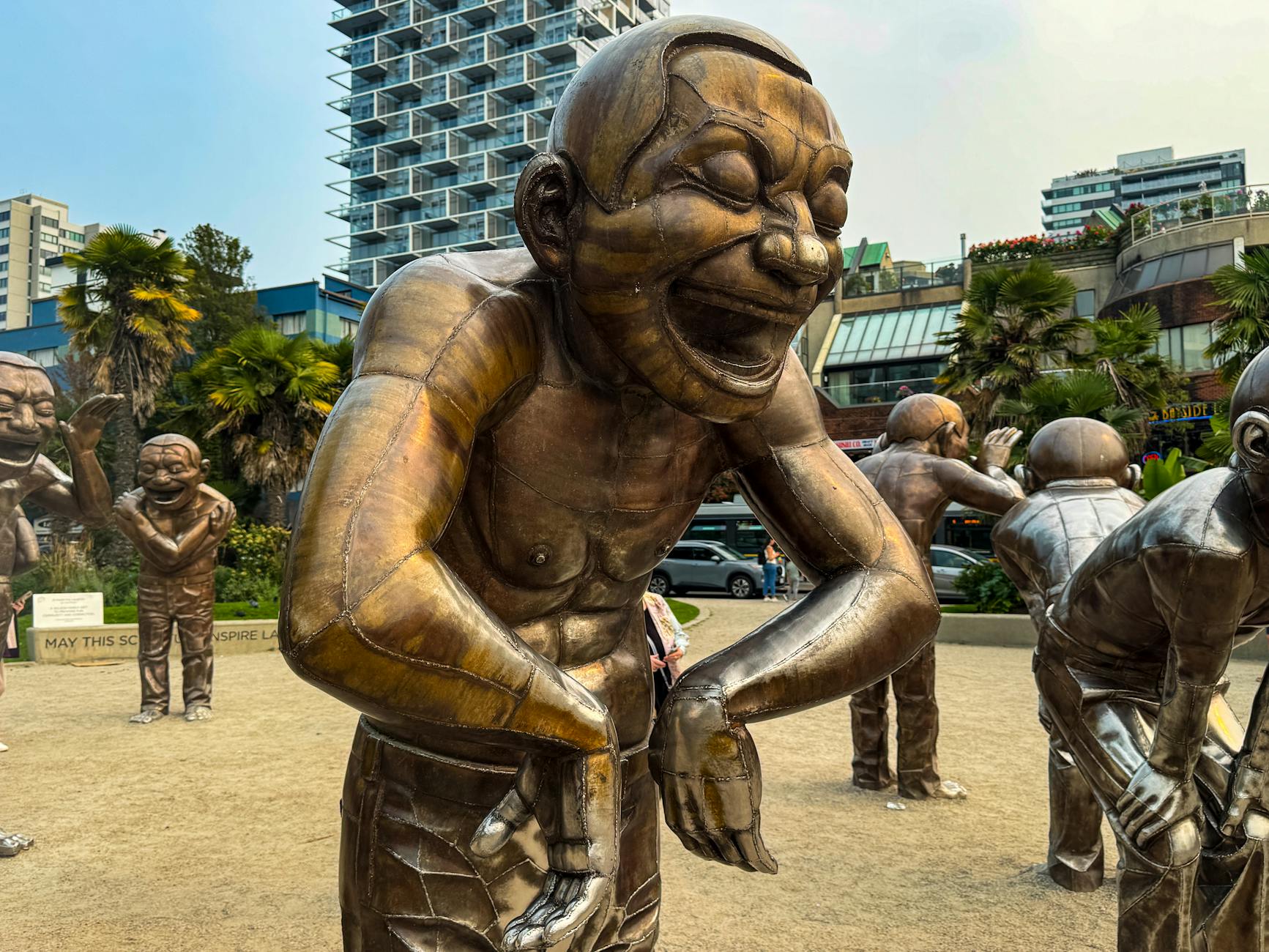
Fourteen oversized bronze figures, each about three metres tall and weighing over 250 kilograms, doubled over in what looks like uncontrollable laughter. It stands in Morton Park at Davie and Denman, a few steps from English Bay beach, and it is the most photographed artwork in the city.
The artist is Yue Minjun, a leading figure in Chinese contemporary art, and the laughing face is his own — a self-portrait he has repeated across decades of work. The laughter is deliberately ambiguous. In the context of Yue’s broader practice it reads less as joy than as a fixed, slightly desperate grin, a coping response to circumstances you cannot change. Visitors photograph it as pure delight, which is arguably part of the joke.
- Artist: Yue Minjun
- Installed: 2009, as a Vancouver Biennale work
- Location: Morton Park, Davie and Denman, English Bay
- Made permanent: purchased and donated to the city so it could stay
- Best time: sunset, with the light coming off the water behind it
It was originally a temporary Biennale installation. Public affection for it was strong enough that it was bought and gifted to the city rather than removed — which is why it is still there when most Biennale pieces are not.
Digital Orca
A breaching killer whale rendered in black and white cubes, as though a low-resolution 3D model had been extruded into the physical world. It stands at Jack Poole Plaza beside the Convention Centre, with the harbour and North Shore mountains behind it.
Douglas Coupland — the Vancouver novelist who gave the language “Generation X” — is also a working visual artist, and the piece does exactly what his writing does: takes a regional cliché and runs it through a digital filter. The orca is the standard emblem of coastal British Columbia, and pixelating it makes a quiet point about a city that reinvented itself around software and screens.
- Artist: Douglas Coupland
- Installed: 2010, for the Winter Olympics
- Location: Jack Poole Plaza, beside the Vancouver Convention Centre
- Best angle: low and from the west, so the cubes silhouette against the mountains
It sits roughly 100 metres from the Olympic Cauldron, so the two are effectively one stop.
The Drop
A 65-foot blue water droplet, caught at the instant before impact, leaning over the plaza outside the Vancouver Convention Centre West building. Close up it is genuinely disorienting — the form reads as liquid and soft even though it is a rigid painted steel and polystyrene structure.
- Artists: Inges Idee, the Berlin-based collective
- Installed: 2009
- Location: outside the Convention Centre West, on the waterfront
- Height: about 65 feet
In a city defined by rain and by the sea, a monumental water droplet is about as on-the-nose as public art gets, and it works anyway. Shoot it from below to exaggerate the lean.
Olympic Cauldron
The cauldron lit for the 2010 Winter Olympics still stands at Jack Poole Plaza — four angled glass-and-steel arms converging on a central column, designed to look like ice crystals rising out of the ground.
It is normally unlit, which surprises people expecting flame. It is fired for major occasions: Canada Day, significant sporting events, civic celebrations and commemorations. The plaza around it is named for Jack Poole, who led Vancouver’s Olympic bid and died the day before the torch relay began.
- Installed: 2010, for the Winter Olympics
- Location: Jack Poole Plaza, Convention Centre
- Lit: only for special occasions — check before making a special trip
- Adjacent: Digital Orca, the seawall, and the Convention Centre’s green roof
Engagement (English Bay)
Two enormous interlocking wedding rings standing in Sunset Beach Park near English Bay, by American artist Dennis Oppenheim. The scale is the joke — ordinary jewellery blown up until it becomes architecture you can walk through and under.
- Artist: Dennis Oppenheim
- Location: Sunset Beach Park, near the English Bay seawall
- Best shot: frame the sunset or a passing freighter inside one of the rings
It sits on the walking route between A-maze-ing Laughter and the False Creek ferry dock, so it costs you nothing to include.
Inukshuk (English Bay)
The granite Inukshuk on the English Bay seawall is one of Vancouver’s most recognisable landmarks, and it became internationally familiar when a stylised inukshuk was adopted as the emblem of the 2010 Winter Olympics.
It was carved by Alvin Kanak of Rankin Inlet for the Northwest Territories pavilion at Expo 86, and afterwards given to the City of Vancouver. An inukshuk is an Inuit stone marker — used across the Arctic for navigation, to mark caches, or to indicate a good hunting or fishing place. A figure with arms and legs like this one is properly an inunnguaq, “in the likeness of a person.”
Worth noting the geography: Inuit territory is thousands of kilometres northeast of here, and this is Coast Salish land. The Inukshuk is a gift and a landmark rather than a local Indigenous monument, which is a distinction a lot of visitors miss.
- Artist: Alvin Kanak, Rankin Inlet
- Made for: Expo 86; gifted to Vancouver afterward
- Location: English Bay seawall, near Sunset Beach
- Best time: sunset, silhouetted against the water
Coast Salish Public Art
For work by the peoples whose territory this actually is, look along the downtown waterfront and in Stanley Park.
- Susan Point’s People Amongst the People — three carved red cedar gateways at Brockton Point in Stanley Park, installed 2008; see our Stanley Park totem poles guide
- Welcome figures along the seawall and at civic entrances, in the Coast Salish tradition of greeting arrivals at the shoreline
- Coast Salish design in the streetscape — spindle whorl motifs worked into paving, railings and plaza surfaces downtown
- The Brockton Point poles themselves, mostly northern works, free and always open
Coast Salish visual language uses crescents, trigons and wedges rather than the ovoids and U-forms of northern formline. Once you have seen the difference it is hard to unsee, and it makes the downtown streetscape considerably more legible.
Olympic Village Public Art
Across False Creek, the Olympic Village area from the 2010 Games has one of the densest concentrations of public art in the city, because the development-driven art requirement applied across the whole site.
- The Birds — two enormous white sparrows by Myfanwy MacLeod, absurdly out of scale, in the plaza; the signature piece here
- Seawall installations along the False Creek south shore
- Habitat Island — a constructed island reachable on foot at low tide, as much landscape work as park
- Integrated architectural works across the housing blocks
The Birds are the reason to cross the water: house sparrows, an introduced and invasive species in North America, rendered at a scale that turns something ignorable into something faintly menacing.
Douglas Coupland Works
Coupland has more public work around Vancouver than any other single artist, and tracking it down makes a reasonable theme for a walk.
- Digital Orca — Jack Poole Plaza
- Golden Tree — a gilded cast of a cedar, in the Marine Gateway area
- Terry Fox Memorial — outside BC Place; four figures of increasing size, a design that replaced a widely disliked earlier monument
- Various commissions integrated into newer developments across the city
The Terry Fox Memorial is the one to see if you only see one. Fox’s Marathon of Hope remains the most emotionally loaded piece of modern Canadian history, and Coupland’s solution — the same running figure four times, each larger than the last — handles it without sentimentality.
Trans Am Totem: Currently Removed
Do not go looking for this one. Trans Am Totem — Marcus Bowcott’s stack of five scrap cars impaled on an old-growth cedar trunk — stood near Quebec Street by Science World from 2015, and it is one of the works most frequently listed in Vancouver guides. It was dismantled and removed in 2021.
The reasons were practical: weather damage, extensive damage from birds, and redevelopment of the northeast False Creek site. The City committed to refurbishing and relocating it to a permanent home, but as of 2026 the new location has still not been settled. The artist has said he would like it on Great Northern Way, near Emily Carr University; the decision rests with the City.
The work itself was a good joke with a sharp edge — cars stacked in the form of a totem pole, on a cedar trunk of the kind logged out of this coast, sited beside a highway interchange. If it returns, it is worth seeking out. Until then, the site is empty.
The Vancouver Biennale Explained
A lot of Vancouver’s best-known outdoor sculpture arrived through the Vancouver Biennale, an open-air exhibition that has been placing international works around the city and region since 1998. It explains both the quality and the impermanence.
- Works are installed on multi-year loans rather than permanently
- Some are purchased and made permanent when they prove popular — A-maze-ing Laughter is the definitive case
- Others are removed at the end of their term and returned or sent elsewhere
- Locations span downtown, False Creek, Kitsilano and beyond the city
Practical implication: check a current source before planning a walk around a specific piece. The City of Vancouver’s Public Art Registry is searchable and authoritative, and it is the only list that reliably reflects what is actually standing.
UBC Public Art
The UBC campus at Point Grey holds a substantial outdoor collection, worth combining with a Museum of Anthropology visit.
- MOA’s outdoor poles and Haida house frames — carved by Bill Reid and Doug Cranmer; free, outdoors, on the bluff
- Coast Salish works across the campus, reflecting UBC’s location on Musqueam territory
- Modernist and contemporary sculpture distributed through the campus grounds
- Rose Garden viewpoint — not art, but the best free view on campus
Self-Guided Walking Tour
About 5 km, 2–3 hours with photo stops. Runs west to east and finishes near transit.
- 1. A-maze-ing Laughter, Morton Park, Davie and Denman — 15 min
- 2. English Bay Inukshuk, along the seawall east — 10 min
- 3. Engagement, Sunset Beach Park — 10 min
- 4. Seawall walk around Coal Harbour toward the Convention Centre — 30 min
- 5. The Drop, Convention Centre West plaza — 10 min
- 6. Digital Orca, Jack Poole Plaza — 10 min
- 7. Olympic Cauldron, same plaza — 10 min
- 8. Coast Salish works along the downtown waterfront — 15 min
- Optional extension: False Creek ferry to Olympic Village for The Birds — add 60–90 min
- Optional extension: Terry Fox Memorial at BC Place — add 20 min
Reverse it for sunset. Walking east to west puts you at English Bay for golden hour, which is when A-maze-ing Laughter and the Inukshuk both look their best. Our walking in Vancouver guide covers the seawall route in more detail, and free walking tours exist if you would rather be guided.
Photography Tips
- Golden hour at English Bay — the western exposure is the best light in the city
- Shoot The Drop from below to exaggerate the lean
- Get low for Digital Orca so the cubes read against the mountains rather than the buildings
- Frame through Engagement‘s rings — a freighter or the sunset inside the ring is the shot
- Arrive early at A-maze-ing Laughter; by midday you are queuing for a clean frame
- Overcast is fine — flat light suits the bronze and the pixelated forms better than harsh sun
- Don’t climb on the works, however much the bronze figures invite it
- Credit artists when you post — they are named on the City’s registry
Related Vancouver guides
Keep planning with these guides:
- Free Things to Do in Vancouver (2026)
- Walking in Vancouver: Seawall & City Routes (2026)
- Stanley Park Totem Poles Guide (2026)
Vancouver Public Art FAQs
Is Vancouver’s public art free to see?
Yes — all of it. The works are outdoors in public space, accessible at any hour, with no tickets or opening times. A self-guided downtown loop of about 5 km takes two to three hours.
Where is A-maze-ing Laughter?
In Morton Park at Davie and Denman, beside English Bay in the West End. Fourteen bronze figures by Chinese artist Yue Minjun, each about three metres tall, installed in 2009 as a Vancouver Biennale work and later purchased so it could stay permanently.
Where is the Trans Am Totem now?
Nowhere you can visit. Marcus Bowcott’s stack of five cars on a cedar trunk was dismantled and removed in 2021 because of weather and bird damage and site redevelopment. The City intends to refurbish and relocate it, but as of 2026 no permanent new location has been confirmed.
Who made Digital Orca?
Douglas Coupland, the Vancouver novelist and visual artist. It was installed at Jack Poole Plaza in 2010 for the Winter Olympics, and renders the orca — the standard emblem of coastal BC — as a low-resolution pixelated form.
Is the Olympic Cauldron lit?
Only for special occasions — Canada Day, major sporting events and civic commemorations. Most of the time it stands unlit at Jack Poole Plaza. Check before making a special trip to see it burning.
Who carved the English Bay Inukshuk?
Alvin Kanak of Rankin Inlet, for the Northwest Territories pavilion at Expo 86, after which it was given to the City of Vancouver. A figure with arms and legs like this is properly an inunnguaq, “in the likeness of a person.”
What is the Vancouver Biennale?
An open-air exhibition that has placed international sculpture around Vancouver since 1998, usually on multi-year loans. Some works are bought and kept — A-maze-ing Laughter is the best-known case — while others are removed when their term ends, which is why published lists go out of date.
How do I find out what public art is currently installed?
The City of Vancouver’s Public Art Registry is the authoritative source, searchable by artist and location, and it reflects what is actually standing rather than what used to be.
What’s the best public art walk in Vancouver?
Start at A-maze-ing Laughter at English Bay, follow the seawall past the Inukshuk and Engagement, continue around Coal Harbour to The Drop, Digital Orca and the Olympic Cauldron at the Convention Centre. About 5 km and two to three hours. Walk it east to west instead if you want to finish at English Bay for sunset.
Where can I see Coast Salish public art in Vancouver?
Susan Point’s People Amongst the People gateways at Brockton Point in Stanley Park, welcome figures along the seawall, and Coast Salish spindle whorl motifs worked into paving and railings downtown. These are by the peoples whose territory Vancouver occupies, unlike the English Bay Inukshuk, which is an Inuit form from thousands of kilometres away.
Where are The Birds sculptures?
In the Olympic Village plaza on the south shore of False Creek — two enormous white house sparrows by Myfanwy MacLeod. Reachable on foot along the seawall or by False Creek ferry from downtown.
Related reading: Pair this with our Vancouver culture and history pillar and our guide to free things to do in Vancouver. During Pride, the West End route passes through the heart of the festivities.