The Vancouver currency is the Canadian dollar, written C$ or CAD, and on September 25, 2026 the Bank of Canada’s rate was C$1.4145 to the US dollar, so one Canadian dollar was worth about 71 US cents. You’ll barely need to touch it in cash: cards and phone payments work almost everywhere, from buses to food trucks, and some of the city’s biggest venues don’t take cash at all. The two things that catch visitors out are both about the bill rather than the money: shelf prices don’t include sales tax, and card machines will offer to charge you in your home currency at a worse rate.
This guide is for visitors working out whether to change money, which cards to bring and what the numbers on a receipt mean. The caveat that matters most: the fees on your own card, set by your bank at home, usually cost more than anything you’ll pay in Vancouver, so check them before you fly. Everything here was checked September 26, 2026 against the Bank of Canada, the Financial Consumer Agency of Canada, the Province of British Columbia and the operators named. For the rest of the trip planning, see our Vancouver travel tips.
Money in Vancouver at a glance
| Question | Short answer |
|---|---|
| Currency | Canadian dollar (C$, CAD) |
| Exchange rate, September 25, 2026 | US$1 = C$1.4145 |
| Cards | Visa and Mastercard almost everywhere; tap and phone payments standard |
| Cash | Rarely needed; a small float of C$5, C$10 and C$20 notes covers the exceptions |
| Sales tax | Added at the till: 12% on most things, 5% on restaurant food, 15% on alcohol |
| ATMs | Bank machines are the better bet; operator fees must show on screen |
| US dollars | Sometimes accepted, at a poor rate; pay in Canadian dollars |
| Tipping | Customary at table service; the amount is up to you |
What currency does Vancouver use?
Vancouver uses the Canadian dollar, like the rest of Canada. Prices are shown with a plain dollar sign, and you’ll see “CAD” or “C$” only where there’s a chance of confusion, such as on tour operators’ websites aimed at Americans. There’s no separate British Columbia money, and US dollars aren’t legal currency here, even if some shops take them.
Notes and coins
Bank of Canada notes come in C$5, C$10, C$20, C$50 and C$100 denominations. Most day-to-day cash comes as C$20 notes from ATMs. Many small businesses are wary of C$100 notes, so break big notes at a bank or a larger shop rather than a coffee counter.
Coins include the C$1 loonie and the C$2 toonie, which replaced the C$2 bill in 1996. Loonies and toonies do the jobs dollar bills do in the US, so a pocket of coins can add up to a surprising amount.
Why your cash total gets rounded
Canada stopped distributing pennies on February 4, 2013, so when you pay cash, the total is rounded to the nearest five cents: amounts ending in 1, 2, 6 or 7 cents round down, and those ending in 3, 4, 8 or 9 round up. Pay by card and you’re charged to the exact cent. It’s the reason a C$4.98 coffee costs C$5.00 in cash and C$4.98 on a card, and nobody will mind either way.
What’s the exchange rate, and where should you change money?
The Bank of Canada publishes indicative rates every business day by 4:30 p.m. Eastern time. On September 25, 2026 they looked like this, with a C$100 dinner converted for scale:
| Your currency | Bank of Canada rate | C$1 is worth about | A C$100 bill is about |
|---|---|---|---|
| US dollar | US$1 = C$1.4145 | US$0.71 | US$70.70 |
Rates move daily, so treat the US dollar figure as a guide rather than a quote, and check the Bank of Canada’s published daily rates for other currencies. The rate you actually get will be worse than the Bank of Canada’s by whatever margin your bank, card or exchange desk takes.
That margin is where the real money goes. Airport exchange counters are convenient and the most expensive way to change money; downtown exchange offices do better, and banks usually change cash only for their own customers. For most visitors, the cheapest route is simply paying by card and taking cash from a bank ATM, provided your card has low foreign transaction fees. If you like arriving with some local cash, order a small amount from your bank at home a week or two before you leave.
Do you need cash in Vancouver?
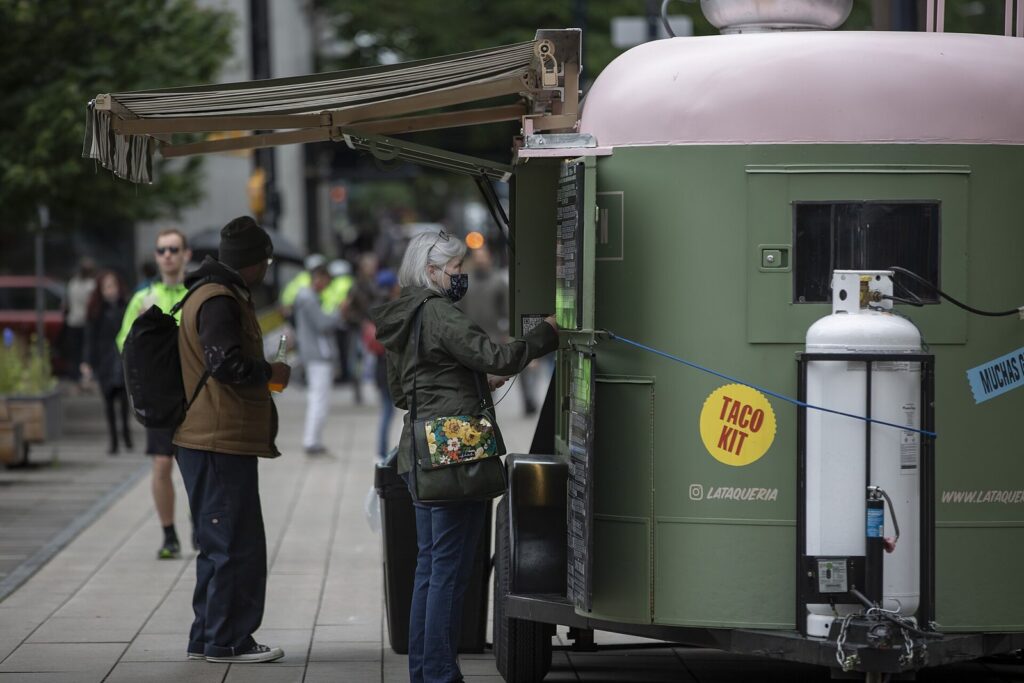
Hardly. Contactless cards and phone wallets are the norm in shops, restaurants, taxis and markets, and you can tap a credit card or phone at the fare gates to pay for buses, SkyTrain and the SeaBus. Some big venues have gone fully cashless: BC Place and Rogers Arena take cards only, and BC Place runs a kiosk that turns cash into a prepaid voucher for its food stands.
Cash still earns its place in a few spots: housekeeping tips, the odd market stall or food cart, coat checks, busking musicians and tip jars. C$50 to C$100 in smaller notes and coins covers a typical week. Our guide to tipping in Vancouver explains who to tip and how much, cash or card.
Which cards work in Vancouver?
Visa and Mastercard are accepted almost everywhere. American Express is widely taken at hotels, bigger restaurants and chains but less so at small independent shops, so don’t make it your only card. Canada’s own debit network, Interac, is what locals use, and foreign debit cards run on their Visa or Mastercard debit networks instead, which works fine at most terminals. Apple Pay, Google Pay and Samsung Pay are widely accepted, including on transit.
Canada uses chip-and-PIN, so know your card’s PIN before you travel; a tap covers most everyday purchases, but larger amounts can prompt you to insert the card. Bring two cards from different networks, kept in different places, so a blocked card or a lost wallet doesn’t end the trip.
Always choose Canadian dollars at the terminal
Card machines and ATMs will often offer to charge you in your home currency, showing a converted total that looks reassuringly familiar. It’s called dynamic currency conversion. Choose Canadian dollars every time and let your own card network do the conversion. The same goes for hotel bills and car rentals at checkout.
Watch your card’s foreign transaction fee
Many cards add a percentage to every purchase made in another currency, and on a week of hotels, meals and tours it adds up faster than any ATM fee. Travel cards and some digital banks waive it. If yours doesn’t, it’s worth getting one before the trip rather than paying the surcharge on every coffee.
How do ATMs work, and what do they cost?
ATMs are everywhere downtown, in bank branches, malls and convenience stores, and some locals still call them ABMs. The operator can charge a non-customer a convenience fee, but under federal rules it must appear on screen before you finish, with the option to cancel at no cost. Your home bank may then add its own withdrawal and conversion fees on top.
Stick to bank-owned machines where you can. The no-name white-label ATMs in convenience stores, bars and hotel lobbies are independently owned, and their fees tend to be higher. Take out larger amounts less often to spread the fixed fees, decline any offer to convert the withdrawal into your home currency, and ask your bank at home whether it has a partner bank in Canada that waives fees for its customers.
How does sales tax work in BC?
Most goods and services carry 12%: the 5% federal Goods and Services Tax (GST) plus BC’s 7% Provincial Sales Tax (PST). A C$50 hoodie costs C$56 at the counter.
Food and drink work differently. Restaurant meals are exempt from PST, so a restaurant bill carries only the 5% GST on food. Alcohol carries 10% PST plus GST, and sweetened fizzy soft drinks carry 7% PST. Hotel rooms carry the most: Destination Vancouver’s breakdown, dated February 2023, adds up to about 20% on the room rate once GST, PST, the municipal and regional district tax, a major-events levy and a destination marketing fee are counted.
There’s no general sales-tax refund for visitors. Destination Vancouver’s tax guide lists a GST rebate only for qualifying foreign conventions, not for individual travellers, so keep receipts for your own records rather than for a claim at the airport.
Can you pay with US dollars in Vancouver?
Sometimes, but it’s rarely a good idea. Some businesses near the cruise terminal and in tourist areas take US cash at a rate they set themselves, usually well below the Bank of Canada’s, and they’ll give change in Canadian dollars. Many others won’t take it at all. For Americans, a card with no foreign transaction fee, charged in Canadian dollars, is almost always cheaper. If you arrive with US cash, change it once at a decent rate rather than a few dollars at a time.
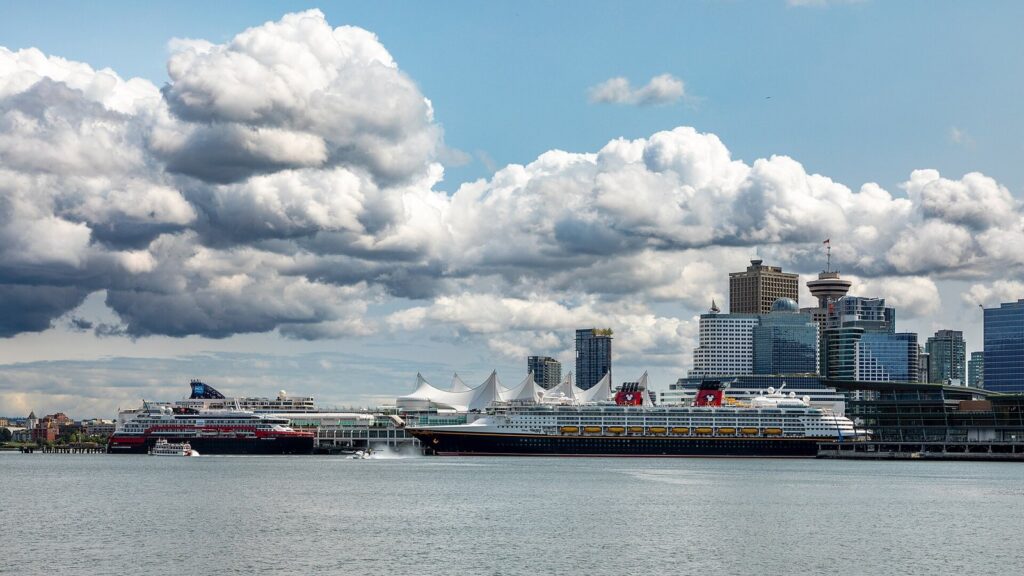
Cruise passengers with a single day in port are the clearest case for not changing money at all: tap a card for transit and lunch and you’ll leave with nothing to change back.
Are travel cards and traveller’s cheques worth it?
Traveller’s cheques aren’t: few Vancouver businesses accept them now, and cashing them means finding a bank willing to do it. Prepaid and multi-currency travel cards are a different story. Several digital banks and travel-money companies let you load Canadian dollars in advance, often at close to the wholesale rate, and then spend on a card that behaves like any other Visa or Mastercard. They’re a good fix if your everyday card charges heavy foreign transaction fees, and they limit the damage if the card is lost or skimmed, since only the loaded balance is at risk.
Read the small print before you commit. Some charge for ATM withdrawals above a monthly allowance, some add a markup at weekends when currency markets are closed, and some hotels and car rental desks won’t accept prepaid cards for a security deposit. Keep a regular credit card for those, and use the travel card for everyday spending.
How much money do you need per day?
That depends far more on your hotel than on anything else. Hotel prices swing hard by season, so when to book a Vancouver trip matters more than which card you pack. For the rest, a few fixed numbers help: a one-zone transit fare is C$3.50 by tap, an adult DayPass covering all zones is C$12.55, and the Canada Line from the airport adds a C$6.50 AddFare. Our breakdown of Vancouver trip cost builds daily budgets from those numbers, and our guide to saving money on Vancouver transit shows where the fare rules work in your favour.
How do you keep your money safe?
Card fraud and skimming are uncommon, but the usual precautions apply. Cover the keypad when you enter a PIN, use ATMs inside banks or busy malls, and keep a backup card somewhere other than your wallet. Lock your phone wallet with a PIN or biometrics, since your phone is now also your purse. Pickpocketing isn’t widespread, but crowded SkyTrain cars and fireworks nights help it along, and phones left on patio tables are the easiest target of all. Our guide to staying safe in Vancouver covers the rest.
Money is one of the easier parts of a Vancouver trip once the three habits are in place: pay in Canadian dollars, use a low-fee card, and read the tax line before you tip. For everything else to sort before you go, see our complete Vancouver planning guide.
Vancouver currency FAQ
What currency is used in Vancouver?
Vancouver uses the Canadian dollar (C$, CAD), the same as the rest of Canada. Notes come in C$5, C$10, C$20, C$50 and C$100, and the coins include the C$1 loonie and C$2 toonie. On September 25, 2026, the Bank of Canada rate was US$1 to C$1.4145, but rates change daily.
Do I need cash in Vancouver?
Very little. Cards and phone payments work almost everywhere, including buses, SkyTrain and taxis, and BC Place and Rogers Arena are cashless. Keep C$50 to C$100 in small notes and coins for housekeeping tips, the odd market stall, coat checks and tip jars, and top up from a bank ATM if you run low.
Can I use US dollars in Vancouver?
Some businesses, mainly in tourist areas and near the cruise terminal, accept US cash, but at their own exchange rate, which is usually poor, and change comes back in Canadian dollars. Many businesses don’t accept US dollars at all. Paying by card in Canadian dollars, with a card that doesn’t charge foreign transaction fees, is almost always cheaper.
What is the sales tax in Vancouver?
Most goods and services carry 12%: the 5% federal GST plus BC’s 7% PST. Restaurant food carries only the 5% GST, alcohol carries 10% PST plus GST, and hotel rooms add up to about 20% in taxes and fees. Individual visitors can’t claim a sales-tax refund.
Are ATM fees high in Canada?
They vary. Bank ATMs charge non-customers a convenience fee that must be shown on screen, with an option to cancel, before you complete the withdrawal, and independent white-label machines in bars and convenience stores tend to charge more. Your home bank may add its own fees, so withdraw larger amounts less often and decline any currency conversion offer.
Should I pay in my home currency or Canadian dollars?
Always Canadian dollars. When a terminal or ATM offers to charge you in your home currency, decline and choose Canadian dollars so your own card network does the conversion. The same applies at hotel checkout and when returning a rental car.
Related Vancouver guides
- Vancouver trip planning essentials: transit, weather, safety and the rest of the groundwork
- Tipping in Vancouver: who to tip, how much and how the tax works
- Vancouver trip cost: daily budgets from shoestring to splurge
- Save money on Vancouver transportation: fares, passes and free rides
- Is Vancouver safe?: an honest guide to the city’s risks
Sources and verification
Checked on September 26, 2026 against the organizations listed below. Exchange rates are the Bank of Canada’s indicative rates for September 25, 2026 and change every business day.
- Bank of Canada: daily exchange rates, bank notes
- Royal Canadian Mint: the C$2 coin, the C$1 coin
- Government of Canada: the end of the penny; Financial Consumer Agency of Canada, ATM fees
- Province of British Columbia: PST on food, beverages and liquor
- Destination Vancouver: Vancouver’s tax structure
- TransLink: fares and payment; BC Place: cashless payments; Rogers Arena: FAQ; Vancouver Art Gallery: visit
Photo credits
- Taco food truck, Vancouver: photo by GoToVan from Vancouver, Canada, Wikimedia Commons (CC BY 2.0)
- Pacific Centre entrance, 2010: photo by Joe Mabel, Wikimedia Commons (CC BY-SA 3.0)
- Robson Street shop window, 2018: photo by GoToVan from Vancouver, Canada, Wikimedia Commons (CC BY 2.0)
- Cruise ships at Canada Place: photo by Dietmar Rabich, Wikimedia Commons (CC BY-SA 4.0)
- Vancouver farmers market berries (featured image): photo by DanDavidCook, Wikimedia Commons (CC BY-SA 4.0)