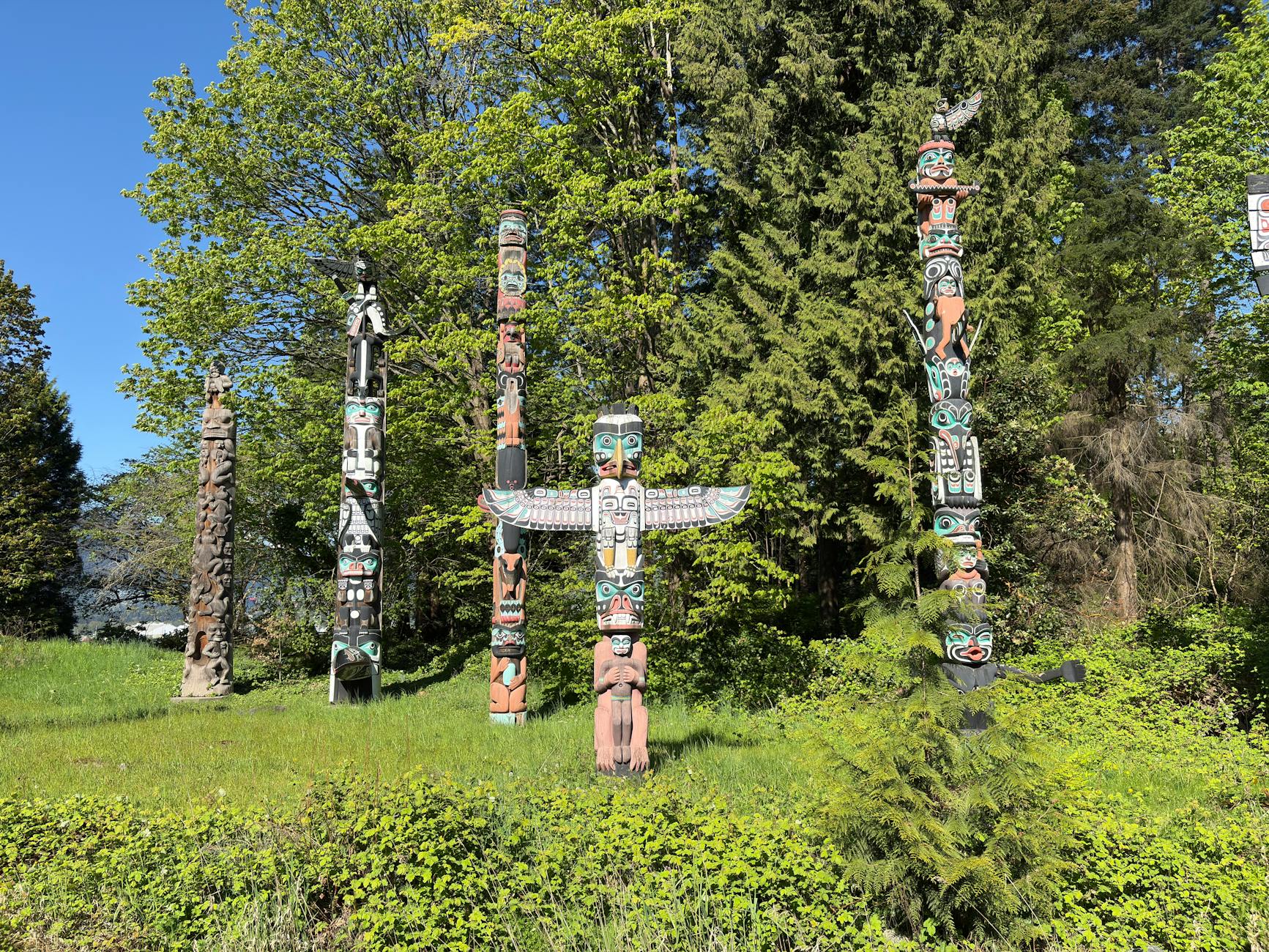
Stanley Park totem poles are British Columbia’s most-visited tourist attraction — a free outdoor display of nine carved poles at Brockton Point representing Kwakwaka’wakw, Haida, Nisga’a, Kitasoo and Squamish peoples. Alongside them stand Susan Point’s three Coast Salish welcome gateways, People Amongst the People, installed in 2008. The display is genuinely worth seeing, and it carries a complicated history: most of the poles are northern works standing on Coast Salish land, assembled from the 1920s as a tourist attraction during the same decades that Indigenous residents were being evicted from the park.
This guide identifies each pole and its carver, explains what the figures actually mean, and provides the context that turns a photo stop into something worth understanding.
Table of Contents
Stanley Park Totem Poles Quick Overview
- Location: Brockton Point, Stanley Park — on the eastern side of the park
- Cost: free, always open
- How many: nine poles, plus three Coast Salish welcome gateways
- Time needed: 20–30 minutes to read them properly
- Getting there: 15-minute seawall walk from Coal Harbour, or the park shuttle
- Nations represented: Kwakwaka’wakw, Haida, Nisga’a, Kitasoo and Squamish
- Nearby: Brockton Point Lighthouse, the Nine O’Clock Gun, the seawall
- Best light: morning, with the poles lit from the east and the North Shore mountains behind
Go early. This is the single busiest attraction in the province, and tour coaches begin arriving mid-morning. Before 9 AM you will often have the site to yourself; by noon in July you will be queuing for a clear photograph.
Important Context
Two things are true at once here, and holding both makes the visit far more interesting.
The poles are magnificent, and they were assembled as a tourist attraction. Beginning in the 1920s, the Park Board acquired poles from northern coastal villages — Haida, Kwakwaka’wakw, Nisga’a — and set them up here as an “Indian village” display. They were bought and shipped from communities hundreds of kilometres away, some at moments of severe economic pressure, and installed without the involvement of the Coast Salish peoples on whose territory the park sits.
During the same decades, Indigenous families were being removed from the park. There were settlements within Stanley Park’s boundaries, including at Brockton Point itself and at X̄wáȳx̄way near Lumbermen’s Arch. Residents were pushed out through the early twentieth century, with the final legal evictions running into the 1930s. The last resident of the Brockton Point community, Rose Cole Yelton, lived in the park until 1935 and died in 2002.
So a display of Indigenous art was being built up on one side of the park while an Indigenous community was being cleared from the other. The memorial pole raised in 2009 stands in front of the very house site the Cole family occupied.
None of this is a reason not to visit. It is a reason to read the signage, notice which Nations are represented and which are not, and understand what you are looking at.
Location & Access
Brockton Point is on the eastern edge of Stanley Park, facing Burrard Inlet and the North Shore.
- On foot: about 15 minutes along the seawall from Coal Harbour, or 25–30 minutes from the West End
- By bike: the seawall runs counter-clockwise one-way — the poles are an easy early stop from the Coal Harbour end
- By car: paid parking at Brockton Point; the lot fills on summer weekends
- By bus: the 19 runs into the park from downtown
- Park shuttle: stops at Brockton Point during its operating season
- Accessibility: the site is flat, paved and fully wheelchair accessible
There is a visitor centre with washrooms and a gift shop beside the display, and the Brockton Point Lighthouse is a two-minute walk further on.
The Nine Totem Poles
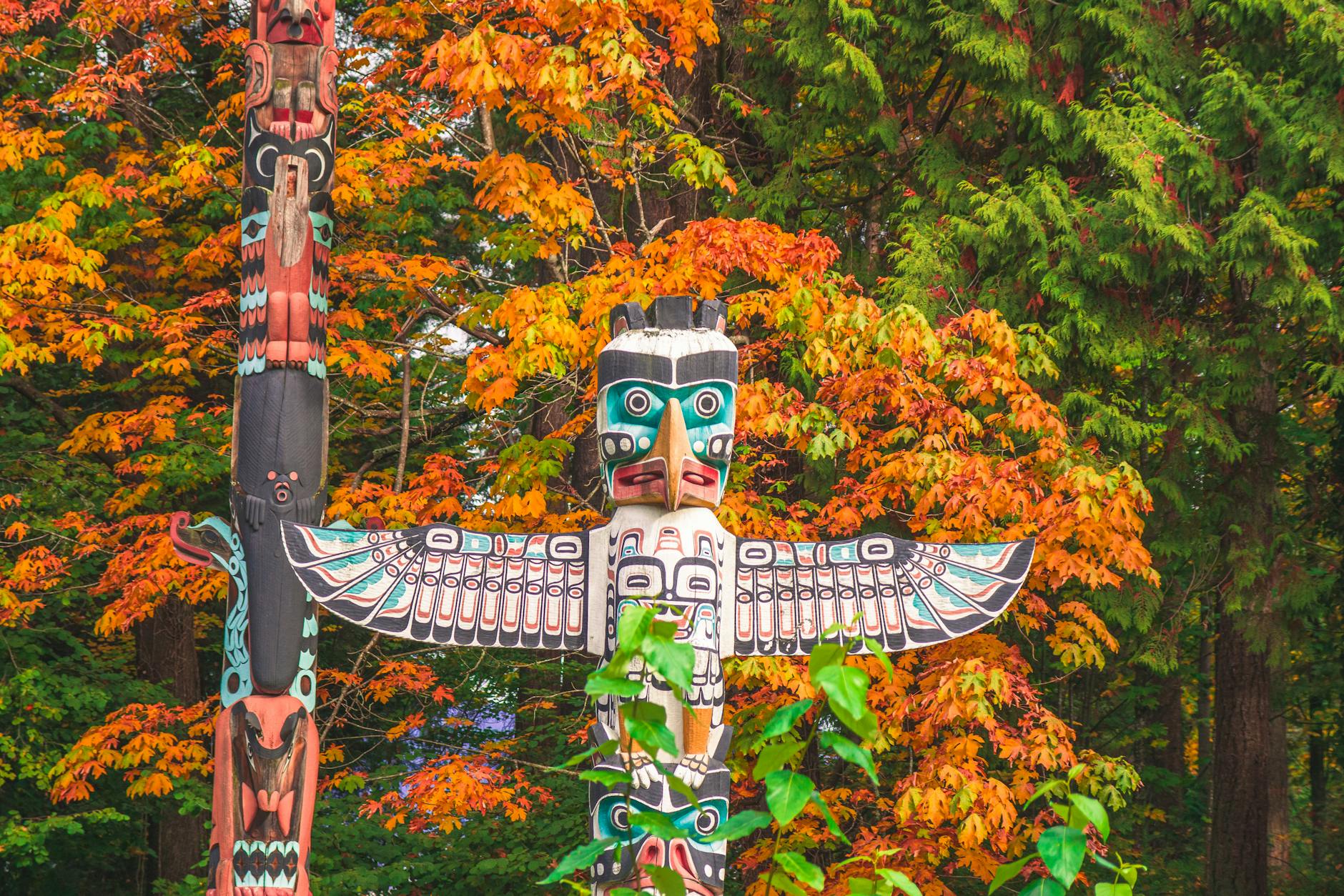
Read them from the signage as you go — each has an interpretive panel. The nine:
- Kakaso’las — carved by Ellen Neel, Kwakwaka’wakw, in 1955. Neel was the first woman known to have carved totem poles professionally, and a grand-niece of the great carver Mungo Martin. The pole carries her own family crests.
- Chief Wakas Pole — Kwakwaka’wakw, from Alert Bay. Its base was originally a doorway, with the Raven’s beak forming the entrance to a house.
- Chief Skedans Mortuary Pole — Haida, from the village of Skedans on Haida Gwaii. A mortuary pole held the remains of a high-ranking person in a box at the top; the broad frontal board is the giveaway.
- Thunderbird House Post — Kwakwaka’wakw. House posts were structural, holding up the roof beams of a big house rather than standing free.
- Ga’akstalas — Kwakwaka’wakw, depicting figures from oral history.
- Beaver Crest Pole — Nisga’a, from the Nass River, carved in the northern style.
- Sky Chief Pole — Kitasoo, from the central coast.
- Oscar Maltipi Pole — Kwakwaka’wakw, displaying ancestral lineage figures.
- Rose Cole Yelton Memorial Pole — Squamish, carved by Robert Yelton, Rose’s son, and raised in 2009. The only pole here made by and for the people whose territory this is, and it stands in front of the site of the family home they occupied until 1935.
If you look at one closely, make it the Rose Cole Yelton pole. It is the newest, the most local, and the one that answers the display’s own history.
Susan Point’s Welcome Gateways
Standing near the poles are three carved red cedar gateways by Musqueam artist Susan Point, titled People Amongst the People. They took three years to make and were installed in 2008, developed with Coast Salish Arts, the Musqueam, Squamish and Tsleil-Waututh Nations, and the Vancouver Park Board.
They are not totem poles, and that is the point. The form is Coast Salish — the traditional slant-roof house profile, with welcome figures standing in the doorways — and the visual language is distinct from the northern formline of the poles beside them. Coast Salish design uses crescents, trigons and wedges rather than the ovoids and U-forms of Haida and Kwakwaka’wakw work.
After eighty years of a display dominated by northern art, the gateways put Coast Salish work on Coast Salish land, at the entrance, in the role of host. Walk through one and then look back at the poles; the difference in visual grammar becomes obvious.
Totem Pole Symbolism
A pole is a legal and genealogical document as much as an artwork. The figures are crests — inherited rights to display a particular being, held by a family or lineage and validated publicly at a potlatch. You cannot simply choose to put a Thunderbird on your pole; you must have the right to it.
- Raven — trickster and transformer; brought light into the world in many coastal traditions
- Eagle — a major clan crest across the northern coast
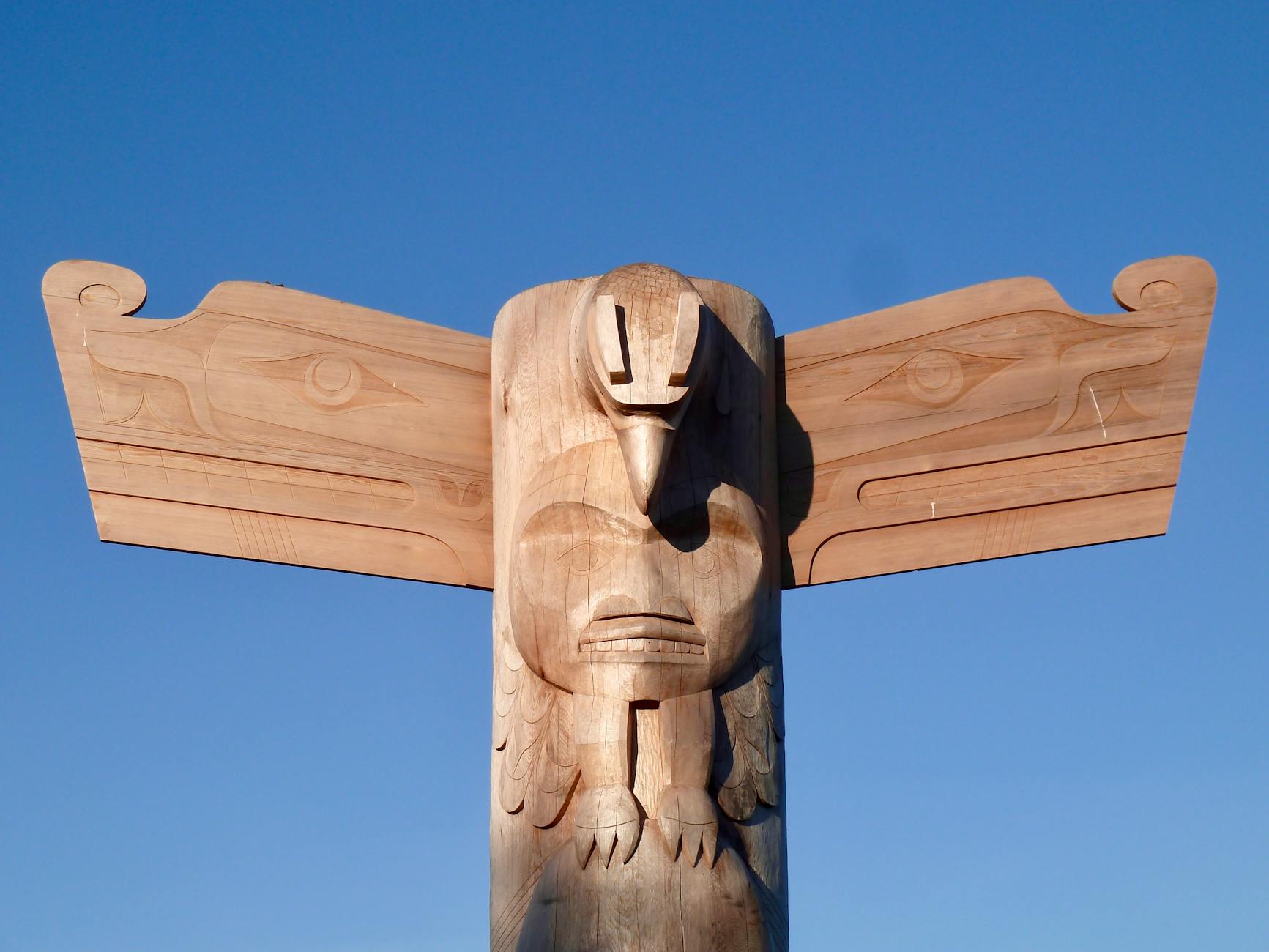
- Thunderbird — supernatural being whose wingbeats make thunder; hunts whales
- Bear — strength, and a common lineage crest
- Killer whale — identified by the dorsal fin and blowhole
- Beaver — large incisors and a crosshatched tail
- Frog — wide mouth, no tail; often a transitional figure between worlds
- Human and ancestor figures — specific named individuals, not generic people
The bottom is not the least important. The phrase “low man on the totem pole” reverses the actual convention: the base is the most visible position and frequently carries the primary crest. It is also the best-carved, since it sits at eye level.
Pole types differ. Memorial poles honour a deceased leader, mortuary poles held remains, house posts were structural, and welcome poles greeted arrivals at the beach. The display here mixes several types.
Cultures Represented
Notice the imbalance, because it tells you how the display was assembled.
- Kwakwaka’wakw — northern Vancouver Island and adjacent mainland; the largest group here
- Haida — Haida Gwaii, roughly 800 km northwest
- Nisga’a — the Nass River valley in the far north of the province
- Kitasoo — the central coast
- Squamish — local, and represented by a single pole raised in 2009
Monumental pole carving was principally a northern coastal tradition. Coast Salish peoples, whose territory this is, built house posts and welcome figures rather than the tall free-standing poles that became the tourist image of “West Coast Native art.” The display reflects what the Park Board wanted visitors to see in the 1920s rather than what stood on this ground.
Display History
- 1888: Stanley Park is established on land with existing Indigenous settlements
- 1920s: the Park Board begins acquiring poles from northern villages for an “Indian village” attraction, originally intended for Lumbermen’s Arch
- 1930s: the last legal evictions of Indigenous residents from the park are completed — Rose Cole Yelton’s family leaves Brockton Point in 1935
- 1960s: the poles are relocated to Brockton Point, where they stand today
- 1980s onward: deteriorating originals move to museum collections, with replicas commissioned from master carvers
- 2008: Susan Point’s People Amongst the People gateways are installed
- 2009: the Rose Cole Yelton Memorial Pole is raised by her son, Robert Yelton
The arc is worth noticing: a display created without Coast Salish involvement has, over the last two decades, been reframed by Coast Salish artists on their own terms.
Originals, Replicas & Repatriation
Several poles at Brockton Point are replicas, and this is not a disappointment — it is how the tradition works.
Cedar left outdoors in a coastal rainforest decays. In many coastal traditions that was expected and accepted: a pole was raised, it stood, it weathered, and eventually it returned to the ground. The idea that a pole must be preserved indefinitely is a museum idea, not an Indigenous one.
By the mid-1980s the originals here were deteriorating badly. Several moved into museum collections for conservation, and exact replicas were commissioned from master carvers — often from the same communities and sometimes the same families as the originals. A replica carved by a living Kwakwaka’wakw carver is a continuation of the tradition, not a copy of a dead one.
Separately, the repatriation movement from the 1980s onward has returned some poles and belongings to the communities they came from. Several originals once destined for or held in Vancouver have gone home.
Photography Etiquette
The poles themselves are public art in a public park and photographing them is entirely fine. A few courtesies:
- Don’t climb on or touch the poles or the gateways
- Don’t pose imitating the figures, or wear costume headdresses for photos
- Ask before photographing Indigenous people at the site, including carvers and guides
- Credit the artists if you post — the carvers are named on the panels
- Step back for others — it is a busy site and everyone wants the same frame
Best shots: early morning for light from the east and empty foreground; the North Shore mountains sit behind the poles from the southern approach; and the gateways frame the poles nicely if you shoot through one.
Indigenous-Led Tours
The interpretive panels are good, but a guide from one of the local Nations changes the visit completely — particularly on the questions the signage cannot easily answer, like why the display looks the way it does and what the Coast Salish relationship to this ground actually is.
Talaysay Tours runs Talking Totems, an art-focused walk covering these poles, alongside its Talking Trees ethnobotany walk and Spoken Treasures history tour, all in Stanley Park. See our Indigenous tours in Vancouver guide for operators, pricing and booking.
Other Vancouver Totems
- Museum of Anthropology, UBC — the Great Hall’s monumental poles and the outdoor Haida house frames carved by Bill Reid and Doug Cranmer; see our MOA guide
- Stanley Park Junction and the miniature train route — additional poles away from Brockton Point
- Vancouver International Airport — a major Northwest Coast collection including Bill Reid’s The Jade Canoe
- Bill Reid Gallery, downtown — the twentieth-century revival of Haida art
- Capilano Suspension Bridge Park — a substantial pole collection, though inside a paid attraction
Pair with Stanley Park Visit
Brockton Point sits naturally in a wider park loop:
- Brockton Point Lighthouse — two minutes further along the seawall
- Nine O’Clock Gun — fired nightly at 9 PM, a short walk east
- Seawall — the full 9 km loop, or the shorter Coal Harbour stretch
- Lumbermen’s Arch — the site of X̄wáȳx̄way village, worth visiting with the totem pole context in mind
- Vancouver Aquarium — 10 minutes into the park interior
Our full Stanley Park guide covers the seawall, beaches, food and itineraries.
Related Vancouver guides
Keep planning with these guides:
- Stanley Park Vancouver: The Complete 2026 Visitor’s Guide
- Indigenous Tours in Vancouver: Who to Book & Why (2026)
- Vancouver History: A Tourist’s Quick Primer (2026)
Stanley Park Totem Poles FAQs
How many totem poles are at Stanley Park?
Nine at Brockton Point, plus three Coast Salish welcome gateways by Susan Point installed in 2008. Additional poles stand at Stanley Park Junction and along the miniature train route.
Are the Stanley Park totem poles free to visit?
Yes. The display is outdoors at Brockton Point, free and open at all times. It is the most visited attraction in British Columbia.
Which First Nations are represented?
Kwakwaka’wakw, Haida, Nisga’a, Kitasoo and Squamish. Most poles are northern works brought from communities hundreds of kilometres away; only the Rose Cole Yelton Memorial Pole, raised in 2009, is by and for the local Coast Salish people whose territory the park occupies.
What is the Rose Cole Yelton Memorial Pole?
A Squamish pole carved by Robert Yelton and raised in 2009, standing in front of the site of the family home occupied until 1935. Rose Cole Yelton was the last surviving resident of the Brockton Point community and died in 2002.
Were there people living in Stanley Park?
Yes. There were Indigenous settlements within the park’s boundaries, including at Brockton Point and at X̄wáȳx̄way near Lumbermen’s Arch. Residents were removed through the early twentieth century, with the last legal evictions completed in the 1930s.
Are the Stanley Park totem poles originals or replicas?
Several are replicas. By the mid-1980s the originals were deteriorating in the coastal climate, so some moved into museum collections and exact replicas were commissioned from master carvers, often from the same communities. In coastal tradition a pole was expected to weather and eventually return to the ground.
What do the figures on a totem pole mean?
They are crests — inherited rights to display a particular being, held by a family or lineage and validated publicly at a potlatch. Common figures include Raven, Eagle, Thunderbird, Bear, Killer Whale, Beaver and Frog, along with named ancestors. A pole is a genealogical and legal record, not decoration.
Is the bottom figure the least important?
No — the opposite. The base is the most visible position, usually carries the primary crest, and is typically the most finely carved because it sits at eye level. The phrase “low man on the totem pole” gets it backwards.
What are the Susan Point gateways?
Three carved red cedar gateways titled People Amongst the People, by Musqueam artist Susan Point, installed in 2008. They use the Coast Salish slant-roof house form with welcome figures in the doorways, and represent Coast Salish art in the host position on Coast Salish land.
What’s the best time to visit the Stanley Park totem poles?
Early morning. This is the busiest attraction in the province and tour coaches arrive from mid-morning. Before 9 AM you will often have the site to yourself, and the eastern light is better for photographs.
How do I get to Brockton Point?
About a 15-minute seawall walk from Coal Harbour, a short cycle on the one-way seawall route, the 19 bus into the park, or the park shuttle in season. Paid parking is available at Brockton Point and fills on summer weekends. The site is flat and wheelchair accessible.
Related reading: Pair this with our Vancouver culture and history pillar and our Museum of Anthropology guide.